
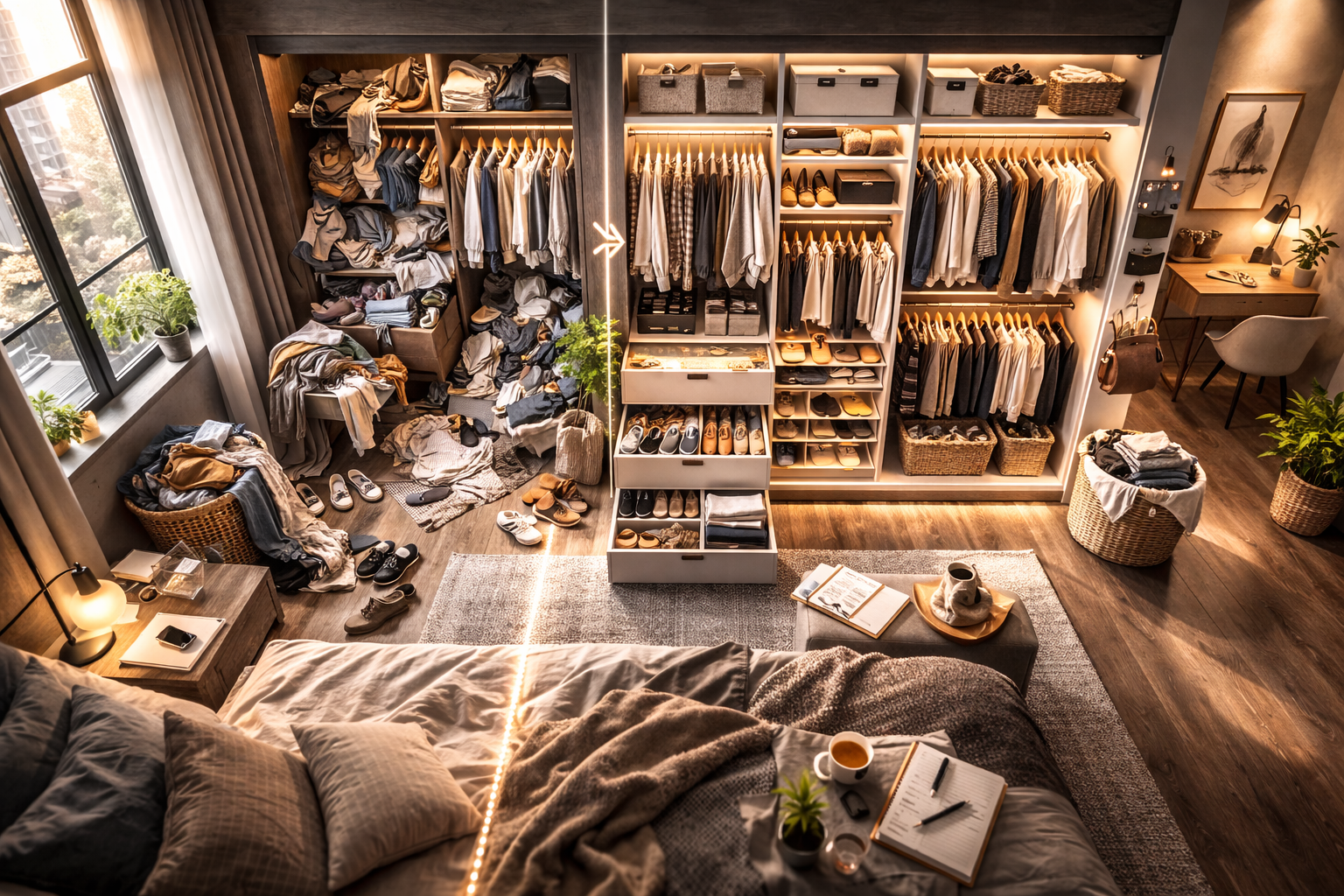
One of the most common complaints about closets is simple and direct: “I need a bigger one.” It feels logical. If clothes are hard to manage, if shoes pile up, if hangers overlap and shelves collapse, the space must be too small.
But in most cases, the closet is not the real problem.
The real problem is structural inefficiency.
Many closets fail not because they lack square footage, but because they lack intentional systems.
When clothing categories blend, when vertical space is unused, when frequency of use is ignored, and when visual clutter overwhelms perception, even large closets feel inadequate.
Before wishing for more space, it is worth examining whether the existing space is being used strategically.
Here is why most people do not need a bigger closet — they need a better system.
The Illusion of Insufficient Space
Closets often feel smaller than they actually are.
This perception is influenced by:
Poor lighting
Overcrowded rods
Collapsed folded stacks
Mixed clothing categories
Visible visual chaos
When structure is missing, the brain interprets density as lack of space.
In reality, much of the closet’s cubic volume may be underutilized.
Understanding the difference between physical size and functional capacity is the first mindset shift.
Most Closets Waste Vertical Space
Look at your closet from floor to ceiling.
In many cases:
There is only one hanging rod
The top shelf is underused
The lower half remains partially empty
Depth is not fully utilized
If you have one rod at shoulder height, you are likely using only half of the available vertical capacity.
Adding a second rod for shorter garments can instantly double hanging space.
Installing under-shelf baskets can add layered storage without remodeling.
Stacking uniform bins at ceiling level can reclaim unused height.
Vertical inefficiency often creates the illusion of a small closet.
Frequency of Use Is Rarely Considered
A common mistake is storing everything with equal priority.
Daily essentials should not compete for access with occasional or seasonal items.
Without frequency-based zoning:
You dig past rarely worn items
You disturb organized sections
You create friction during busy mornings
When clothing is organized by how often it is used, accessibility improves dramatically.
Middle zones should hold daily rotation.
Upper zones should hold seasonal storage.
Lower zones should manage shoes and accessories.
The system must reflect behavior.
Visual Clutter Shrinks Perception
Closets can feel suffocating when too many visual elements compete for attention.
Mismatched hangers.
Random colored bins.
Patterned baskets.
Unlabeled containers.
The brain processes this as chaos.
Uniform hangers, consistent bins, and controlled color palettes reduce cognitive overload.
When the closet looks cohesive, it feels larger.
Visual simplicity amplifies perceived space.
Overcrowding Is Often Volume, Not Space
Many people store more clothing than their closet can comfortably support.
However, the solution is not always extreme decluttering.
Instead, consider controlled volume management.
Ask:
How many items do I actually wear weekly?
How many pairs of shoes are in rotation?
How many jackets are necessary this season?
Implementing category caps prevents slow expansion.
For example:
No more than 12 daily shirts.
No more than 8 accessible shoes.
No more than 3 active jackets.
Boundaries protect system integrity.
Poor Folding Techniques Create Instability
Collapsed stacks waste horizontal space.
When sweaters lean into each other:
You avoid accessing them.
They lose shape.
They create visual mess.
Using shelf dividers maintains vertical boundaries.
Creating shorter stacks prevents toppling.
Structured folding preserves shelf clarity.
Micro-adjustments prevent macro-disorder.
Lighting Is a Hidden Structural Problem
Dark closets distort perception.
Shadows hide empty space and amplify density.
Adding neutral white lighting:
Improves visibility.
Reveals unused areas.
Reduces frustration.
Brightness increases psychological spaciousness.
A well-lit closet always feels larger than a dim one.
Shoe Storage Is Often the Primary Bottleneck
Shoes frequently consume disproportionate floor space.
Without vertical shoe organization:
Pairs scatter.
Depth is lost.
Floor visibility disappears.
Using vertical stackable shoe boxes or slim racks elevates storage upward instead of outward.
Visible floor depth enhances perception of openness.
Your Closet System Should Match Your Routine
Closets fail when they are designed aesthetically rather than behaviorally.
If you:
Dress quickly in the morning.
Change outfits frequently.
Alternate between work and casual.
Your closet must accommodate that flow.
Group clothing according to daily rhythm.
If your system fights your routine, disorder returns.
Temporary Organization vs Sustainable Systems
Many organization attempts fail because they focus on immediate visual improvement rather than long-term structure.
Sustainable systems require:
Defined zones.
Clear boundaries.
Capacity limits.
Weekly micro-maintenance.
Without maintenance rituals, even large closets collapse into clutter.
Structure must be reinforced consistently.
The Psychological Impact of a Functional Closet
When your closet works:
Mornings feel easier.
Decision-making accelerates.
Stress decreases.
Clothing care improves.
A functional closet supports mental clarity.
A dysfunctional closet creates subtle daily friction.
Space efficiency directly influences emotional stability.
Signs You Need a Better System, Not a Bigger Closet
If your closet:
Has unused upper space.
Has only one rod despite tall ceilings.
Contains mixed seasonal clothing.
Has visible floor clutter.
Uses inconsistent containers.
Then your problem is likely structural, not spatial.
Reorganizing strategically may eliminate the desire for more square footage.
How to Rebuild Your Closet System Step by Step
- Empty everything.
- Categorize by frequency of use.
- Install vertical layering (double rods, stacked bins).
- Standardize hangers and containers.
- Create defined zones.
- Implement capacity limits.
- Add lighting if necessary.
- Maintain weekly five-minute resets.
This process transforms inefficiency into structure.
Final Perspective: Capacity Is Designed, Not Given
You may not need more space.
You may need:
Better vertical use.
Clearer zoning.
Controlled volume.
Visual cohesion.
Routine alignment.
Closets do not fail because they are small.
They fail because they lack intentional systems.
Before wishing for a walk-in, optimize what you have.
You might discover your closet was never too small.
It was simply under-designed.
Now it can work for you.

Ryan Lewis is a home organization enthusiast who specializes in smart, renter-friendly solutions for small spaces. With a passion for functional design and practical living, Alex shares tips, guides, and ideas to help readers create calm, clutter-free environments—no matter the size of their home.