
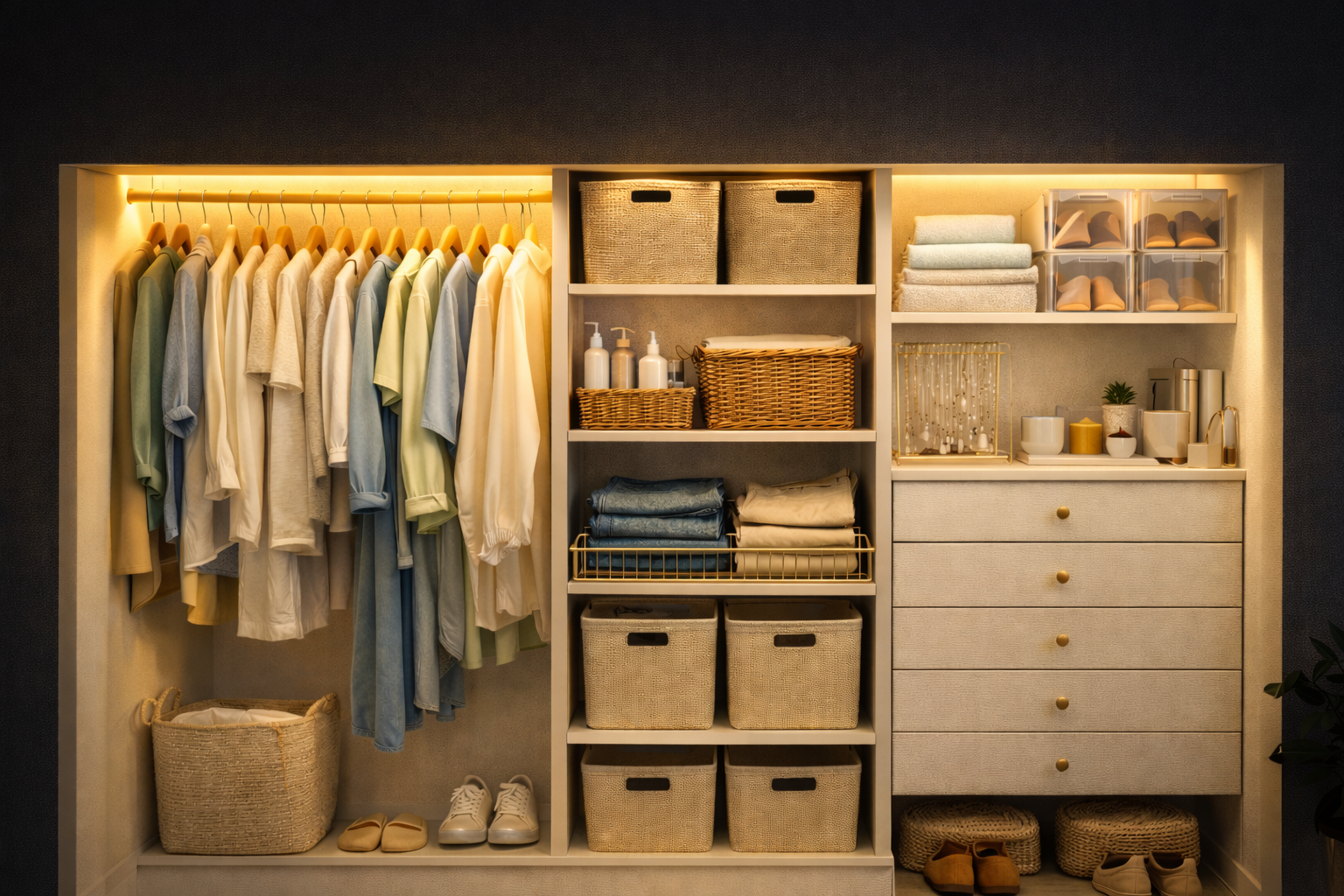
Closet lighting is usually treated as a cosmetic upgrade. People think of it as something that makes the space look nicer, not something that changes how the closet functions.
In reality, lighting is a structural multiplier. It directly affects visibility, access accuracy, storage density, and even how long organization systems last.
Two closets with identical dimensions can feel radically different depending on lighting. One feels cramped, confusing, and difficult to use.
The other feels open, clear, and efficient. The difference is not storage. It is light.
This article explains why closet lighting is a structural element, how poor lighting reduces usable space, and how intentional lighting design increases functional capacity without adding a single shelf.
Lighting Determines What Space Is Usable
Usable space is not only about physical reach. It is about visual reach.
If you cannot see an item clearly, it may as well not exist. Poor lighting turns real space into invisible space.
Closet lighting determines which areas are perceived as accessible and which fade into neglect.
The Difference Between Lit Space and Functional Space
A closet may be physically open, but if light does not reach certain zones, those zones become functionally closed.
Dark corners discourage use. Shadowed shelves feel deeper than they are. Low light increases hesitation.
Functional space is space that is both reachable and visible.
Why Poor Lighting Mimics Clutter
When visibility is low, the brain struggles to parse shapes and categories.
Items blur together. Edges disappear. Contrast is lost.
This creates the sensation of clutter even when items are organized.
Clutter perception is often a lighting problem, not a storage problem.
How Lighting Affects Access Speed
Access speed depends on how quickly the eye can identify what it needs.
Dim or uneven lighting slows scanning. You hesitate, move items aside, and second-guess.
Better lighting increases access speed without changing layout.
Speed is a functional outcome.
Lighting and Shelf Effectiveness
Shelves rely on visibility.
Poorly lit shelves hide items in the back or underneath.
This reduces usable depth because back rows become dead zones.
Light restores shelf depth by making items visible.
Why Upper Shelves Suffer Most From Bad Lighting
Upper shelves are often the darkest zone.
Overhead lighting rarely penetrates deeply or evenly.
As a result, upper shelves are underused or misused.
Lighting that reaches upper zones increases their functional value.
Lower Zones and Shadow Accumulation
Lower shelves and floor zones often sit in shadow.
Clothes hanging above block light. Bodies block light during use.
Shadowed lower zones feel cramped and inconvenient.
Lighting reduces hesitation and improves stability in lower zones.
The Illusion of “Too Much Stuff” Created by Shadows
Shadows compress visual space.
They make areas feel tighter than they are.
Removing shadows often reveals that space was available all along.
Light expands perceived volume.
Lighting as a Structural Equalizer
Lighting can compensate for structural constraints.
Narrow closets feel wider with even lighting. Deep closets feel shallower when the back is illuminated.
Light does not change dimensions, but it changes behavior.
Why Single Overhead Lights Usually Fail
Most closets rely on a single ceiling fixture.
This creates uneven distribution.
The center may be bright, but corners, shelves, and lower zones remain dark.
Single-source lighting creates functional blind spots.
Direction Matters More Than Brightness
Brightness alone does not solve lighting problems.
Direction determines whether light reaches storage surfaces.
Light must be aimed where items live, not where people stand.
Directional lighting improves usability more than increased wattage.
Shadow Lines and Shelf Placement
Shelves cast shadows.
Poor shelf placement combined with poor lighting doubles the problem.
Light must be planned alongside shelf layout.
Ignoring this interaction creates dead zones.
Why Dark Closets Encourage Overbuying
When items are hard to see, people forget what they own.
They rebuy duplicates.
Lighting has financial consequences.
Visibility reduces redundancy.
Lighting and Color Perception
Color differentiation matters for sorting and retrieval.
Poor lighting distorts color perception.
This slows decisions and increases mistakes.
Accurate light improves categorization.
Warm vs Neutral Light in Closets
Light temperature affects clarity.
Warm light softens edges. Neutral light sharpens them.
Closets benefit from clarity over ambiance.
Lighting choice should favor function.
Even Lighting Reduces Visual Noise
Uneven lighting exaggerates contrasts.
Bright spots and dark voids fragment the space visually.
Even lighting smooths perception.
Smooth perception feels organized.
Lighting and Vertical Segmentation
Vertical zones need vertical lighting.
Light should reach from top to bottom.
Ignoring vertical distribution limits usable height.
Vertical lighting unlocks vertical storage.
Why Lighting Extends Storage Lifespan
Poor lighting increases mishandling.
Items are shoved, dropped, or misstacked.
Good lighting encourages precision.
Precision reduces wear and disorder.
Lighting and Drawer Functionality
Drawers benefit from internal illumination.
Without it, deeper drawers hide contents.
Lighting turns drawers into transparent systems.
Visibility improves retrieval accuracy.
The Relationship Between Lighting and Depth
Depth feels greater when dark.
Lighting the back wall reduces perceived depth.
This makes deep closets easier to use.
Light compresses distance.
Why Battery Lighting Is Structurally Valid
Hardwiring is not always possible, especially in rentals.
Battery lighting still improves structural performance.
Consistency matters more than permanence.
Temporary solutions can be effective.
Placement Over Power
Where light is placed matters more than how powerful it is.
Strategic placement beats brute force.
Target storage surfaces, not walkways.
Lighting as a Tool for Zone Definition
Different zones can be defined with light.
Brighter zones feel more important.
This naturally guides usage patterns.
Light can reinforce hierarchy.
How Lighting Reduces Maintenance Effort
When everything is visible, disorder is noticed early.
Early correction prevents collapse.
Lighting supports maintenance passively.
Diagnosing Lighting-Related Storage Failure
Signs include:
Items disappearing
Uneven use of shelves
Avoidance of certain zones
Frequent rearranging
These often trace back to lighting.
Fixing Lighting Without Changing Structure
Lighting upgrades rarely require structural change.
They add capacity without adding storage.
This makes lighting one of the highest ROI improvements.
Why Lighting Is Ignored in Closet Planning
Lighting feels intangible.
Shelves feel concrete.
People plan what they can touch.
But light shapes what can be used.
Lighting in Small Closets
Small closets benefit disproportionately from lighting.
Even minor improvements have large effects.
Light scales well in tight spaces.
Lighting and Psychological Ease Without Psychology
Although this article avoids behavior, one structural effect is clear.
Better lighting reduces hesitation.
Reduced hesitation improves flow.
Flow is structural efficiency.
Why Lighting Should Be Planned Early
Lighting retrofits are harder once storage is installed.
Planning lighting first prevents compromise.
Sequence matters.
Combining Lighting With Other Structural Decisions
Lighting interacts with shelves, rods, doors, and depth.
Isolated planning fails.
Integrated planning succeeds.
The Cost of Ignoring Lighting
Ignoring lighting leads to wasted space, wasted time, and wasted purchases.
It is an invisible tax.
Lighting removes that tax.
Turning Light Into Structural Support
When lighting is intentional, the closet supports you.
When it is absent, the closet resists you.
Support should be the goal.
The Structural Rule of Closet Lighting
If you avoid a zone because it is dark, it is not usable space.
Light defines usability.
Frequently Asked Questions
Is brighter lighting always better
No. Even distribution matters more than intensity.
Can lighting really replace storage upgrades
It can unlock existing storage and reduce the need for upgrades.
What zones need lighting most
Upper shelves, back walls, and lower zones.
Is temporary lighting worth it
Yes. Consistent light improves structure regardless of permanence.
What is the first lighting fix to try
Add light that reaches the back of shelves.

Ryan Lewis is a home organization enthusiast who specializes in smart, renter-friendly solutions for small spaces. With a passion for functional design and practical living, Alex shares tips, guides, and ideas to help readers create calm, clutter-free environments—no matter the size of their home.