
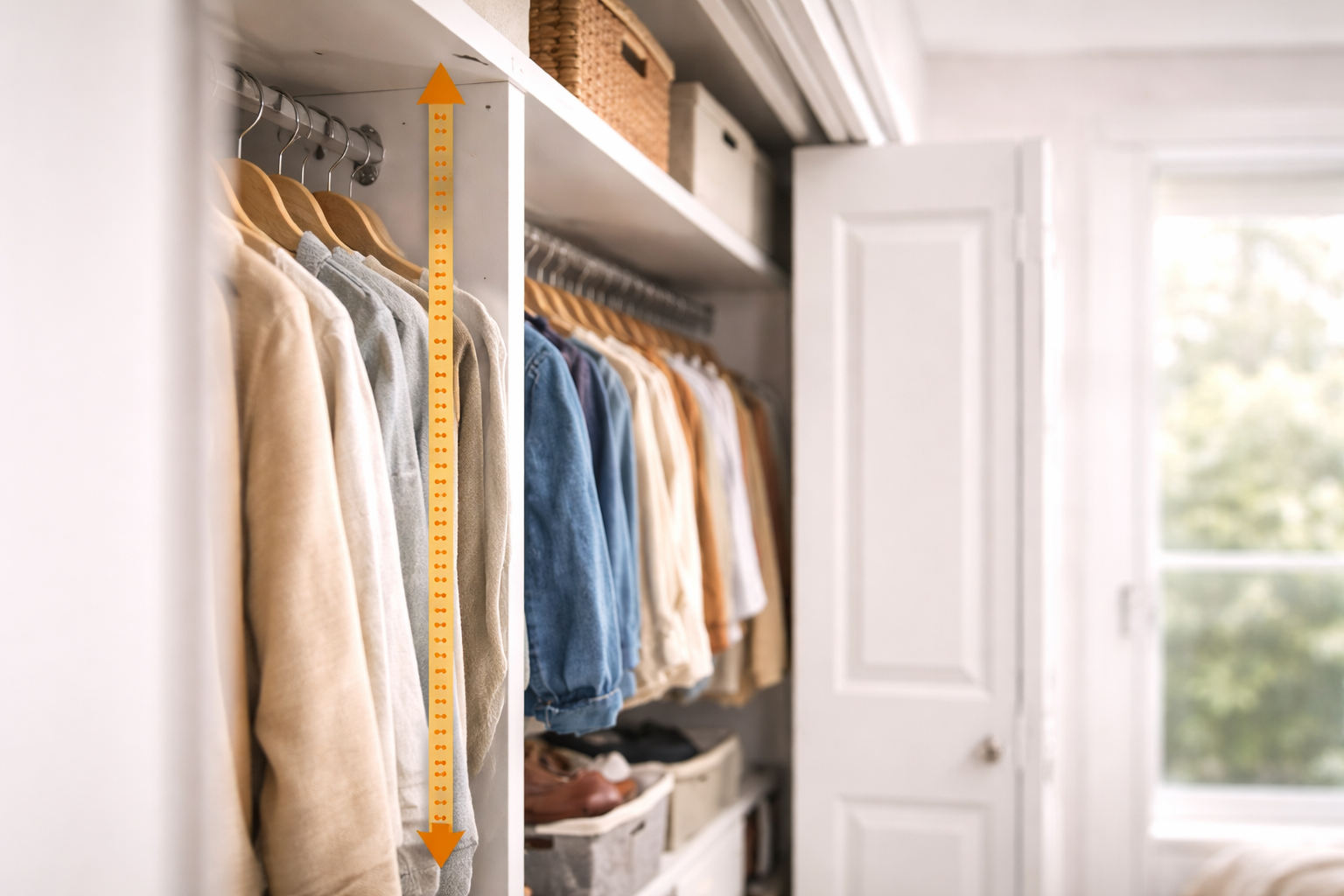
Closet depth is rarely discussed, rarely measured, and almost never questioned. Most people accept the depth of their closet as a fixed fact and then struggle endlessly to make storage work inside it.
Shelves feel crowded. Clothes get crushed. Items disappear behind others. Frustration builds without a clear explanation.
The problem is not a lack of organizers. It is depth mismatch.
Closet depth quietly dictates what can be stored, how items behave once stored, and whether access remains usable over time.
When depth is ignored, even well-designed closets fail. When depth is understood and respected, the same space suddenly becomes easier to use.
This article explains why closet depth is one of the most misunderstood structural constraints, how depth silently limits storage, and how to work with depth instead of fighting it.
Closet Depth Is a Structural Constraint, Not a Preference
Depth is determined by construction. Walls, studs, and building standards define how far a closet extends inward.
Unlike shelves or rods, depth cannot be adjusted easily. Storage solutions must adapt to it.
Treating depth as flexible leads to constant conflict between storage and structure.
Why Depth Problems Are Often Misdiagnosed
When closets feel crowded, people blame volume. They assume they own too much or need more shelves.
In reality, depth is often the issue. Items are forced into layers they cannot support.
Depth problems look like clutter, but they behave like access failures.
The Difference Between Nominal Depth and Usable Depth
Nominal depth is the measurement from wall to wall. Usable depth is the portion of that space you can actually use without losing access.
In many closets, usable depth is much smaller than nominal depth.
Door swing, rod placement, and item thickness reduce effective depth.
Ignoring this distinction leads to poor storage choices.
How Deep Closets Create False Storage Capacity
Deep closets appear generous. They promise more space.
In practice, deep closets encourage stacking and hiding. Items placed in the back are rarely accessed.
This creates “dead storage,” which increases clutter perception.
More depth does not equal more usability.
Shallow Closets and Their Hidden Advantages
Shallow closets are often criticized, but they offer one key advantage: forced visibility.
Items must be placed in front-facing arrangements. Stacking is limited naturally.
When storage is designed correctly, shallow closets often outperform deep ones in daily usability.
Depth and Shelf Design Are Inseparable
Shelf depth determines how items behave.
Deep shelves allow multiple rows. Shallow shelves force single rows.
Single-row storage is easier to maintain and access.
Deep shelves require depth management strategies to remain functional.
Why Deep Shelves Encourage Overstacking
When shelves are deep, people stack items front to back.
This hides items, increases pressure on stacks, and leads to forgotten belongings.
Overstacking is a structural response, not a personal choice.
The Shelf Collapse Cycle in Deep Closets
Deep shelves often follow a predictable failure pattern.
Items are stacked deep
Front items are used repeatedly
Back items are ignored
Stacks collapse
Shelves become chaotic
This cycle repeats indefinitely.
Depth and Hanging Space Interaction
Depth also affects hanging space.
If rods are placed too close to the back wall, garments brush against it. If too far forward, doors interfere.
Garments themselves consume depth.
Ignoring garment thickness reduces usable depth dramatically.
The Problem With Treating Depth as Unlimited
Many storage solutions assume depth is abundant.
Large bins, deep drawers, and bulky organizers eat depth quickly.
Once depth is consumed, access disappears.
Depth should be rationed, not filled.
Depth Management as a Structural Strategy
Depth management means intentionally limiting how much of the depth is used.
This often feels counterintuitive but improves function.
Leaving unused depth is often the correct choice.
Using Shallow Containers to Control Depth
Shallow containers act as depth limiters.
They prevent items from being pushed too far back.
This transforms deep shelves into usable storage.
Containers should define boundaries, not maximize volume.
The Role of Vertical Dividers in Depth Control
Vertical dividers break deep shelves into manageable sections.
They prevent lateral spreading and back-row hiding.
Dividers convert depth into structured zones.
Why Drawers Behave Better Than Shelves in Deep Closets
Drawers convert depth into linear access.
Everything moves forward when opened.
This eliminates back-row invisibility.
Drawers are depth-friendly structures.
The Cost of Ignoring Depth in Drawer Selection
Deep drawers encourage overfilling.
Overfilled drawers become heavy, hard to open, and disorganized.
Drawer depth must match item depth.
Depth and Closet Floor Behavior
The floor is often the deepest zone.
Shoes, bins, and bags pile up, creating congestion.
Deep floor zones require strict role assignment.
Without it, clutter spreads upward.
Assigning Single Roles to Deep Zones
Deep zones should have one function only.
Multiple functions compete for depth and create chaos.
Single-role zones preserve access.
Depth and Door Interference
Closet doors reduce usable depth when open.
Swing doors intrude into depth. Sliding doors limit access width.
Depth planning must account for door behavior.
Ignoring doors leads to blocked storage.
The Illusion of “Hidden Storage” in Deep Closets
Hidden storage sounds appealing but often fails.
Hidden items are forgotten, duplicated, or wasted.
Visibility is more valuable than concealment.
When Deep Closets Actually Work Well
Deep closets perform better when used for low-frequency storage.
Archive items, luggage, and seasonal bins can tolerate depth.
Daily-use items cannot.
Depth suitability depends on frequency.
Designing Depth Zones by Frequency
Front zone for daily use
Mid zone for occasional use
Back zone for archive use
This hierarchy prevents misuse.
Why Most Closets Ignore Depth Zoning
Depth zoning is not visually obvious.
Builders design for volume, not usability.
Users inherit the consequences.
Retrofitting Depth Zoning Without Remodeling
Depth zoning can be introduced with containers, dividers, and reassignment.
No construction is required.
Small changes reframe space.
How Depth Misuse Leads to Overbuying
When items are hidden, people forget they own them.
This leads to unnecessary purchases.
Depth misuse has financial consequences.
Depth and Mental Load
Searching through deep storage increases cognitive effort.
This creates frustration and avoidance.
Shallow access reduces mental load.
Why Depth Problems Feel Like Personal Failure
People blame themselves for mess.
In reality, depth mismatch creates unsolvable friction.
Understanding depth removes shame.
Depth Awareness as a Skill
Learning to see depth as a constraint improves storage decisions.
You stop buying organizers that fight structure.
Skill replaces trial and error.
Depth as the Most Expensive Mistake in Closet Design
Depth mistakes lead to wasted purchases, frustration, and repeated reorganization.
They are costly over time.
Preventing them saves energy and money.
When to Leave Depth Unused on Purpose
Unused depth is not waste.
It is a buffer that preserves access.
Purposeful emptiness is functional.
Designing Storage That Respects Depth
Respecting depth means choosing storage that aligns with how space behaves.
Shallow, structured, front-facing solutions outperform deep ones.
Design follows physics.
Why Depth Planning Should Come Before Buying Anything
Depth determines what fits.
Buying first and forcing later fails.
Measure depth. Then decide.
Turning Depth From Enemy Into Ally
When depth is managed, closets feel calmer.
Items stay visible. Access improves.
The space becomes predictable.
The Structural Rule of Depth
If you cannot see it easily, you will not maintain it.
Depth should never hide what you need.
Frequently Asked Questions
Is a deeper closet always better
No. Deep closets often reduce usability if depth is unmanaged.
Can I fix depth issues without remodeling
Yes. Containers, dividers, and reassignment solve most problems.
Why do items disappear in my closet
Because depth allows back-row hiding.
Are drawers better than shelves for deep closets
Often yes, because they convert depth into access.
What is the first depth fix to try
Limit how far items can be pushed back.

Ryan Lewis is a home organization enthusiast who specializes in smart, renter-friendly solutions for small spaces. With a passion for functional design and practical living, Alex shares tips, guides, and ideas to help readers create calm, clutter-free environments—no matter the size of their home.