
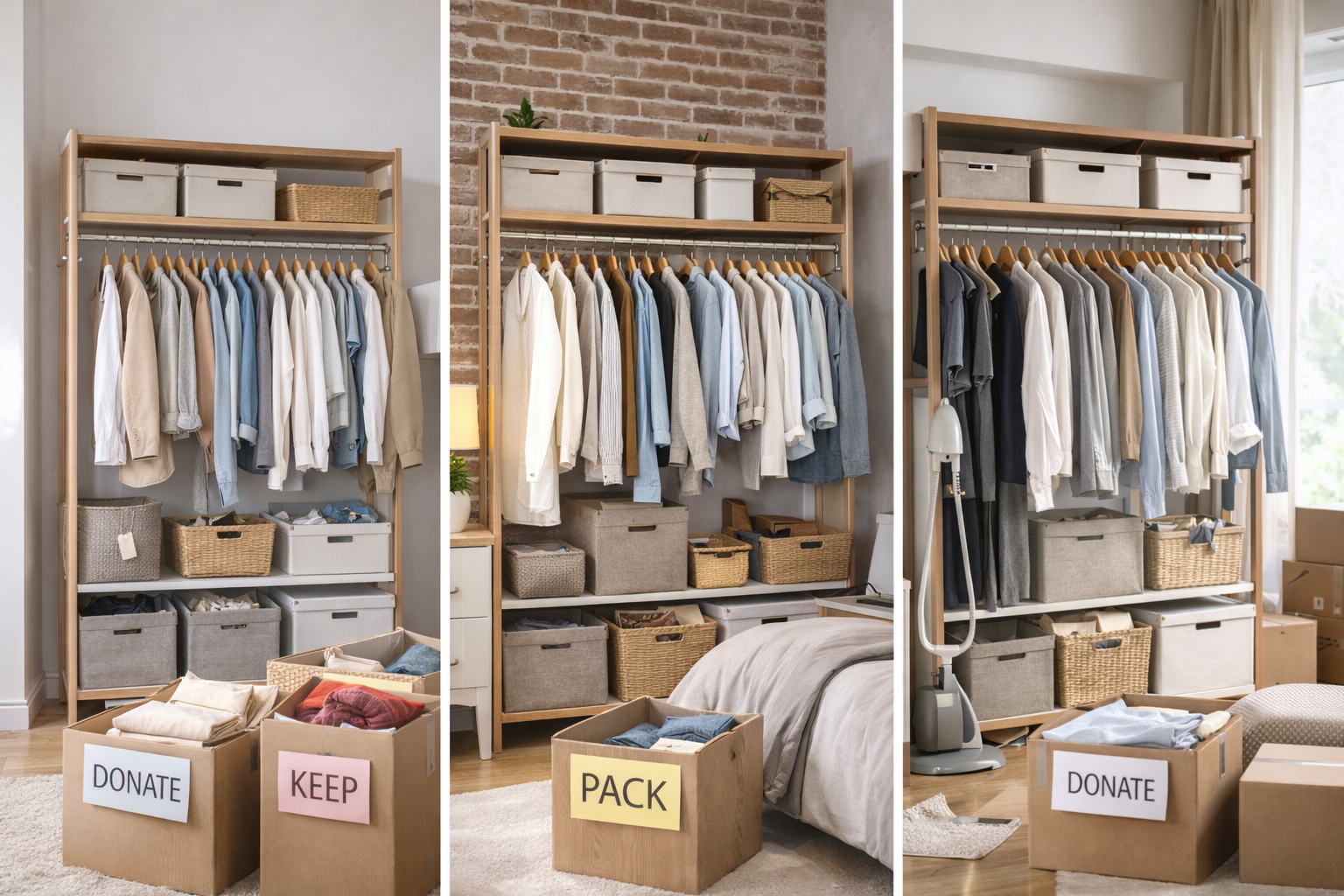
People often believe that every move requires a new closet solution. Shelves are replaced, organizers are discarded, and systems are rebuilt from scratch.
This cycle is expensive, exhausting, and unnecessary. In reality, the most effective closet systems are not those designed for a single apartment, but those designed to survive multiple apartments.
Rental life is defined by change. Layouts differ, closet sizes shift, doors behave differently, and constraints vary. A closet system that works only once is fragile. A system that adapts becomes an asset.
This article explains how to design and maintain a closet system that can move with you, adapt to different apartments, and remain functional over time without constant replacement.
Why Most Closet Systems Fail After the First Move
Closet systems often fail after a move because they were designed for a specific space.
Shelf heights were optimized too precisely.
Rod placement assumed a certain ceiling height.
Widths were customized to exact dimensions.
When those dimensions change, the system collapses.
Failure is not about quality. It is about over-specificity.
The Difference Between Space-Specific and System-Based Design
Space-specific design optimizes for one layout.
System-based design optimizes for principles.
Principles travel. Layouts do not.
A system built on principles can be reconfigured to fit new constraints.
Why Rental Closets Require Portability Thinking
Renters rarely control their next closet.
You do not know its width, depth, or door type.
Designing for unknown future conditions requires restraint and flexibility.
Portability thinking treats the closet as a variable, not a constant.
The Core Principle of Multi-Apartment Closet Systems
The core principle is simple.
Your system should not depend on exact measurements.
It should depend on ranges.
Ranges tolerate variation.
Exactness breaks.
Avoiding Hard Customization
Hard customization locks structure.
Cut shelves
Permanent mounts
Built-ins sized to the inch
These choices feel satisfying but create fragility.
Soft customization adapts.
What Soft Customization Looks Like
Soft customization uses adjustable components.
Shelves that move
Rods that shift
Modules that stack
Soft systems trade perfection for longevity.
Longevity wins in rental life.
Designing Around Zones, Not Dimensions
Zones are portable.
Prime zone
Secondary zone
Archive zone
These concepts apply everywhere.
Exact shelf height does not.
Design around roles, not measurements.
Why Frequency-Based Systems Travel Well
Frequency is independent of apartment size.
Daily items remain daily items.
Archive items remain archive items.
If your system is built on frequency, it adapts naturally.
Modular Components as Structural Building Blocks
Modular components are the backbone of portable systems.
They can be rearranged, resized, and repurposed.
They absorb variation.
Fixed components resist it.
Why Standardized Module Sizes Matter
Modules that follow common size standards fit more spaces.
They stack, align, and combine easily.
Non-standard modules become orphans after a move.
Standardization increases survivability.
The Role of Negative Space in Portability
Negative space is intentional emptiness.
It allows systems to stretch or compress.
Closets without margin break when conditions change.
Margin is adaptability insurance.
Why Overfilling a Closet Kills Portability
Overfilled systems rely on exact conditions.
When conditions change, there is no room to adjust.
Portable systems always leave room to breathe.
Breathing room enables reconfiguration.
Designing a Closet System That Scales Up and Down
Some apartments have small closets.
Others are larger.
Your system should scale both ways.
This means components that can be added or removed without disrupting the whole.
Scalability beats optimization.
The Mistake of Optimizing for the Largest Closet
Designing for the best-case closet creates disappointment later.
Design for the smallest expected closet.
Anything larger becomes a bonus.
Constraint-first design is resilient.
Why Drawer Units Are Highly Portable
Drawer units are self-contained.
They do not depend heavily on walls.
They can move between closets easily.
This makes them excellent anchors for portable systems.
Why Shelves Should Be Semi-Independent
Shelves that rely on fixed rails or specific wall spacing struggle after moves.
Semi-independent shelving adapts better.
Independence increases compatibility.
The Advantage of Floor-Supported Systems
Floor-supported systems rely less on wall geometry.
They tolerate uneven walls and door placement.
This makes them ideal for rentals.
Walls change. Floors remain.
How to Think About Rods in a Portable System
Rods should be adjustable in height and position.
They should not be permanently fixed.
Portable systems allow rods to shift based on ceiling height and garment mix.
Flexibility protects hanging space.
Avoiding Closet Systems That Require Wall Precision
Some systems demand perfectly square walls and exact spacing.
Rental closets rarely offer this.
Tolerance for imperfection is essential.
Choose systems that forgive irregularity.
Designing for Door Variability
Door types vary dramatically.
Swing doors
Sliding doors
Bifold doors
Your system must retreat from blocked zones.
Portable systems avoid deep commitment near doors.
Why Depth Discipline Improves Portability
Deep systems struggle in shallow closets.
Shallow systems can still function in deep closets.
Design for minimum depth.
Minimum depth travels.
The Portable Closet System Mindset
A portable system is never “finished.”
It is always adjustable.
This mindset reduces frustration during moves.
Change becomes expected, not disruptive.
How to Document Your Closet System for Future Moves
Simple documentation helps.
Photos
Notes on zone logic
Component list
This memory reduces reinvention after each move.
Reassembling a Familiar System in a New Space
Familiarity speeds setup.
You already know what belongs where.
This reduces decision fatigue after moving.
Familiar systems stabilize life quickly.
Why Familiar Systems Reduce Post-Move Stress
Moves drain energy.
Rebuilding everything from scratch multiplies stress.
A familiar closet system restores routine faster.
Routine restores normalcy.
When to Upgrade Components Between Moves
Moves reveal weaknesses.
A shelf that never worked
A bin that collapsed
A rod that sagged
Replace weak links incrementally.
Incremental upgrades outperform full replacements.
Avoiding the “New Apartment, New Everything” Trap
New space does not require new systems.
It requires reconfiguration.
Reconfiguration is cheaper and smarter.
Why Portable Systems Save Money Over Time
Replacing entire systems is expensive.
Portable systems amortize cost across years and apartments.
Long-term value beats short-term aesthetics.
Teaching the System to Adapt Instead of Replacing It
When something does not fit, adjust the system.
Do not discard it.
Adaptation preserves investment.
The Role of Labels in Portable Systems
Labels help preserve logic across moves.
They remind you of intended roles.
They reduce re-decision during setup.
Labels are memory aids.
How Portable Systems Improve Decision Quality
When structure is familiar, decisions are faster.
You are not inventing logic under pressure.
Speed improves quality.
Why Portable Closet Systems Feel Calmer
Calm comes from predictability.
Predictability comes from systems that repeat.
Portable systems repeat logic even when space changes.
Designing for the Life You Have, Not the Apartment You Are In
Apartments are temporary.
Your life patterns are more stable.
Design systems around life patterns.
Life-centered systems travel well.
The Structural Rule of Multi-Apartment Closets
If a system only works in one space, it is not a system. It is a custom installation.
Systems must survive change.
Frequently Asked Questions
Is it realistic to reuse a closet system across apartments
Yes, if the system is modular and principle-based.
What is the biggest mistake renters make
Over-customizing for one space.
Should I avoid all wall-mounted systems
Not all, but prioritize reversible and adjustable ones.
How much margin should I leave
Enough to reassign zones without removing components.
What is the most portable closet element
Freestanding drawers and modular shelving.

Ryan Lewis is a home organization enthusiast who specializes in smart, renter-friendly solutions for small spaces. With a passion for functional design and practical living, Alex shares tips, guides, and ideas to help readers create calm, clutter-free environments—no matter the size of their home.