
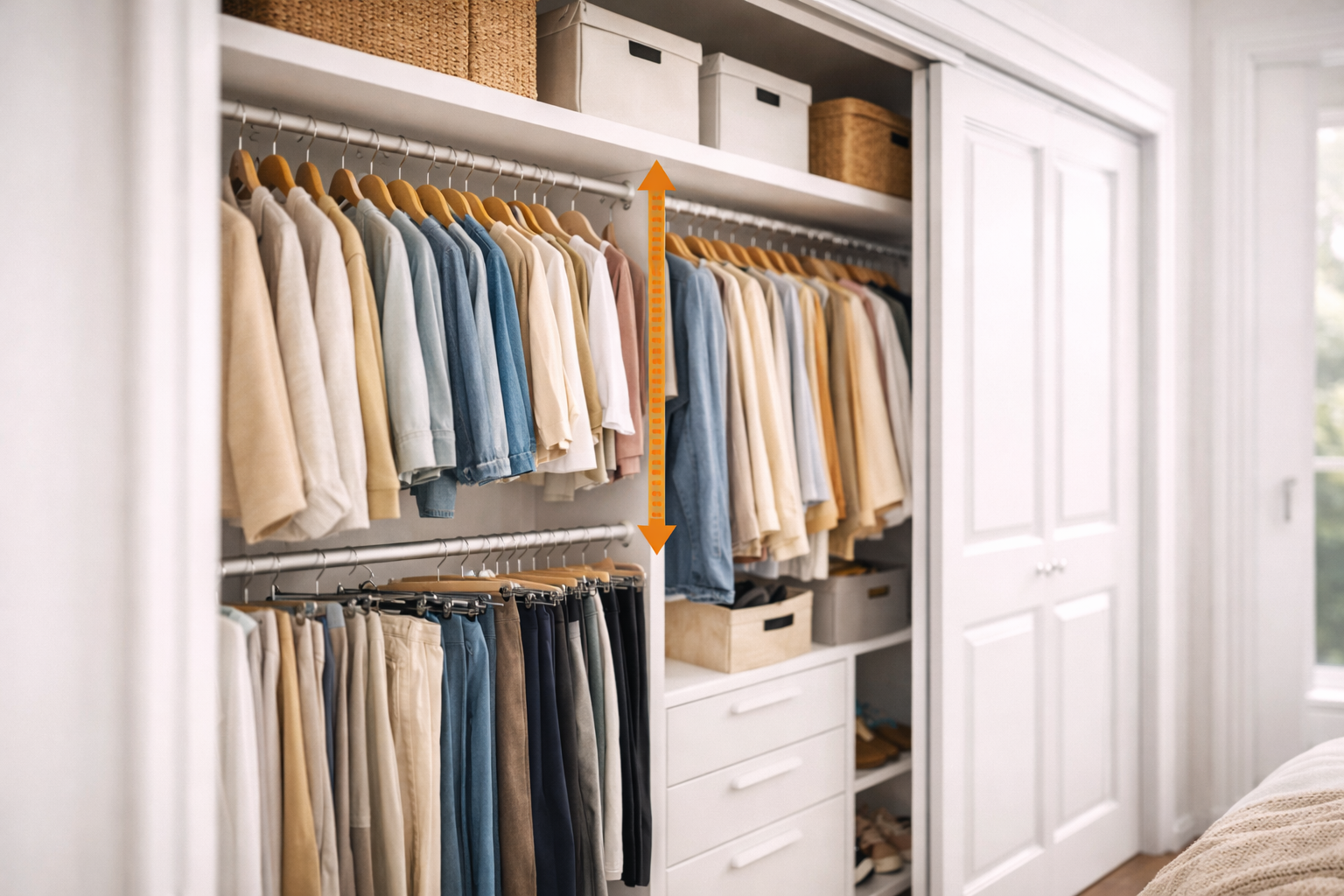
Hanging rods are often treated as a default feature of closets. They come pre-installed, sit at a familiar height, and rarely receive serious consideration.
Because they look simple, people assume they are simple. In reality, hanging rod placement is one of the most consequential structural decisions in any closet.
When rods are placed poorly, hanging space becomes inefficient, clothes wrinkle, vertical space is wasted, and the entire closet feels smaller than it actually is.
When rods are placed intentionally, the same closet can suddenly hold more, function better, and feel easier to use.
This article explains why hanging rod placement is so often misunderstood, how improper placement undermines closet performance, and how to think structurally about rods so they work with the space instead of against it.
Why Hanging Rods Deserve More Attention Than They Get
Hanging rods define the largest continuous storage zone in most closets. They determine how much vertical space remains above and below garments, how garments interact with each other, and how easily clothes can be accessed.
Because rods are linear and visually unobtrusive, their impact is underestimated. Yet a rod placed a few inches too high or too low can waste an entire layer of usable space.
Rod placement is not just about hanging clothes. It is about vertical efficiency.
The False Assumption of “Standard” Rod Height
Most closets are built using generic measurements. Rods are often installed at heights considered “standard” by builders, not by users.
These standards rarely reflect real wardrobes.
Some people own mostly short garments. Others own many long items. Some wardrobes change seasonally. A single fixed height rarely fits all these realities.
Standard heights are compromises, not solutions.
How Rod Height Determines Vertical Waste
Rod height directly affects how much space is wasted above and below hanging clothes.
If the rod is too high, the space below garments becomes unusable. If it is too low, valuable vertical space above garments is lost.
Both scenarios reduce effective capacity without changing the closet’s physical size.
Rod height determines whether vertical space is functional or dead.
The Relationship Between Garment Length and Rod Placement
Different garments have different length requirements.
Shirts and jackets need relatively little vertical clearance. Dresses, coats, and long skirts require much more.
When these garments share a single rod without planning, inefficiency is inevitable.
Short items waste space below. Long items block space above.
Rod placement must reflect garment distribution, not averages.
Single Rod Layouts and Their Limitations
A single rod layout is simple but inefficient for most wardrobes.
It assumes uniform garment length and ignores vertical segmentation.
This layout often results in large unused zones either above or below the hanging clothes.
Single rod layouts are easy to install but rarely optimal.
Double Rod Layouts When They Work and When They Fail
Double rod layouts are often promoted as a space-saving solution. When done correctly, they can significantly increase hanging capacity.
When done incorrectly, they create clutter and access issues.
Structural Requirements for Double Rod Success
Sufficient ceiling height
Clear separation between upper and lower garments
Proper allocation based on garment length
Without these conditions, double rods reduce usability.
The Common Mistake of Symmetrical Rod Placement
Many double rod setups place rods symmetrically, dividing the vertical space evenly.
This looks neat but often fails functionally.
Most wardrobes do not have equal proportions of short garments above and below.
Symmetry is not efficiency.
Asymmetrical Rod Placement for Real Wardrobes
Asymmetrical rod placement allocates more space to where it is needed.
For example, placing the upper rod higher and the lower rod lower accommodates different garment lengths more effectively.
Asymmetry reflects reality, not aesthetics.
Rod Placement and Access Zones
Rod placement affects reach and comfort.
Rods placed too high require stretching or tools. Rods placed too low force bending and crowd lower storage.
Comfort matters for daily use.
Rod height should respect natural reach zones.
The Impact of Rod Placement on Wrinkling
When garments are crowded vertically, they wrinkle more easily.
Poor rod placement forces clothes to press against shelves, floors, or each other.
Wrinkling is often blamed on fabric, but structure is frequently the cause.
Proper rod spacing reduces contact and friction.
Rod Depth and Closet Width
Rod placement is not only vertical. Depth matters too.
Rods placed too close to the back wall cause clothes to brush against it, leading to creasing and wear.
Rods placed too far forward interfere with doors and movement.
Depth must balance garment clearance and access.
Rod Placement and Door Interaction
Closet doors affect rod usability.
Swing doors reduce usable depth when open. Sliding doors limit access width.
Rod placement must account for door behavior to avoid blocked access.
Ignoring door interaction leads to awkward daily use.
The Problem With Fixed Rod Placement
Fixed rods lock assumptions into the structure.
When wardrobe composition changes, fixed rods cannot adapt.
This forces behavioral adaptation or clutter.
Fixed rods transfer structural inflexibility to the user.
Adjustable Rods and Structural Flexibility
Adjustable rods allow height and sometimes depth changes.
They introduce flexibility into the most important storage zone.
Flexibility allows the closet to evolve with the wardrobe.
In small apartments, this adaptability is critical.
How Rod Placement Affects Shelf Placement
Rod placement and shelf placement are interdependent.
A rod placed too high may force shelves into unusable positions. A poorly placed shelf may crowd a rod.
Rod decisions should be made before shelf decisions.
Hierarchy matters.
Rod Placement and Floor Utilization
Rod height determines what fits below.
Shoes, drawers, bins, or nothing at all.
If the rod is too low, the floor becomes congested. If too high, the floor becomes underused.
Balanced placement optimizes both zones.
Designing Rod Placement Around Use Frequency
Daily-use garments should be easiest to reach.
Rarely used garments can accept higher or less convenient placement.
Rod height should reflect frequency, not equality.
Seasonal Rotation and Rod Placement
Wardrobe composition changes seasonally.
A rod placement that works in summer may struggle in winter.
Flexible rod placement supports rotation.
Static placement resists it.
The Illusion of “More Hanging Space”
Many closets advertise increased hanging space by adding rods.
If placement is poor, more rods create more problems.
Hanging space must be usable, not just present.
Diagnosing Poor Rod Placement
Signs of poor rod placement include:
Wrinkled clothes
Crowded garments
Unused vertical space
Blocked access
Difficulty reaching items
These are structural symptoms.
Improving Rod Placement Without Remodeling
Many rod issues can be improved without major changes.
Adjustable hardware
Repositioning within existing constraints
Reassigning garment types
Small shifts yield large gains.
Rod Placement in Small Closets
Small closets magnify rod placement errors.
A few inches make a significant difference.
Precision matters more when space is limited.
Rod Placement and Long-Term Maintenance
Poor rod placement increases daily effort.
Good placement reduces maintenance because clothes stay aligned naturally.
Maintenance is a structural outcome.
Why Rod Placement Is a Design Problem, Not a Storage Problem
Rod placement defines how space behaves.
It is a design decision with lasting consequences.
Treating it as an afterthought undermines everything else.
Designing Rods as Part of a System
Rods should be planned alongside shelves, drawers, and floor zones.
Isolated decisions create imbalance.
System thinking prevents failure.
When to Use Multiple Rods and When Not To
Multiple rods are powerful but not universal.
They work best when garment length distribution supports them.
They fail when added indiscriminately.
Assessment must come first.
The Cost of Ignoring Rod Placement
Ignoring rod placement leads to wasted space, frustration, and unnecessary purchases.
People buy more organizers to compensate for structural inefficiency.
Structure should eliminate the need for compensation.
Turning Hanging Space Into a Structural Advantage
When rods are placed correctly, hanging space becomes a strength rather than a liability.
Clothes align naturally. Access improves. Space opens up.
The closet feels larger without changing size.
Why Hanging Rod Placement Deserves Priority
Among all closet decisions, rod placement has the highest leverage.
It affects vertical allocation, access, and garment care simultaneously.
Few decisions deliver such broad impact.
Frequently Asked Questions
Is there a universal best rod height
No. Rod height should match garment lengths and user reach.
Are double rods always better
No. They work only when garment distribution supports them.
Can rod placement really affect wrinkling
Yes. Crowding and contact are structural causes of wrinkles.
Should rods be adjustable
In most small or changing environments, yes.
What is the first rod mistake to fix
Rod height that wastes vertical space or crowds garments.

Ryan Lewis is a home organization enthusiast who specializes in smart, renter-friendly solutions for small spaces. With a passion for functional design and practical living, Alex shares tips, guides, and ideas to help readers create calm, clutter-free environments—no matter the size of their home.