
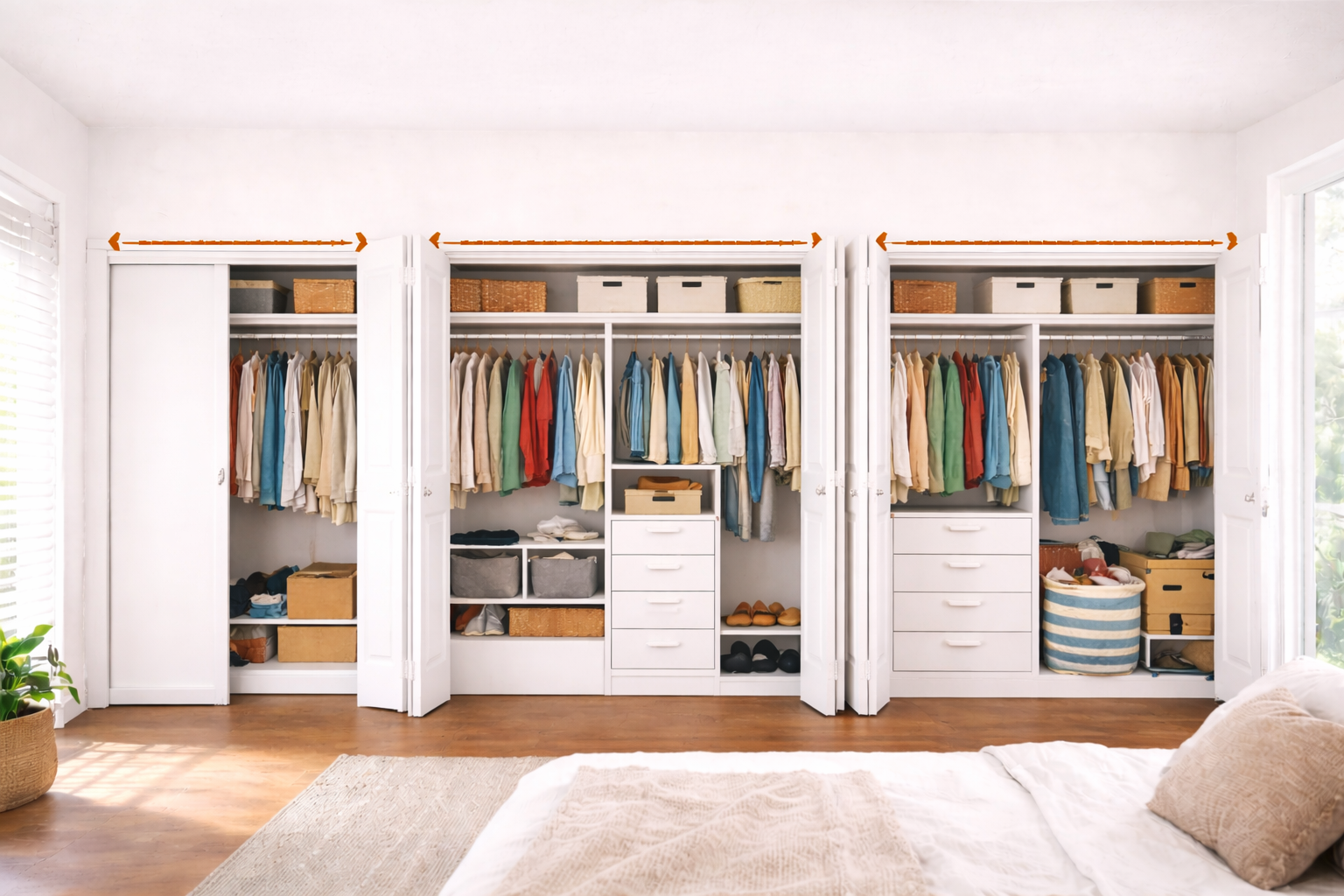
Closet width is rarely the first thing people think about when planning storage. Attention usually goes to shelves, rods, bins, and drawers.
Width is treated as a background fact, something fixed and unchangeable. Yet width is the constraint that quietly determines how every other structural decision behaves.
When width is misunderstood, even well-chosen organizers fail. Access becomes awkward, items overlap, and the closet feels cramped regardless of how much vertical space exists.
When width is respected and planned for, the same closet becomes easier to use, more flexible, and more stable over time.
This article explains why closet width is one of the most important structural constraints, how width limits or enables other systems, and how to design storage that works with width instead of fighting it.
Width Is the Primary Access Constraint
Height and depth matter, but width controls access. Width determines how many items can sit side by side without interfering with each other.
If width is insufficient, items overlap horizontally. This creates friction even when vertical and depth planning are correct.
Access failure is usually a width problem before it is a storage problem.
Why Width Problems Are Often Invisible at First
Width issues often emerge slowly. At first, everything fits. Over time, as volume increases or categories expand, side-by-side competition intensifies.
Clothes press together. Shelves feel crowded. Drawers scrape against frames.
Because width changes are gradual, the root cause is rarely identified.
The Difference Between Gross Width and Usable Width
Gross width is the wall-to-wall measurement. Usable width is the portion of that space that can actually be accessed without obstruction.
Door frames, wall irregularities, and structural supports reduce usable width.
Ignoring this difference leads to overloading.
How Width Affects Hanging Space More Than Anything Else
Hanging rods rely heavily on width. Each garment requires horizontal clearance to hang freely.
When width is insufficient, garments overlap, wrinkle, and become hard to browse.
No amount of vertical optimization fixes horizontal congestion.
Why Closets Feel Crowded Even When They Are Not Full
A closet can be only half full by volume and still feel crowded if width is misused.
Items collide laterally. Visual separation disappears.
Crowding is about spacing, not quantity.
The Illusion of “More Space” Through Vertical Expansion
When width is limited, people compensate by adding vertical storage.
This often worsens usability. Vertical expansion increases density without improving access.
Width bottlenecks remain unresolved.
Width and Shelf Functionality
Shelf width determines how many items can sit next to each other.
When shelves are too wide, items spread and slump. When too narrow, capacity is lost.
Width must balance containment and access.
Why Wide Shelves Often Fail in Narrow Closets
Wide shelves in narrow closets create lateral clutter.
Items slide, tilt, and collapse because side boundaries are absent.
This leads to constant maintenance.
Using Dividers to Manage Shelf Width
Dividers introduce artificial width boundaries.
They break long shelves into usable segments, preventing lateral sprawl.
Dividers convert width into structure.
Drawer Width and Its Structural Consequences
Drawer width affects how items are grouped.
Overly wide drawers encourage mixing categories. Narrow drawers enforce separation.
Category separation improves maintenance.
The Problem With Overwide Drawers
Wide drawers feel luxurious but often become chaotic.
Items migrate, piles merge, and retrieval slows.
Width without segmentation reduces usability.
Narrow Drawers as a Structural Advantage
Narrow drawers naturally limit scope.
They force intentional grouping and prevent overload.
In small closets, narrow drawers often outperform wide ones.
Width and Door Interaction
Closet doors reduce usable width when open.
Swing doors block side zones. Sliding doors limit simultaneous access.
Width planning must account for door behavior.
Ignoring doors creates dead zones.
Why Side Zones Are Often Underutilized
Side zones near door frames or walls often feel awkward.
These zones are structurally limited by width and reach.
Forcing primary storage into side zones usually fails.
Assigning Low-Priority Storage to Narrow Zones
Narrow side zones are best for low-frequency or slim items.
Belts, scarves, and lightweight accessories fit well.
High-priority items deserve wider zones.
Width and Visual Clarity
Width affects visual separation.
Items with adequate lateral space are easier to identify and retrieve.
Crowded width creates visual noise.
Visual noise increases perceived clutter.
Why Width Planning Reduces Decision Fatigue
Clear lateral separation reduces scanning effort.
You see options faster. Decisions become easier.
Width planning supports mental clarity.
Horizontal Spacing as a Design Tool
Leaving space between items is often more effective than adding storage.
Spacing improves access and reduces friction.
Empty width is functional width.
The Role of Negative Space in Width Management
Negative space prevents lateral pressure.
It absorbs volume fluctuations without collapse.
Margin is a width strategy.
Width and System Resilience
Systems fail when there is no lateral flexibility.
Width margins allow systems to recover after disruption.
Resilience depends on space to move.
Diagnosing Width-Related Failures
Signs of width failure include:
Clothes jammed together
Shelves that slump
Drawers that overflow sideways
Difficulty browsing items
These indicate lateral overload.
Fixing Width Problems Without Remodeling
Width issues can often be mitigated without changing walls.
Reduce lateral density
Use dividers
Reassign priorities
Leave intentional gaps
Small changes restore balance.
Why Adding More Storage Rarely Fixes Width Issues
Adding storage increases density.
Density worsens width congestion.
Fixing width requires subtraction, not addition.
Width Planning in Small Closets
Small closets magnify width errors.
Every inch matters.
Precision in width planning yields outsized benefits.
The Hierarchy of Width Allocation
Widest zones for highest-use items
Medium zones for occasional items
Narrow zones for low-priority items
Hierarchy prevents competition.
Why Equal Width Distribution Often Fails
Equal distribution ignores frequency.
High-use items deserve more lateral space.
Equality creates inefficiency.
Adjustable Systems and Width Flexibility
Adjustable systems allow width reallocation.
Components can shift laterally or be resegmented.
Flexibility preserves usability.
Fixed Systems and Width Lock-In
Fixed systems lock width assumptions.
When categories grow or shrink, the structure cannot adapt.
This leads to clutter.
Combining Width and Depth Planning
Width and depth interact.
Deep zones require more width to remain usable.
Narrow zones require shallow depth.
Ignoring this interaction creates compounded failure.
Width and Closet Floor Behavior
Floor zones often carry the widest items.
Shoes, bins, and bags require lateral clearance.
Crowded floors block access above.
Designing Floor Width Intentionally
Limit floor roles.
Avoid overlapping zones.
Width clarity at the floor stabilizes the entire closet.
Why Width Is Often the First Constraint to Fail
When storage increases, width is exceeded before height or depth.
This makes width the limiting factor.
Design should respect this order.
Width Awareness as a Design Skill
Seeing width as a resource changes decisions.
You stop cramming and start spacing.
Skill replaces frustration.
Why Measuring Width Changes Everything
Many problems become obvious once width is measured.
Assumptions dissolve.
Measurement enables intentional design.
When to Accept Width Limits
Not all width problems can be solved.
Acceptance leads to smarter allocation.
Fighting limits leads to clutter.
Designing Within Width Constraints
Design should flow from constraints.
Width defines layout.
Layout defines storage success.
Turning Width From a Limitation Into a Guide
When width is respected, it guides decisions.
You know where items belong.
The closet feels predictable.
Why Width Planning Improves Long-Term Stability
Stable systems balance load.
Width balance prevents collapse.
Stability reduces maintenance.
The Structural Rule of Width
If items touch too closely side by side, the system is overloaded.
Spacing is a signal of health.
Frequently Asked Questions
Is wider always better
Only if width is used intentionally and not overloaded.
Can dividers really solve width issues
Yes. They create usable segments.
Why do clothes wrinkle even when hung properly
Because lateral pressure compresses them.
Should I leave empty space on purpose
Yes. Margin prevents lateral collapse.
What is the first width fix to try
Reduce side-by-side density in prime zones.

Ryan Lewis is a home organization enthusiast who specializes in smart, renter-friendly solutions for small spaces. With a passion for functional design and practical living, Alex shares tips, guides, and ideas to help readers create calm, clutter-free environments—no matter the size of their home.