
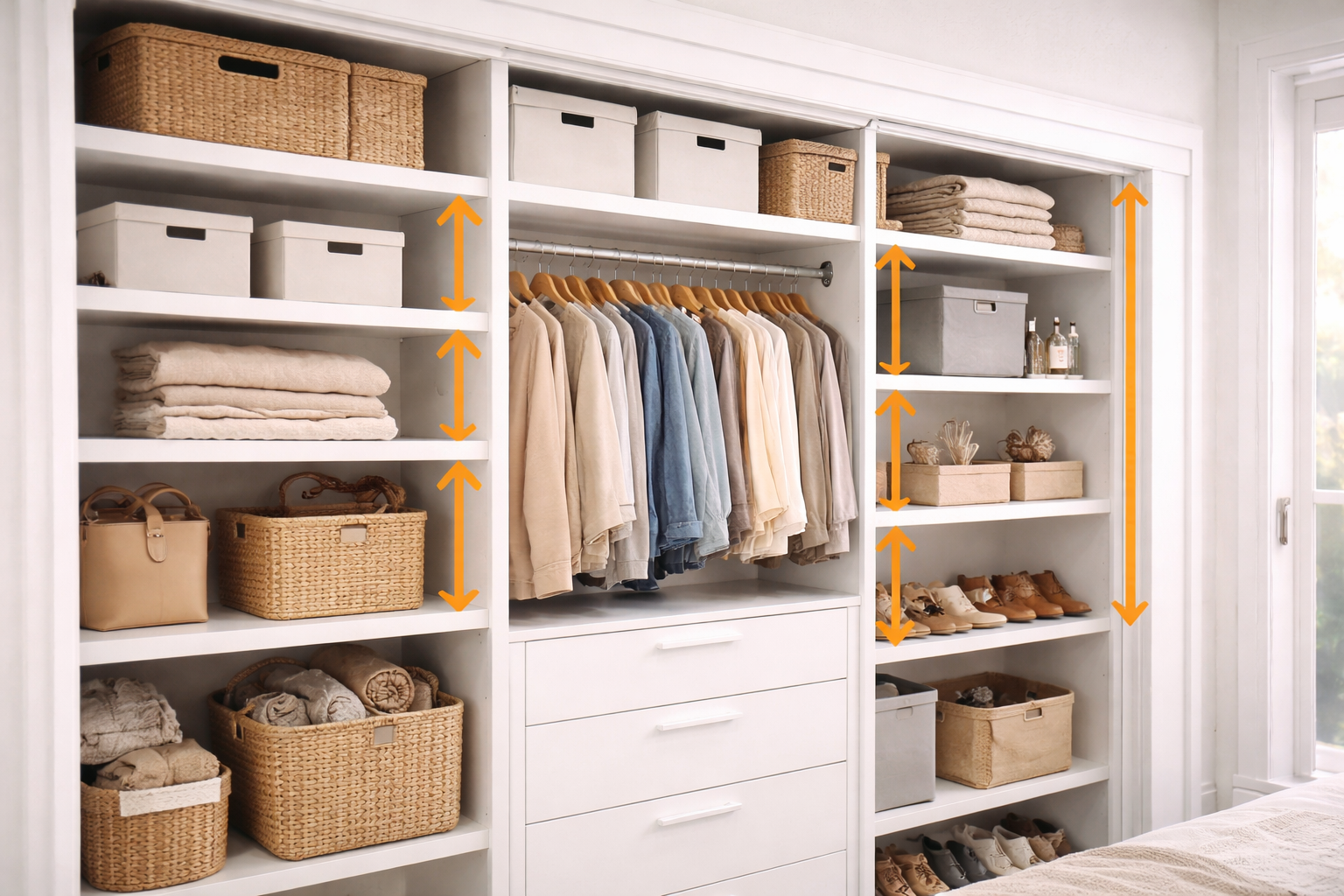
When people think about improving a closet, they often focus on adding more shelves. The assumption is simple: more shelves equal more storage. In practice, this logic fails frequently. Closets end up crowded, difficult to use, and visually chaotic, even with an impressive number of shelves installed.
The real issue is not how many shelves a closet has, but where those shelves are placed. Shelf placement determines how space behaves, how items are accessed, and whether storage remains usable over time. Poor placement wastes space even when shelf count is high. Thoughtful placement can make a modest number of shelves feel surprisingly generous.
This article explains why shelf placement matters more than shelf count, how structural misplacement undermines storage, and how to think about shelves as a system rather than as isolated additions.
Shelves Are Structural Tools, Not Storage Decorations
Shelves are often treated as interchangeable accessories. In reality, they are structural elements that define how vertical space is divided and how gravity affects stored items.
Every shelf creates a boundary. It limits vertical movement, controls stacking behavior, and shapes access patterns. When shelves are placed without strategy, they fragment space instead of organizing it.
Understanding shelves as structural dividers rather than mere surfaces changes how they are used.
Why Adding Shelves Often Makes Closets Worse
It seems counterintuitive, but adding shelves can reduce usable space. This happens when shelves are placed too close together, too deep, or in zones where they interfere with access.
Excessive shelving creates narrow vertical compartments that do not match real item dimensions. As a result, items are forced to bend, stack awkwardly, or overflow.
Shelf overload increases density instead of capacity.
Vertical Space Is Finite and Must Be Allocated Intentionally
A closet’s vertical height is limited. Every shelf consumes part of that height. When shelves are added without a plan, they steal space from each other.
The key question is not “how many shelves fit,” but “how should vertical space be divided to match what is stored.”
Vertical allocation must reflect item height distribution, not visual symmetry.
The Three Shelf Placement Zones
Like closets themselves, shelves operate in zones.
Upper shelf zone
Mid shelf zone
Lower shelf zone
Each zone has different access characteristics and storage suitability.
Shelves placed without regard to these zones often fail functionally.
Upper Shelf Placement and Reach Constraints
Upper shelves are defined by reach. Items stored here require stretching, stepping, or tools to access.
Placing frequently used shelves in this zone creates friction.
Common Placement Mistake
Installing multiple upper shelves to “maximize” vertical space and then using them for daily items.
Structural Best Use
Upper shelves should be few, well-spaced, and reserved for low-frequency items. Deep stacking should be avoided.
Upper shelves support storage rotation, not daily retrieval.
Mid Shelf Placement as the Functional Core
The mid zone is where shelves deliver the most value. It is within easy reach and visually dominant.
This is where shelf placement has the greatest impact on usability.
Structural Mistake
Placing shelves too far apart or too close together without regard to item height.
Structural Best Practice
Mid shelves should match the height of the items they store. Folded clothing, bags, or bins should fit comfortably without excess vertical waste.
Precision in the mid zone pays the highest dividends.
Lower Shelf Placement and Gravity Effects
Lower shelves interact with gravity and movement. Items here are more likely to be disturbed by foot traffic.
Structural Mistake
Using deep lower shelves for loose stacking, which encourages piles and collapse.
Structural Best Practice
Lower shelves should be shallow and stable. They are well-suited for contained storage, such as shoes or bins.
Stability matters more than capacity in the lower zone.
Shelf Depth Is as Important as Shelf Height
Shelf placement is not only vertical. Depth determines visibility and access.
Deep shelves hide items. Shallow shelves expose them.
Why Deep Shelves Fail
Items stored behind others are forgotten. Forgotten items turn into clutter.
Deep shelves encourage stacking and compression.
Structural Fix
Use shallow shelves whenever possible. If deep shelves exist, subdivide depth with containers to reclaim usability.
Depth should be controlled intentionally.
Spacing Shelves Based on Real Item Dimensions
Uniform shelf spacing looks neat but rarely works well. Items vary in height.
Shoes, folded clothes, bags, and boxes all have different spatial needs.
Structural Mistake
Evenly spaced shelves that force items to bend or waste space above them.
Structural Best Practice
Vary shelf spacing. Adjust heights based on the tallest item in each category.
Shelves should adapt to items, not the other way around.
Shelf Placement and Visual Density
Shelf placement affects how crowded a closet feels. Too many shelves create visual fragmentation.
Each shelf edge adds a horizontal line, increasing visual complexity.
Why This Matters
Visual density increases perceived clutter even when items are organized.
Structural Fix
Reduce unnecessary shelves. Fewer, well-placed shelves feel calmer and more usable.
Visual simplicity improves perceived space.
The Problem With Shelf Stacking
Stacking shelves vertically without considering access creates dead zones.
Items on lower shelves block access to upper ones.
Structural Fix
Limit vertical stacks. Use shelves to define zones, not to create towers.
Vertical clarity improves usability.
Shelf Placement and Folding Behavior
Shelf height influences how clothes are folded and stacked.
Too much vertical space encourages tall stacks that collapse. Too little space forces tight compression.
Structural Best Practice
Shelf height should encourage shallow stacks. Shallow stacks are easier to maintain and retrieve.
Shelf placement shapes folding behavior.
Shelf Placement Versus Drawer Placement
Shelves and drawers serve different structural purposes.
Shelves favor visibility. Drawers favor containment.
Structural Insight
Using shelves where drawers are needed increases clutter. Using drawers where shelves would suffice wastes space.
Shelf placement decisions should consider whether containment or visibility is more important.
Shelf Placement and Long-Term Maintenance
Poor shelf placement increases maintenance effort. Items must be rearranged constantly.
Good placement reduces maintenance because items naturally stay in place.
Maintenance is a structural outcome, not a behavioral one.
Why Shelf Count Is a Misleading Metric
Shelf count is easy to measure. Shelf effectiveness is not.
Many closets advertise “more storage” by adding shelves without improving usability.
Usability, not quantity, determines success.
Diagnosing Shelf Placement Problems
Signs of poor shelf placement include:
Items falling over
Stacks collapsing
Difficulty reaching items
Unused vertical gaps
Overcrowded surfaces
These are structural symptoms.
Reworking Shelf Placement Without Remodeling
Many shelf problems can be fixed without structural changes.
Removing shelves
Adjusting spacing
Reassigning zones
Using containers to manage depth
Small changes often yield large improvements.
Shelf Placement in Small Closets
Small closets magnify shelf placement errors.
Every inch matters. Poor placement wastes precious space quickly.
Thoughtful placement unlocks hidden capacity.
Shelf Placement and Storage Hierarchy
Shelves should reflect priority. High-priority items deserve better placement.
Low-priority items can accept less convenient positions.
Hierarchy should guide placement decisions.
Why Fewer Shelves Often Work Better
Reducing shelf count can increase usable space.
Fewer shelves allow taller compartments and better access.
Minimal structure often outperforms maximal structure.
Designing Shelf Layouts That Age Well
Storage needs change. Shelf layouts should accommodate change.
Adjustable spacing and modular placement improve longevity.
Static shelf layouts age poorly.
Shelf Placement and Structural Balance
Shelves affect weight distribution.
Poor placement can create sagging or instability over time.
Balanced placement preserves structural integrity.
When to Remove Shelves Instead of Adding Them
If shelves block access, create dead zones, or increase clutter, removal is the correct choice.
Subtraction is often the most effective structural improvement.
Rethinking Shelves as a System
Shelves should be planned as a coordinated system, not added individually.
System thinking prevents imbalance.
Why Shelf Placement Is a Design Decision, Not a Storage Decision
Shelf placement defines how space is divided, not just how items sit.
It is a design decision with long-term consequences.
Design decisions should be intentional.
How Proper Shelf Placement Changes Closet Experience
When shelves are well placed, the closet feels calmer.
Items are easier to find. Maintenance decreases.
The space feels larger without changing dimensions.
Frequently Asked Questions
Is it better to have fewer shelves
Often yes, if placement improves access and reduces clutter.
Can I fix shelf placement without tools
In many cases, yes, by reassigning zones or removing shelves.
Why do shelves feel crowded even when they are not full
Because spacing and depth do not match item dimensions.
Should shelf spacing be uniform
No. Spacing should match what is stored.
What is the most common shelf placement mistake
Installing shelves based on symmetry instead of function.

Ryan Lewis is a home organization enthusiast who specializes in smart, renter-friendly solutions for small spaces. With a passion for functional design and practical living, Alex shares tips, guides, and ideas to help readers create calm, clutter-free environments—no matter the size of their home.