
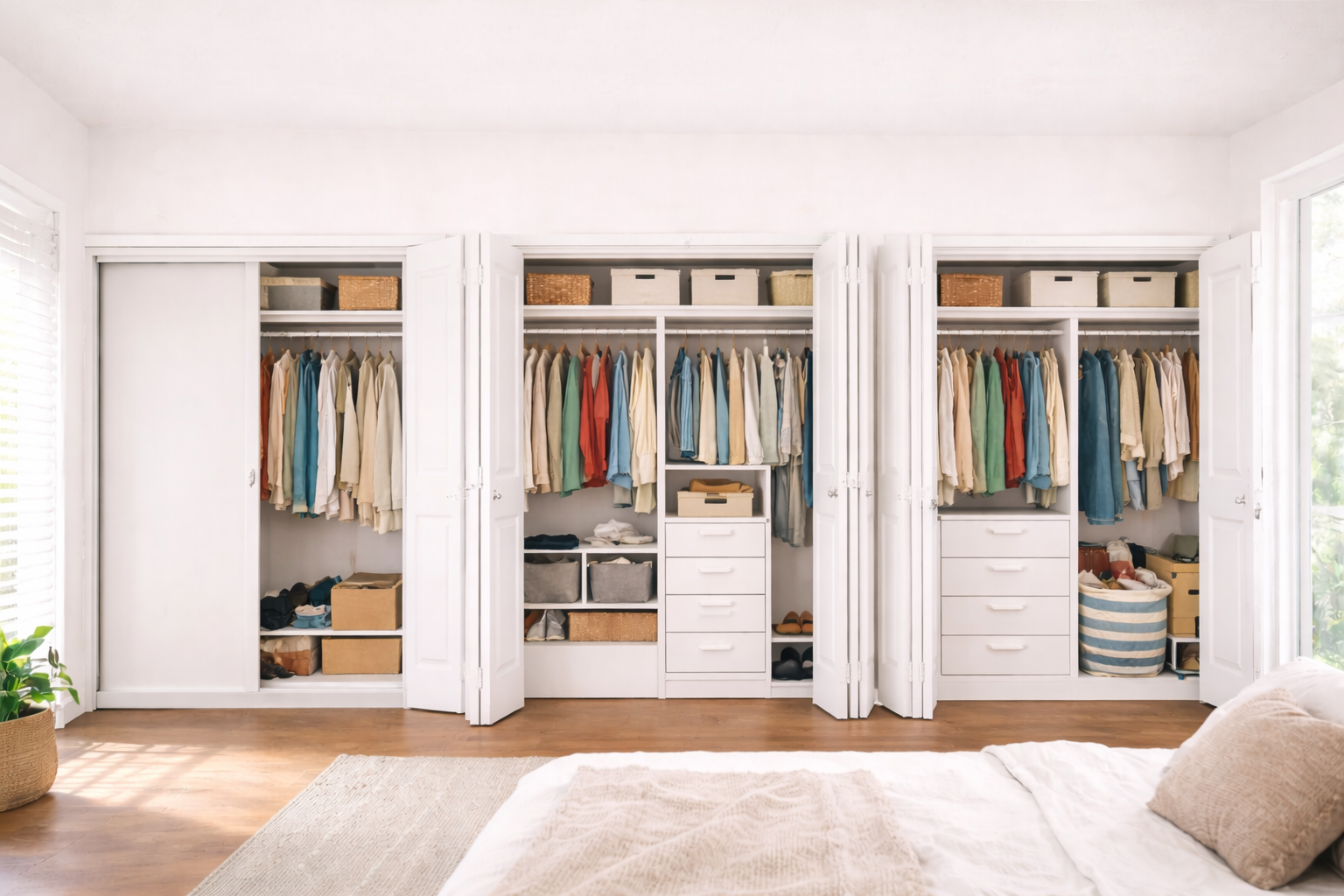
Closet doors are usually treated as an afterthought. They are seen as a finishing detail rather than a structural element.
People focus on shelves, rods, and organizers while assuming the door simply opens and closes. In reality, closet doors silently control access, usable depth, visibility, and even how much of the closet can be organized effectively.
In many apartments, the door is the single biggest factor limiting storage performance. Two closets with identical interior dimensions can behave completely differently depending on door type.
One feels usable and flexible. The other feels cramped and frustrating.
This article explains why closet doors are a structural decision, how different door types reshape usable space, and how to design storage that works with the door instead of fighting it.
Closet Doors Are Part of the Structure, Not an Accessory
A closet is not just the space inside the walls. It is the space plus the opening mechanism. Doors define how much of the interior can be accessed at once, how close storage can sit to the opening, and how items move in and out.
Ignoring the door means designing for a space that does not exist in real use.
Closet doors shape the usable envelope of the closet.
The Difference Between Physical Space and Functional Space
Physical space is measured wall to wall. Functional space is the area you can actually reach and use comfortably.
Closet doors reduce functional space in ways that are not obvious on a floor plan.
Door swing, track placement, and overlap all subtract from usable storage.
Many closets fail because they are designed for physical space instead of functional space.
Swing Doors and Their Hidden Costs
Swing doors are common in apartments, especially older ones. They appear simple and intuitive, but structurally they are expensive in terms of space.
When a swing door opens, it occupies interior depth and blocks side access. Storage placed near the door must account for this movement.
How Swing Doors Reduce Usable Depth
When open, a swing door intrudes into the closet. This intrusion means shelves and rods must be set back to avoid collision.
This reduces effective depth, even if the closet itself is deep.
Depth lost to door swing cannot be reclaimed.
Side Zone Blocking
Swing doors often block access to one side of the closet at a time.
This makes side zones awkward and underused.
Placing high-priority storage in these zones leads to frustration.
Double Swing Doors and Partial Access
Double swing doors improve access compared to single doors but still limit usability.
Only part of the closet is visible at a time unless both doors are fully open.
This creates uneven access patterns.
Items behind closed sections are often ignored.
Sliding Doors and Width Limitations
Sliding doors behave differently. Instead of intruding into depth, they reduce usable width.
At least part of the closet is always covered.
This creates permanent blind zones.
Why Sliding Doors Create Invisible Storage
Because one panel always overlaps another, a portion of the closet cannot be accessed without moving the door.
People tend to use the visible section more frequently.
Hidden sections become low-use zones by default.
The Behavioral Consequences of Partial Visibility
Even though this article focuses on structure, it is important to understand the structural outcome.
When sections are consistently hidden, they effectively shrink.
Functional width is reduced, even if physical width remains the same.
Sliding doors convert width into intermittency.
Bifold Doors and Access Tradeoffs
Bifold doors fold inward or outward, splitting the opening.
They offer more access than sliding doors but less than fully open swing doors.
They also intrude partially into depth when open.
Structural Impact of Bifold Hinges
Hinges and folds reduce usable edge space.
Storage placed too close to the opening may interfere with folding motion.
Bifold doors create irregular access zones.
Pocket Doors and Maximum Access
Pocket doors slide into the wall, removing themselves entirely from the opening.
Structurally, this provides the highest access potential.
However, pocket doors impose constraints elsewhere, such as wall structure.
Not all apartments can accommodate them.
How Door Type Determines Storage Placement
Door behavior should dictate where storage is placed.
Prime storage should never sit behind frequently blocked zones.
Low-priority storage can tolerate partial access.
Ignoring this hierarchy leads to underused space.
Door Clearance and Rod Placement
Rod placement must account for door clearance.
If rods are placed too close to the opening, garments can interfere with doors.
This leads to snagging, wrinkling, and damage.
Proper setback protects both clothes and doors.
Door Clearance and Shelf Depth
Shelves near the opening must respect door swing or slide paths.
Deep shelves near swing doors are especially problematic.
They reduce access and increase collision risk.
Depth must taper near doors.
Why Doors Create Dead Zones
Dead zones are areas that exist physically but are inconvenient to use due to door interference.
These zones often sit near corners, edges, or behind door panels.
Trying to force high-use storage into dead zones fails.
Dead zones should be assigned intentionally.
Assigning the Right Storage to Door-Restricted Zones
Door-restricted zones are best for:
Archive storage
Seasonal bins
Low-frequency items
Placing daily items here increases friction.
Priority placement must follow access reality.
Doors and Lighting Interaction
Doors also affect light.
Sliding and bifold doors reduce natural light penetration.
Dark zones feel deeper and more cluttered.
Lighting must compensate for door-induced shadows.
How Door Choice Affects Perceived Space
Doors influence how large a closet feels.
Full access doors make spaces feel larger.
Partial access doors fragment space visually.
Perception matters for usability.
Retrofitting Storage for Existing Door Constraints
Most people cannot change door types easily.
The solution is to adapt storage to the door.
This means reallocating zones, adjusting depth, and redefining priorities.
Retrofitting is about acceptance, not replacement.
Using Door Interiors as Structural Extensions
Door interiors are often overlooked.
Hooks, slim racks, and shallow organizers can live here without interfering with door function.
This converts the door from obstacle to asset.
Door interiors are best for lightweight, low-depth items.
The Risk of Overloading Door-Mounted Storage
Door-mounted storage adds weight and movement.
Overloading can strain hinges or tracks.
Structural limits still apply.
Use restraint.
Door Alignment and System Stability
Misaligned doors create unpredictable interference.
Storage that works when the door is aligned may fail when it shifts.
Door maintenance affects storage performance.
Stability matters.
Why Door Planning Should Happen First
Door behavior defines the opening.
The opening defines access.
Access defines storage hierarchy.
Planning storage before understanding door behavior leads to redesign.
Diagnosing Door-Related Storage Failures
Signs of door-related failure include:
Blocked shelves
Crushed garments
Unused side zones
Constant rearranging near the opening
These indicate door interference.
Door Constraints in Small Closets
Small closets magnify door issues.
Every inch lost to door behavior matters.
Door planning is critical in tight spaces.
Combining Door Strategy With Width and Depth Planning
Doors interact with width and depth.
A sliding door reduces width. A swing door reduces depth.
Storage must respond accordingly.
Ignoring interactions creates compounded problems.
When Door Replacement Is Worth Considering
In some cases, replacing doors improves usability dramatically.
This is rare but impactful.
The decision should be structural, not aesthetic.
Designing Storage That Accepts Door Reality
Acceptance reduces frustration.
Designing with door constraints leads to calmer systems.
Fighting doors leads to clutter.
Why Doors Are the Gatekeepers of Closet Performance
Doors decide what you can reach, see, and use.
They gate access.
Gatekeepers deserve attention.
Turning Doors From Limitation Into Guide
When door behavior is understood, it guides layout decisions.
You know where not to place things.
Clarity improves outcomes.
Structural Hierarchy Revisited
Door
Width
Depth
Height
Doors often sit at the top of the hierarchy.
Ignoring them undermines everything else.
Why Door Awareness Saves Money
Many storage purchases fail because doors interfere.
Understanding doors prevents wasted buying.
Planning saves resources.
The Structural Rule of Doors
If the door blocks it regularly, it is not prime storage.
Respect the rule.
Frequently Asked Questions
Which closet door type is best for storage
Pocket doors offer the most access, but are not always possible.
Are sliding doors bad
Not inherently, but they reduce usable width.
Can I improve storage without changing doors
Yes, by reallocating zones and adjusting depth.
Should I store daily items near the door
Only if door behavior does not block them.
What is the first door-related fix to try
Move high-priority items away from door-restricted zones.

Ryan Lewis is a home organization enthusiast who specializes in smart, renter-friendly solutions for small spaces. With a passion for functional design and practical living, Alex shares tips, guides, and ideas to help readers create calm, clutter-free environments—no matter the size of their home.