
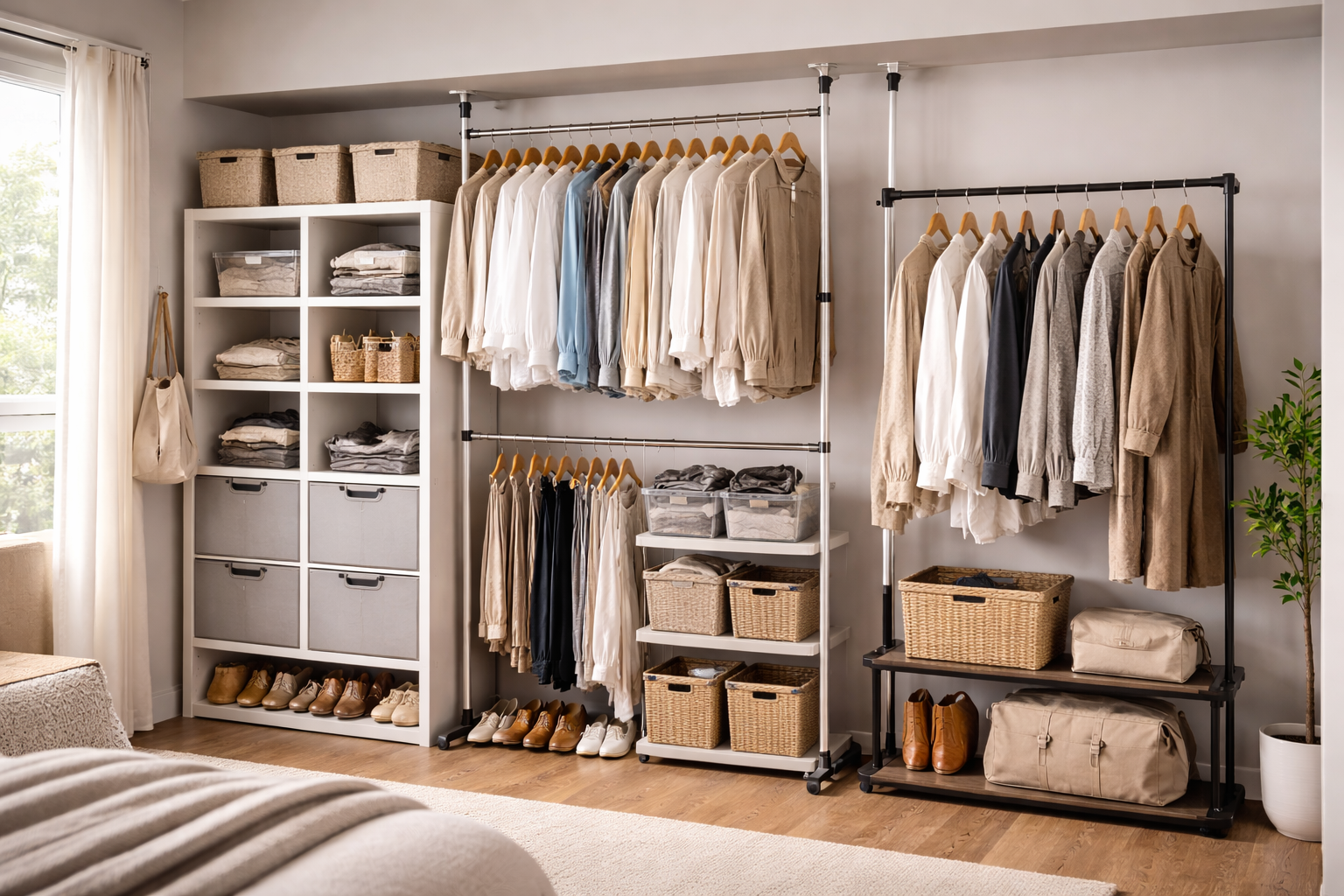
One of the biggest challenges renters face is investing in closet organization systems that only work in one specific apartment.
You buy shelves that perfectly fit your current closet, install a layout that feels ideal, and then move to a new place where nothing fits the same way.
Suddenly, your carefully organized system becomes useless.
This cycle wastes money, time, and energy.
The smarter strategy is to build a portable closet system — one that adapts to different layouts, dimensions, and rental restrictions. Instead of designing your organization around walls, you design it around mobility.
If you move every few years, your closet system should move with you.
Here is how to build a portable closet system that remains functional, renter-friendly, and adaptable no matter where you live.
Why Portable Closet Systems Are a Smart Investment for Renters
Renters often hesitate to invest in organization because they see it as temporary. However, buying low-quality or fixed systems repeatedly is more expensive in the long run.
Portable closet systems offer:
Flexibility
Long-term cost savings
Ease of assembly and disassembly
Compatibility with lease restrictions
Adaptability to different closet shapes
Instead of replacing your system with every move, you simply reinstall it.
Mobility creates stability.
Step 1: Choose Modular Over Fixed
The foundation of a portable system is modular design.
Modular pieces include:
Stackable shelving cubes
Freestanding drawer towers
Adjustable clothing racks
Tension rods
Collapsible storage bins
Each unit works independently but can be combined with others.
Avoid systems that require wall anchoring or permanent mounting.
Modular equals adaptable.
Step 2: Prioritize Adjustability
Closet dimensions change dramatically between apartments. Rod heights vary. Shelf spacing differs. Depth can shrink or expand.
Choose components that allow:
Height adjustment
Width adjustment
Expandable rods
Removable dividers
Adjustability ensures that even if your new closet is smaller or taller, your system can adapt without replacement.
Flexibility prevents waste.
Step 3: Invest in Freestanding Units
Freestanding storage units are ideal for renters because they do not rely on walls for support.
Examples include:
Slim vertical drawer towers
Narrow bookcase-style shelving
Freestanding garment racks
Portable wardrobe cabinets
When positioned correctly, they mimic built-in cabinetry without drilling.
Freestanding equals lease-safe.
Step 4: Use Tension Rods Strategically
Tension rods are one of the most powerful renter-friendly tools available.
They can be used to:
Create double hanging space
Separate clothing categories
Add extra hanging inside unused vertical areas
Because they rely on pressure instead of hardware, they leave no damage behind.
Portable systems should always include tension rods.
Step 5: Standardize Storage Containers
Matching bins, baskets, and boxes are easier to move and reorganize.
When all containers follow the same dimensions, you can rearrange them easily in new closets.
Standardized bins allow:
Stacking
Interchangeability
Efficient packing during moves
Uniformity supports portability.
Step 6: Build a Category-Based System
Instead of organizing based on shelf position, organize based on clothing categories.
Keep permanent categories such as:
Daily wear
Workwear
Outerwear
Shoes
Accessories
Seasonal storage
When you move, categories stay the same. Only their physical placement changes.
Structure should be habit-based, not layout-based.
Step 7: Avoid Overcustomizing to One Space
It is tempting to perfectly measure and fill every inch of your current closet.
But extreme precision can limit portability.
Leave breathing room in your layout. Allow slight flexibility in spacing.
A system that is slightly adaptable will survive multiple moves.
Step 8: Keep Assembly Simple
Choose systems that:
Require minimal tools
Have clear instructions
Disassemble quickly
Do not require complex hardware
Complex installations increase stress during moving day.
Simple assembly saves time.
Step 9: Store Installation Hardware Properly
Keep screws, connectors, and instructions in labeled bags.
When moving, store all hardware in one clearly marked container.
Losing small parts can render portable systems unusable.
Organization must extend to the system itself.
Step 10: Maintain Weight Balance
Portable units should be lightweight yet sturdy.
Heavy solid wood systems may look beautiful but are difficult to transport.
Opt for materials that balance durability with mobility.
Weight matters when relocating.
Step 11: Design for Both Small and Large Closets
Your next apartment may have:
A walk-in closet
A reach-in closet
No closet at all
Portable systems should function independently of built-in structures.
For example, a freestanding garment rack can function inside a closet or in a bedroom corner.
Versatility ensures usability anywhere.
Step 12: Think Beyond the Closet
Portable closet systems can extend into bedrooms when necessary.
If your next apartment has limited closet space, your freestanding units can act as open wardrobe solutions.
Planning for versatility protects your investment.
Step 13: Maintain a Controlled Wardrobe Size
No system remains portable if volume keeps expanding.
Adopt a one-in-one-out rule.
Review clothing seasonally.
Keeping wardrobe size manageable ensures your system continues to function effectively.
Portability depends on discipline.
Step 14: Plan Packing in Advance
When moving, disassemble portable units carefully and label components.
Wrap panels in protective material.
Keep small parts in sealed bags.
Intentional packing protects your system and makes reinstallation smoother.
Step 15: Reinstall With Observation First
When arriving at a new apartment, study the closet before reinstalling.
Measure the new space.
Evaluate rod heights.
Observe lighting conditions.
Then reassemble your portable system accordingly.
Adaptation should be thoughtful, not rushed.
Final Thoughts: Build Once, Use Everywhere
Portable closet systems empower renters to invest confidently in organization without fearing future moves.
By choosing modular, adjustable, freestanding components and maintaining category-based structure, you create a closet system that evolves with you.
Instead of rebuilding every time, you refine.
Instead of starting from scratch, you reinstall.
Organization should travel with you.
A well-designed portable system transforms every new apartment into a familiar, functional space from day one.

Ryan Lewis is a home organization enthusiast who specializes in smart, renter-friendly solutions for small spaces. With a passion for functional design and practical living, Alex shares tips, guides, and ideas to help readers create calm, clutter-free environments—no matter the size of their home.