
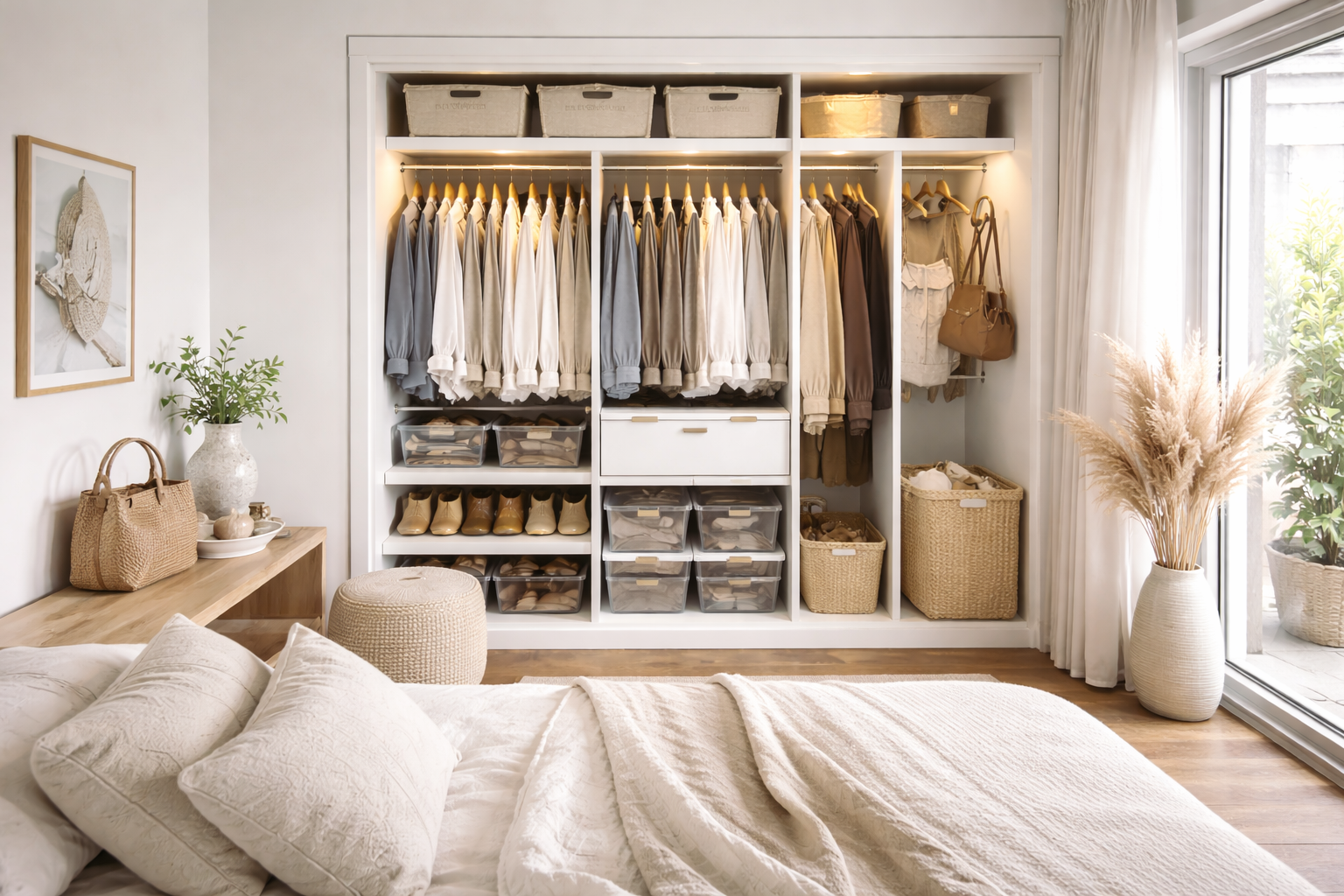
Living in a small apartment requires intentional choices. Every item must justify its presence. Every piece of furniture must serve a purpose.
Every visual element affects how large or cramped the space feels. Nowhere is this more noticeable than inside the closet.
In compact apartments, especially those under 700 square feet, closets are often shallow, narrow, and visually overwhelming.
The instinctive reaction is to add more shelves, more bins, and more storage units. Ironically, this often makes the closet feel even smaller.
The real solution is not adding more. It is subtracting intelligently and organizing minimally.
A minimalist closet system does not mean owning fewer clothes only. It means designing a layout that reduces visual density, increases accessibility, and improves spatial perception.
When done correctly, a minimalist closet can make a small apartment feel twice as large.
Here is how to design and implement minimalist closet systems that truly transform compact living spaces.
Why Minimalism Works So Well in Small Closets
Minimalism is not about emptiness. It is about clarity.
In small closets, clutter creates:
Visual heaviness
Reduced airflow
Decision fatigue
Hidden inefficiencies
Minimalist systems focus on:
Controlled volume
Visual uniformity
Clear zoning
Intentional spacing
When the eye encounters fewer visual interruptions, the space appears larger.
Small apartments benefit from visual calm.
Step 1: Start With Ruthless Editing
No minimalist closet system works without volume control.
Before organizing anything, remove every item from your closet and evaluate honestly.
Ask:
Have I worn this in the last 12 months?
Does this fit my current lifestyle?
Would I buy this again today?
Small apartments cannot support sentimental overflow.
Minimalism begins with selective ownership.
The fewer unnecessary items you store, the easier it is to create structure.
Step 2: Choose a Single Hanging Strategy
Mismatched hangers instantly create visual noise.
Switch to a single hanger type:
Slim velvet for maximum capacity
Matte black for modern minimalism
Light wood for soft neutrality
Uniform hangers align garments evenly and reduce horizontal bulk.
Even spacing between garments allows airflow and improves visibility.
Small adjustments create noticeable impact.
Step 3: Reduce Shelf Overcrowding
Many small closets fail because shelves are stacked too tightly.
Instead of piling clothing in tall unstable stacks, reduce pile height.
Create:
Shorter stacks
Clear category boundaries
Intentional spacing
A shelf with breathing room looks larger than a shelf fully packed.
Minimalism values space as much as storage.
Step 4: Use Closed Storage Strategically
Visible clutter shrinks perception.
Use uniform closed bins for:
Seasonal clothing
Backup items
Occasional wear
Choose bins in neutral tones and consistent dimensions.
When containers match, the closet feels cohesive rather than chaotic.
Uniformity supports spatial illusion.
Step 5: Limit Active Shoe Rotation
Shoes consume valuable real estate.
Keep only 6–8 pairs in active rotation inside the closet.
Store occasional or seasonal footwear in labeled upper bins or under-bed storage.
Clear floor space dramatically improves depth perception.
In small apartments, visible floor equals visual expansion.
Step 6: Create Vertical Continuity
Vertical lines elongate space visually.
Install:
Double hanging rods
Vertical drawer towers
Stacked uniform bins
Keep lines straight and aligned.
Avoid uneven stacks or irregular shapes.
Clean vertical continuity mimics built-in architecture.
Step 7: Incorporate Lighting as a Design Element
Minimalist closets rely on light to amplify simplicity.
Add:
Neutral white LED strips
Motion-sensor bars
Under-shelf lighting
Eliminating shadows increases clarity.
Bright closets feel larger and more intentional.
Light multiplies space perception.
Step 8: Maintain Negative Space
Negative space is intentional emptiness.
Leave small gaps:
Between clothing categories
Between bins
Above shelves
Negative space prevents suffocation.
In small apartments, emptiness is powerful.
It signals control.
Step 9: Use Capsule Wardrobe Logic
Capsule wardrobes align perfectly with minimalist systems.
Focus on:
Neutral core pieces
Versatile layering items
Interchangeable outfits
When clothing works together, volume naturally decreases.
Less variety often equals more functionality.
Intentional wardrobes support intentional closets.
Step 10: Avoid Decorative Overload
Small closets do not benefit from heavy decoration.
Avoid:
Excess baskets
Large decorative bins
Unnecessary styling elements
Minimalist systems prioritize function.
If adding one decorative touch, keep it subtle and aligned with your palette.
Restraint protects spaciousness.
Step 11: Create Clear Micro-Zones
Even in minimalism, structure matters.
Divide your closet into:
Daily essentials
Workwear
Occasional wear
Accessories
Keep each zone defined and limited.
Boundaries prevent gradual expansion.
Controlled zones maintain long-term order.
Step 12: Weekly Micro-Reset
Small apartments show disorder quickly.
Adopt a weekly five-minute reset:
Realign hangers
Refold stacks
Return displaced items
Consistency prevents buildup.
Minimalist systems require light but regular maintenance.
Step 13: Think Beyond the Closet
Closet minimalism influences the entire apartment.
When your wardrobe is controlled:
Bedroom surfaces remain clear
Chairs do not collect clothing
Laundry cycles simplify
Morning routines accelerate
The impact extends beyond storage.
Minimalism improves flow.
Step 14: Psychological Benefits of Minimal Closet Systems
Living in small apartments can feel overwhelming.
A minimalist closet reduces:
Decision fatigue
Visual stress
Time wasted searching
When clothing is visible, accessible, and intentional, daily stress decreases.
Calm environments improve productivity.
Structured spaces support mental clarity.
Step 15: Long-Term Sustainability
Minimalist systems are not one-time projects.
Schedule quarterly reviews:
Remove unused items
Adjust seasonal zones
Refine categories
Minimalism evolves.
Small apartments demand adaptability.
Final Perspective: Space Is a Design Decision
Small apartments do not have to feel small.
Through controlled volume, visual uniformity, negative space, vertical alignment, and disciplined rotation, a minimalist closet system can transform spatial perception.
You do not need renovation.
You need restraint.
When the closet breathes, the apartment breathes.
Minimalism is not about having less for the sake of less.
It is about creating room for what matters.

Ryan Lewis is a home organization enthusiast who specializes in smart, renter-friendly solutions for small spaces. With a passion for functional design and practical living, Alex shares tips, guides, and ideas to help readers create calm, clutter-free environments—no matter the size of their home.