
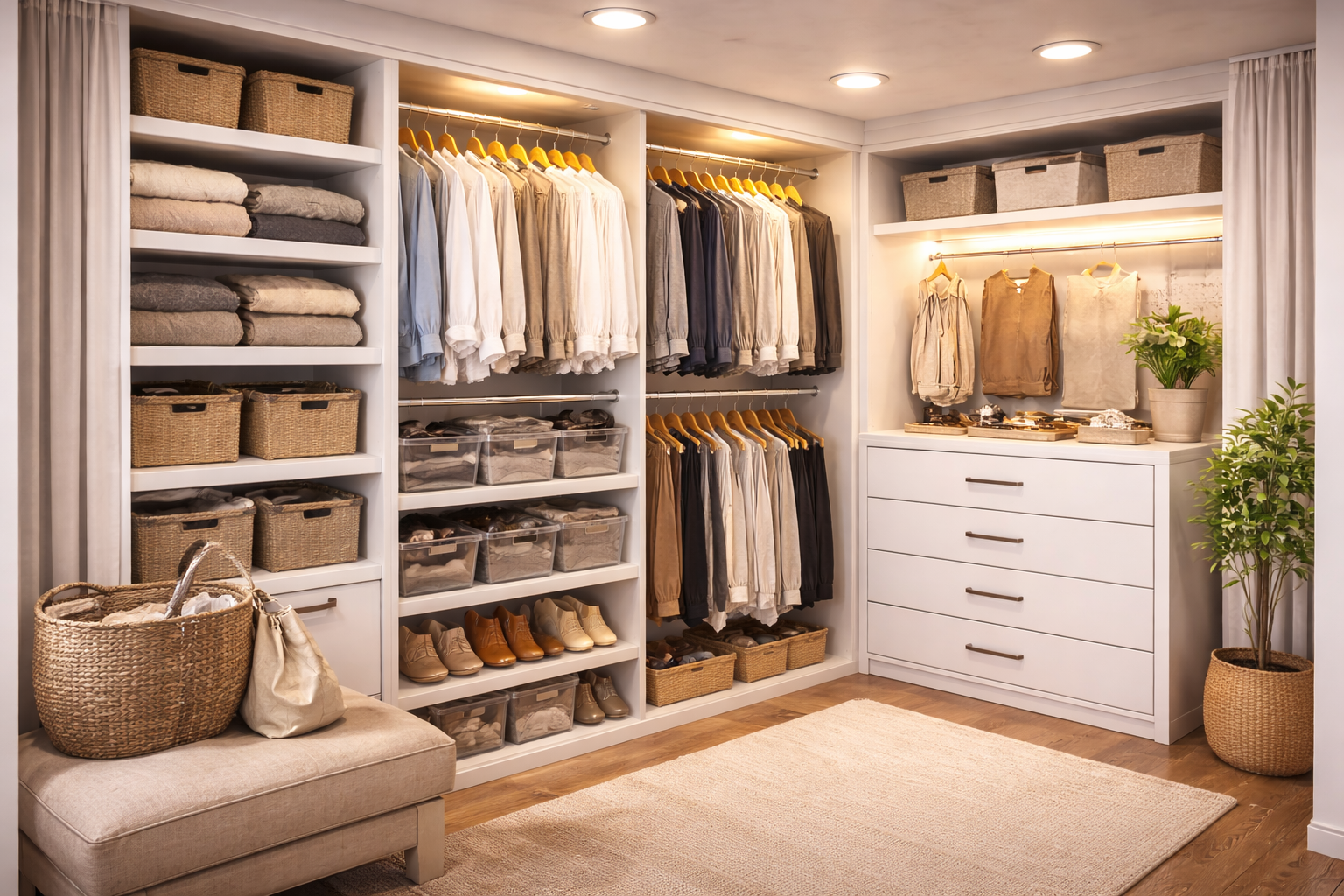
Upgrading a rental closet can feel like walking a tightrope. On one side, you want functionality, structure, and aesthetic refinement.
On the other, you are bound by lease agreements, damage clauses, and the constant awareness that your security deposit is at stake.
Most renters either do nothing and live with inefficient storage, or overmodify and risk penalties when moving out.
But there is a third path.
You can significantly upgrade your rental closet — visually, structurally, and functionally — without drilling into walls, rewiring lighting, installing permanent fixtures, or violating lease terms.
The key is understanding how to simulate permanence through modular design, visual consistency, structural layering, and behavioral organization.
This guide breaks down exactly how to do that safely, strategically, and sustainably.
Step 1: Understand What Actually Risks Your Deposit
Before upgrading anything, understand what typically causes renters to lose part of their deposit when modifying closets.
Common violations include:
Drilling into walls or shelves
Installing permanent anchors
Painting inside closet interiors
Removing built-in rods or shelves
Using industrial adhesives that damage paint
Altering electrical wiring
Your upgrade strategy must avoid anything that cannot be reversed cleanly.
The golden rule is simple: If you cannot remove it in under 30 minutes without visible trace, do not install it.
True renter-friendly upgrades are 100% reversible.
Step 2: Redefine “Upgrade”
An upgrade does not mean construction. It means improvement in efficiency, accessibility, and visual cohesion.
A rental closet upgrade can involve:
Improved lighting
Better category separation
Modular shelving
Uniform storage systems
Enhanced vertical use
Hidden clutter control
Upgrades are strategic improvements, not structural changes.
The mindset shift matters.
Step 3: Start With a Structural Audit
Before adding anything, evaluate your closet objectively.
Ask:
How much vertical space is unused?
Is the rod too high or too low?
Are folded stacks collapsing?
Are shoes overcrowded?
Is lighting insufficient?
Are categories blended together?
Do not buy solutions blindly. Diagnose first.
An upgrade should solve a problem, not add visual complexity.
Step 4: Maximize Vertical Space Without Drilling
Most rental closets waste vertical height.
Instead of installing permanent shelves, use:
Stackable modular shelving cubes
Freestanding vertical towers
Adjustable shelf risers
Tension-based expansion systems
These additions increase storage capacity without altering walls.
Vertical optimization creates the illusion of built-in design.
Height equals opportunity.
Step 5: Install Double Hanging With Tension Rods
If your rental closet has a single high rod, you are losing 40–50% of potential hanging space.
Install a tension rod below the main rod to create double hanging sections.
Benefits include:
Immediate capacity expansion
No drilling required
Easy removal during move-out
Better category separation
Shorter garments like shirts and folded pants can occupy the lower rod.
Layered hanging mimics custom installations without permanence.
Step 6: Upgrade Lighting Without Electrical Work
Lighting transforms perception more than almost any other upgrade.
Rental closets are often dim and shadowed.
Add:
Rechargeable LED light bars
Motion-sensor strip lighting
Magnetic lighting systems
Neutral white bulbs (4000K–5000K)
Place lighting strategically:
Under shelves
Above hanging rods
Near shoe storage
Good lighting increases visibility, reduces frustration, and enhances the overall experience of the space.
A well-lit closet feels intentional and high-end.
Step 7: Replace Visual Chaos With Uniformity
Mismatched hangers and random bins create a temporary appearance.
Upgrade by standardizing:
Hangers
Storage bins
Drawer organizers
Labels
Choose one cohesive palette:
Neutral beige
Soft gray
Black and white
Natural woven tones
Uniformity creates visual sophistication.
Consistency signals design intention.
Step 8: Introduce Structured Zones
Rental closets often fail because everything shares one continuous space.
Divide the closet into zones:
Daily wear
Workwear
Outerwear
Shoes
Accessories
Seasonal storage
Use visual spacing, dividers, or modular shelving to define each section.
Zones create structure without construction.
Structure reduces stress.
Step 9: Conceal What Does Not Need Display
A custom-looking closet never exposes everything.
Use closed bins for:
Backup clothing
Rarely used items
Travel accessories
Sentimental pieces
Selective visibility enhances elegance.
Not everything needs to be on display.
Step 10: Create a Controlled Shoe System
Shoes are one of the fastest ways to create floor clutter.
Upgrade shoe storage using:
Stackable clear shoe boxes
Slim shoe racks
Under-shelf shoe organizers
Vertical shoe towers
Keep only current-season shoes accessible.
Store others in labeled bins.
Clear floors make closets feel larger.
Step 11: Upgrade Drawer Interiors
If your closet includes drawers, improve their internal structure.
Add expandable dividers for:
Socks
Belts
Jewelry
Scarves
Internal organization supports long-term order.
Hidden chaos eventually spreads outward.
Step 12: Maintain Removability
Every upgrade should meet three criteria:
No permanent hardware
No paint damage
No structural alteration
Test removability before fully committing.
If adhesive feels too strong, reconsider.
Protecting your deposit is part of smart upgrading.
Step 13: Avoid Over-Upgrading
It is possible to overcomplicate.
Too many bins, shelves, and systems can create rigidity and visual overwhelm.
Upgrade strategically.
Each addition should solve a defined issue.
Minimal effective intervention produces better results than maximal cluttered intervention.
Step 14: Plan for Move-Out From Day One
As you install upgrades, think ahead.
Keep:
Instruction manuals
Spare hardware
Packaging if possible
Store all components neatly.
When moving out, reverse the process carefully.
A smooth move-out preserves your deposit.
Step 15: Psychological Impact of an Upgraded Closet
Closets influence daily routines more than most renters realize.
An upgraded closet:
Reduces morning stress
Speeds up decision-making
Prevents overbuying duplicate clothing
Improves clothing care
Enhances confidence
Functional design affects mental clarity.
Even small upgrades produce meaningful impact.
Step 16: Long-Term Strategy for Frequent Movers
If you move often, invest in portable modular systems rather than apartment-specific solutions.
Choose adjustable components that adapt to:
Different rod heights
Different shelf depths
Different closet widths
Portability ensures that each future apartment benefits from the same structured system.
Build once, reuse everywhere.
Step 17: Audit Quarterly
An upgraded closet requires maintenance.
Every three months:
Edit categories
Remove overcrowded sections
Adjust lighting placement
Reevaluate storage needs
Upgrades only remain effective when maintained.
Structure without discipline fades.
Final Perspective: Upgrade With Intelligence, Not Construction
Upgrading a rental closet without losing your security deposit is entirely possible when you focus on reversibility, modular design, visual consistency, and structural zoning.
You do not need carpentry to create refinement.
You need:
Intentional layout
Layered lighting
Category discipline
Uniform storage
Vertical optimization
Removal-safe installations
A rental closet can feel customized, elevated, and thoughtfully designed without a single drilled hole.
Upgrade strategically.
Install reversibly.
Maintain consistently.
Move out confidently.
Your deposit stays protected.
Your closet feels permanent.
Your daily routine improves.

Ryan Lewis is a home organization enthusiast who specializes in smart, renter-friendly solutions for small spaces. With a passion for functional design and practical living, Alex shares tips, guides, and ideas to help readers create calm, clutter-free environments—no matter the size of their home.