
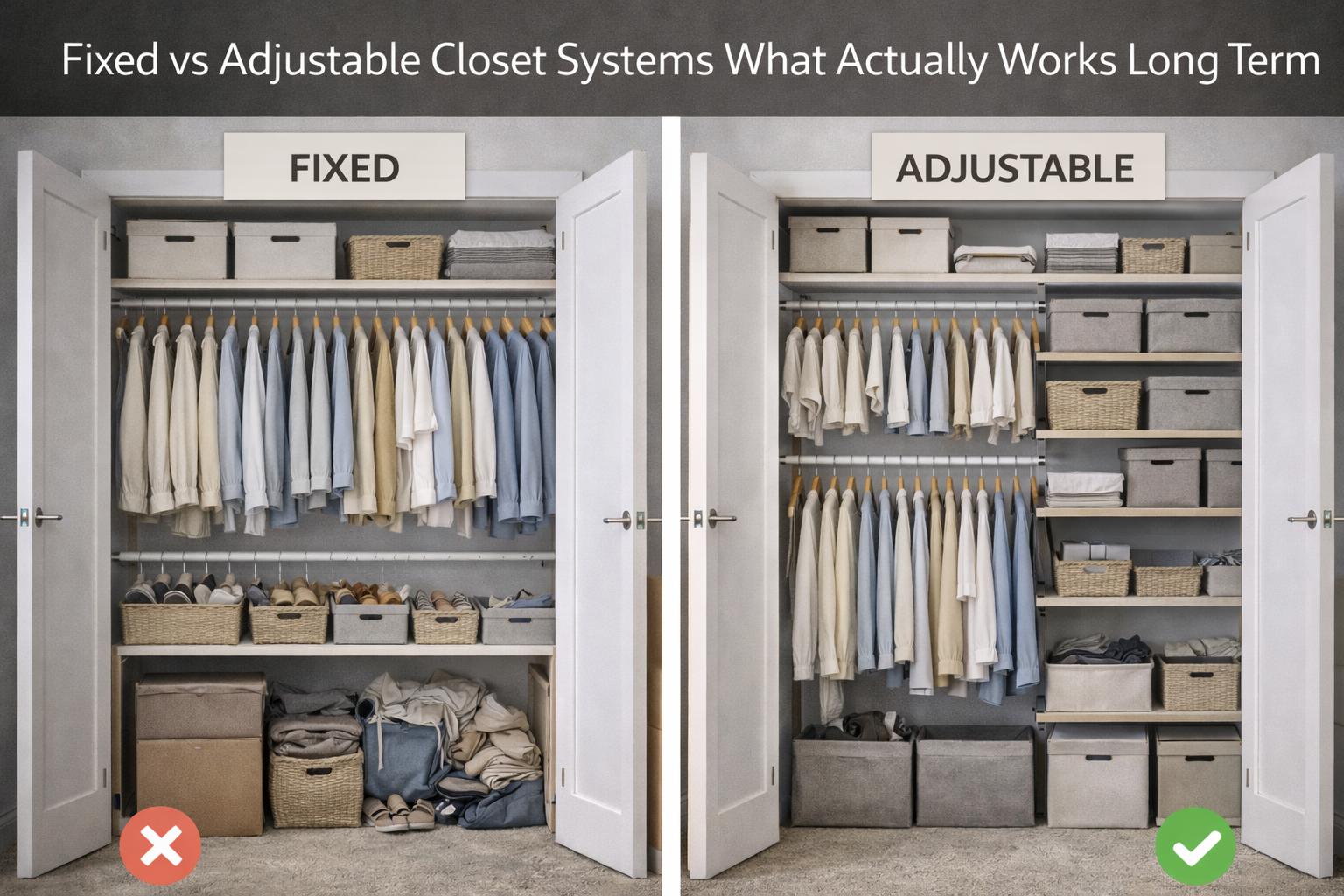
Closet systems are often sold as permanent solutions. Once installed, they are expected to solve storage problems indefinitely.
This idea is appealing, especially in small apartments where space feels scarce and order feels urgent. But permanence is not the same as durability. Many closet systems look impressive at first and fail quietly over time.
The core issue is not quality or price. It is the choice between fixed and adjustable structures. Each approach shapes how storage behaves, how the closet adapts to change, and whether the system remains useful as life evolves.
This article explains the structural differences between fixed and adjustable closet systems, why one often outperforms the other in real living environments, and how to decide which approach actually works long term.
What Defines a Fixed Closet System
A fixed closet system is built around permanence. Shelves are installed at set heights. Rods are anchored in specific positions. The structure is designed to remain unchanged.
Fixed systems often prioritize clean lines, symmetry, and visual uniformity. They are commonly associated with custom closets or built-in cabinetry.
Structurally, fixed systems assume stability. They assume wardrobes, habits, and storage needs will remain relatively constant.
What Defines an Adjustable Closet System
An adjustable closet system is designed for change. Shelves can move. Rods can shift. Components can be added, removed, or reconfigured.
Adjustable systems sacrifice some visual rigidity in exchange for flexibility. They are often modular, using tracks, slots, or standardized components.
Structurally, adjustable systems assume variability. They expect clothing volume, categories, and priorities to change over time.
Why This Distinction Matters More Than Most People Think
Closets are not static environments. Clothing changes seasonally. Lifestyles shift. Body sizes fluctuate. Storage needs evolve.
When structure cannot adapt, the system begins to fail even if it is well built.
The choice between fixed and adjustable is not aesthetic. It is strategic.
The Hidden Assumptions Behind Fixed Systems
Fixed systems assume that you already know exactly how you will use the space. Shelf heights, rod placement, and storage zones are locked in based on current needs.
This assumption rarely holds long term.
Even small changes, such as acquiring longer garments, switching jobs, or changing climate, can disrupt a fixed layout.
Why Fixed Systems Often Feel “Outgrown”
Many people report that fixed systems feel perfect at first and frustrating later.
This is not because the system is poorly made. It is because the system cannot respond to new constraints.
When needs change, fixed systems force workarounds. Items get squeezed, stacked, or displaced, creating clutter.
The Structural Cost of Permanence
Permanence reduces adaptability. When structure is locked, the only way to regain balance is to change behavior or reduce belongings.
In small apartments, this pressure is intense because alternative storage options are limited.
Fixed systems transfer the burden of adaptation onto the user.
Adjustable Systems and Structural Elasticity
Adjustable systems introduce elasticity. Elasticity is the ability to stretch, absorb change, and return to balance.
Shelves move to accommodate taller items. Rods shift as garment mix changes. Components are repurposed as needs evolve.
Elasticity reduces friction over time.
Why Elasticity Is Crucial in Small Apartments
Small apartments amplify change. A small increase in clothing volume has a big impact. A seasonal shift alters proportions significantly.
Elastic systems absorb these changes without breaking.
In contrast, rigid systems expose every mismatch.
The Tradeoff Between Visual Order and Functional Longevity
Fixed systems often look cleaner. Lines are straight. Spacing is consistent. Everything appears intentional.
Adjustable systems may look more utilitarian, especially if not styled carefully.
The tradeoff is longevity. Visual perfection on day one often costs flexibility on day one hundred.
When Fixed Systems Actually Make Sense
Fixed systems are not inherently bad. They work well under specific conditions.
Stable wardrobes
Predictable routines
Large closets with excess capacity
Minimal seasonal variation
In these cases, fixed structures can perform well.
Why These Conditions Rarely Apply to Rentals
Rental apartments rarely meet these conditions.
Closets are small. Structures are constrained. Storage needs fluctuate.
Permanence becomes a liability rather than an asset.
The Risk of Over-Optimizing a Fixed Layout
Fixed systems are often optimized aggressively. Every inch is allocated. Every shelf is filled.
This leaves no margin.
When anything changes, the system collapses.
Adjustable Systems and Built-In Margin
Adjustable systems naturally include margin. Empty slots, movable components, and modular gaps create space for change.
Margin is not waste. It is resilience.
Closets with margin recover faster from disruption.
Structural Failure Modes of Fixed Systems
Fixed systems fail in predictable ways.
Shelves become too tall or too short
Rods become overcrowded
Vertical space becomes misallocated
Floor zones become overloaded
Because nothing moves, pressure builds.
Structural Failure Modes of Adjustable Systems
Adjustable systems can fail too, but in different ways.
Components may shift too frequently
Over-adjustment can create instability
Poor-quality hardware may wear
These failures are usually correctable without full replacement.
Maintenance Over Time Fixed vs Adjustable
Fixed systems require behavioral maintenance. You must adapt to the structure.
Adjustable systems require occasional structural maintenance. You adapt the structure.
Structural maintenance is usually easier than behavioral change.
Cost Over Time Not Just Initial Price
Fixed systems often cost more upfront, especially custom builds.
Adjustable systems may cost less initially but require thoughtful setup.
Over time, adjustable systems often save money because they reduce replacement and reconfiguration costs.
Why Adjustable Systems Reduce Organizing Burnout
Burnout happens when effort feels wasted.
Fixed systems often lead to burnout because problems cannot be resolved structurally.
Adjustable systems allow problem-solving. When something stops working, you change the layout instead of blaming yourself.
Structural Learning Over Time
Adjustable systems allow learning. You observe what works and adjust accordingly.
Fixed systems lock learning out.
Learning is essential for long-term success.
The Illusion of “Set It and Forget It”
No closet is truly set and forget.
The difference is whether change requires overhaul or adjustment.
Adjustable systems make change incremental.
Combining Fixed and Adjustable Elements
The most successful closets often blend both approaches.
Fixed elements define boundaries. Adjustable elements handle variability.
The key is placing flexibility where change is most likely.
Where Flexibility Matters Most Structurally
Hanging space
Shelf height for folded items
Vertical allocation
Overflow zones
These areas benefit most from adjustability.
Where Fixed Structure Is Acceptable
Overall width
Wall boundaries
Door placement
These constraints are unavoidable.
Understanding where flexibility matters prevents overengineering.
How to Evaluate a Closet System Before Committing
Ask structural questions.
Can shelves move
Can rod height change
Is there margin
What happens when volume increases
If answers are unclear, longevity is at risk.
Adjustable Systems and Rental Constraints
Adjustable systems often work better in rentals because they are less invasive.
They respect constraints and preserve reversibility.
Reversibility is a hidden form of flexibility.
Why Adjustable Systems Age Better
As closets age, needs shift.
Systems that age well are those that can be reconfigured without replacement.
Adjustable systems age structurally. Fixed systems age aesthetically but fail functionally.
Designing for the Next Version of Your Life
Closet systems should support who you are becoming, not just who you are now.
Adjustability creates future-proofing.
Fixed systems freeze time.
Structural Simplicity Beats Structural Perfection
Complex fixed systems look impressive but break easily.
Simple adjustable systems survive complexity.
Longevity favors simplicity.
Frequently Asked Questions
Are adjustable systems always better than fixed ones
Not always, but they outperform fixed systems in small or changing environments.
Do adjustable systems look messy
They can, but thoughtful alignment and consistency reduce visual noise.
Is it worth replacing a fixed system
Sometimes small adjustments or partial replacement create significant improvement.
What is the biggest advantage of adjustable systems
Adaptability without full replacement.
What is the biggest risk of fixed systems

Ryan Lewis is a home organization enthusiast who specializes in smart, renter-friendly solutions for small spaces. With a passion for functional design and practical living, Alex shares tips, guides, and ideas to help readers create calm, clutter-free environments—no matter the size of their home.