
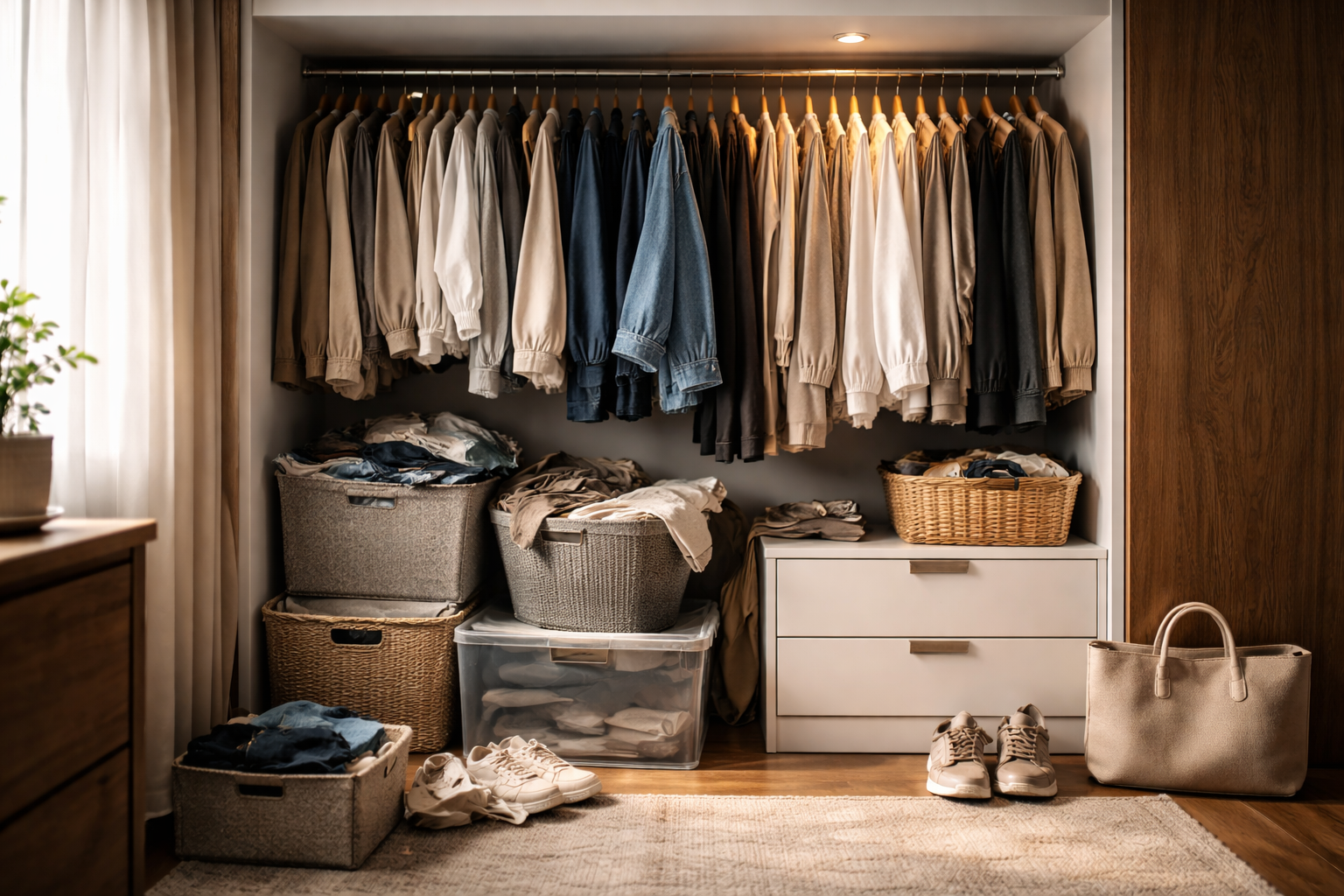
When your closet feels chaotic, the most instinctive reaction is to buy something.
A new bin.
A drawer unit.
Matching baskets.
A shoe rack.
Clear containers.
A closet system kit.
It feels productive. It feels proactive. It feels like progress.
But in many cases, buying more storage is not solving the problem.
It is amplifying it.
Closets do not become functional because they contain more containers. They become functional because they contain fewer unresolved decisions and clearer structural boundaries.
If your closet feels worse every time you “upgrade” it, here is why.
Storage Does Not Fix Structural Confusion
When categories are undefined, containers simply hide confusion inside new shapes.
You buy five bins.
Now you must decide:
What goes in each bin?
How full should they be?
Where should they sit?
What happens when one overflows?
Without clear category logic, bins become relocation tools, not solutions.
You are moving clutter.
Not eliminating it.
Containers Multiply Micro-Decisions
Every container creates:
A lid to open.
A label to read.
A choice to make.
A placement decision.
If you have:
Eight different baskets.
Three drawer units.
Two hanging organizers.
A stack of shoe boxes.
Your closet now contains dozens of micro-systems.
Micro-systems increase friction.
Friction decreases sustainability.
You Bought Storage Before Reducing Volume
This is the most common mistake.
Storage should follow editing.
If you add containers without first reducing excess clothing, you are compressing the same volume into tighter compartments.
Compression hides overload temporarily.
But it does not remove it.
Eventually, overflow returns.
And you buy more storage.
The cycle repeats.
Over-Compartmentalization Creates Rigidity
When closets are divided into too many small sections, flexibility disappears.
Now you have:
A bin for gym socks.
A bin for dress socks.
A bin for winter scarves.
A bin for light scarves.
A bin for belts.
A bin for backup belts.
Excess micro-categorization requires constant maintenance.
If one item is misplaced, it disrupts multiple sections.
Simplicity sustains better than hyper-detail.
Storage Can Increase Visual Clutter
Different shapes.
Different materials.
Different colors.
Different sizes.
Even when organized, visual inconsistency increases cognitive load.
Your brain processes every object.
More objects equal more processing.
Uniformity reduces noise.
Excess storage increases it.
You Are Solving the Wrong Problem
Closet frustration usually comes from:
Too many active choices.
Undefined zones.
Lack of frequency-based access.
No capacity limits.
Routine misalignment.
Storage addresses none of these directly.
It only provides additional surfaces.
If the structure remains undefined, new surfaces fill quickly.
The “Temporary Satisfaction” Effect
Buying organizers gives a short-term dopamine boost.
You feel in control.
You feel proactive.
You feel productive.
But satisfaction fades when structural issues persist.
True improvement feels calm.
Not exciting.
Excitement often signals temporary change.
Calm signals sustainable change.
When Storage Actually Helps
Storage works when:
Volume is already controlled.
Categories are clearly defined.
Frequency zoning is established.
Capacity limits exist.
Only then do containers support the system.
Storage is a supporting actor.
Not the main solution.
The Right Order of Operations
If your closet feels overwhelming, follow this sequence:
- Remove everything.
- Reduce volume.
- Group by frequency.
- Define zones.
- Establish category limits.
- Leave negative space.
- Then, and only then, add minimal storage where needed.
Containers should support structure.
Not replace it.
Why Empty Space Feels Uncomfortable
Many people fill shelves completely because emptiness feels wasteful.
But emptiness is structural protection.
Negative space prevents overflow.
It absorbs small disruptions.
It reduces visual pressure.
Closets need breathing room.
Full capacity equals fragility.
The Illusion of Efficiency
Stacked bins may look efficient.
But if retrieving one item requires moving two others, efficiency decreases.
True efficiency allows quick access without disturbing surrounding areas.
Test your system:
Can you retrieve an item in under five seconds without shifting anything else?
If not, complexity is too high.
Sustainable Closet Systems Are Surprisingly Simple
The most functional closets share common traits:
Limited visible categories.
Uniform hangers.
Defined frequency zones.
Controlled volume.
Minimal containers.
Consistent spacing.
Adequate lighting.
They do not look busy.
They look intentional.
Intentional systems feel lighter.
Psychological Freedom From Less
Reducing containers reduces decisions.
Reducing decisions reduces stress.
Reducing stress increases maintenance consistency.
The goal is not to own the perfect organizer.
It is to build a closet that requires minimal daily effort.
Effortless systems endure.
Signs You Should Stop Buying Storage
If you:
Own unused bins.
Have empty organizers.
Reorganize monthly.
Feel overwhelmed despite “organized” shelves.
Still struggle with outfit selection.
Then the issue is structural, not storage-related.
Pause purchasing.
Redesign foundation first.
Final Perspective: Structure Before Containers
Buying more storage feels like progress.
But progress in closet organization comes from clarity.
Clarity of categories.
Clarity of frequency.
Clarity of limits.
Clarity of routine alignment.
Once structure exists, minimal storage enhances it.
Without structure, storage multiplies confusion.
Before adding another bin, ask:
Am I solving clutter?
Or am I relocating it?
The answer determines whether your closet improves or continues the cycle.

Ryan Lewis is a home organization enthusiast who specializes in smart, renter-friendly solutions for small spaces. With a passion for functional design and practical living, Alex shares tips, guides, and ideas to help readers create calm, clutter-free environments—no matter the size of their home.