
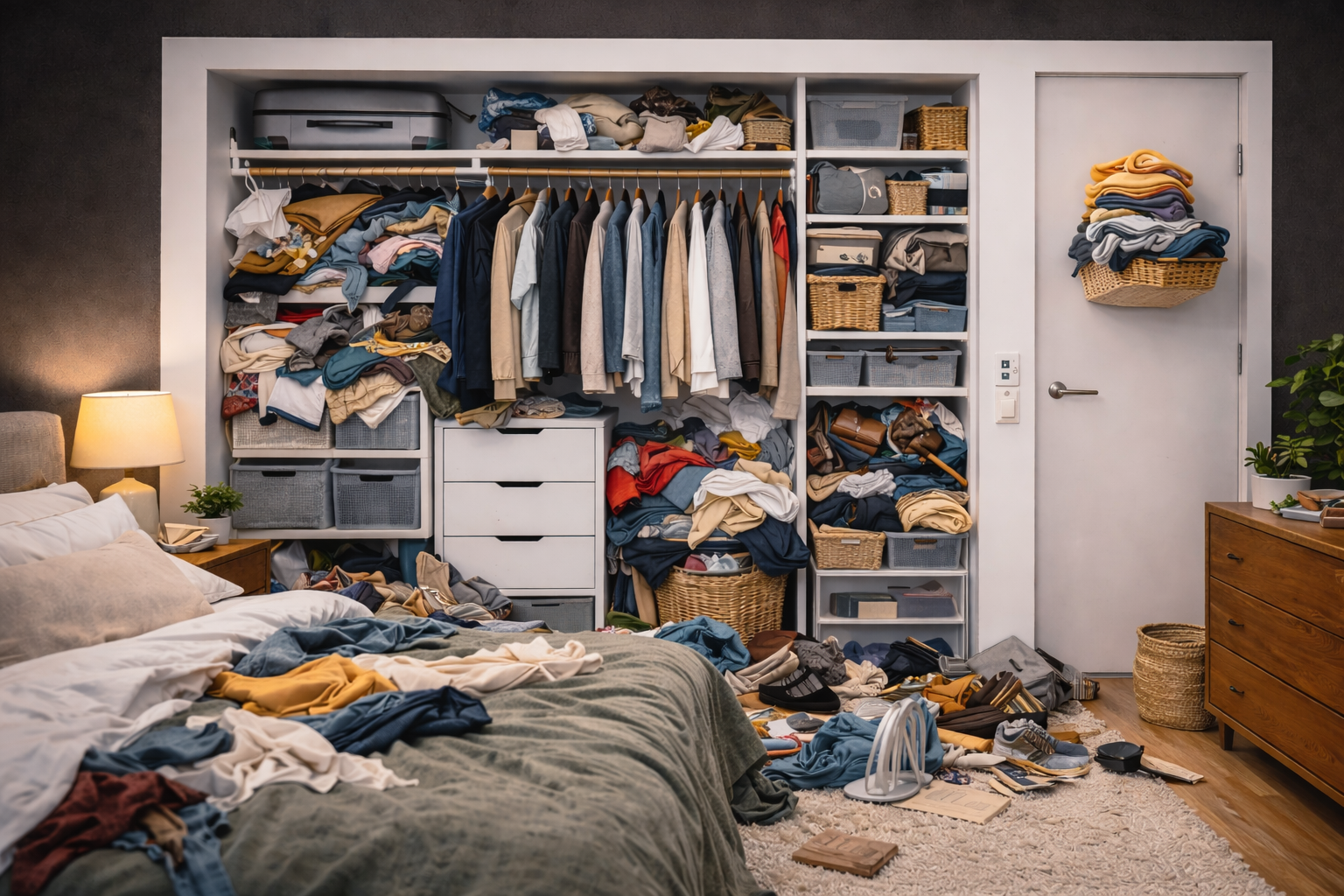
Many people feel like they are constantly organizing their closet, yet it never stays organized. No matter how many times they clean, fold, or rearrange, the mess always seems to return.
This creates frustration and often leads to the belief that the closet itself is the problem.
In reality, most messy closets are not caused by lack of space or poor furniture. They are caused by unresolved organizational problems. When these problems are not identified and addressed directly, any solution becomes temporary.
This article explains why closets stay messy and how to fix the underlying issues that cause disorder to return again and again.
The Difference Between a Messy Closet and a Broken System
A messy closet is often treated as a surface issue. People focus on tidying up what they see instead of understanding why the mess forms in the first place.
A broken system is one that does not support daily behavior. When the system is broken, clutter is inevitable, no matter how often the closet is cleaned.
Fixing the closet requires fixing the system behind it.
Problem 1: Your Closet Does Not Match Your Daily Habits
One of the most common reasons closets stay messy is that they are organized according to ideal behavior, not real behavior.
For example, clothes that are worn daily may be stored in hard-to-reach areas, while rarely used items occupy prime space. This forces constant disruption of the layout.
When organization does not align with how you actually live, mess is guaranteed.
How to Fix It
Observe your habits for a few days. Notice which items you reach for most often and which ones are ignored.
Reorganize the closet so that daily-use items are the easiest to access. Less-used items should move higher, deeper, or into secondary storage.
When the system matches behavior, order becomes natural.
Problem 2: Too Many Items Competing for the Same Space
Closets become messy when too many items fight for limited space. Overcrowding causes clothes to overlap, stacks to collapse, and items to spill into one another.
This problem is not solved by better folding or stronger shelves. It is a capacity issue disguised as an organization issue.
How to Fix It
Set a realistic limit for what the closet can hold comfortably. This often means removing or relocating items that are rarely worn.
Seasonal rotation is one of the most effective fixes. Only items relevant to the current season should occupy primary space.
Reducing competition instantly improves order.
Problem 3: No Clear Zones Inside the Closet
Without zones, closets turn into dumping grounds. Items are placed wherever there is space, not where they belong.
Over time, categories blend together. Shoes mix with folded clothes. Accessories drift across shelves. This lack of structure makes maintenance exhausting.
How to Fix It
Create clear zones based on function. At minimum, define zones for hanging clothes, folded items, shoes, and accessories.
Each zone should have physical boundaries, such as shelves, bins, or dedicated areas. When every item has a home, clutter has nowhere to spread.
Zones turn chaos into structure.
Problem 4: Deep Storage That Hides Items
Deep shelves and packed drawers hide items behind others. When things cannot be seen easily, they are forgotten.
Forgotten items are rarely maintained. They become wrinkled, buried, or replaced by duplicates, increasing clutter.
How to Fix It
Shift toward shallow, front-facing storage. Arrange items so that everything is visible at a glance.
Use shallow shelves, narrow bins, or vertical stacking techniques that keep items accessible.
Visibility is one of the strongest anti-clutter tools.
Problem 5: Too Much Reliance on the Floor
The closet floor often becomes the final dumping spot. Shoes, bags, and random items pile up without structure.
Floor clutter blocks access and creates visual mess that spreads upward.
How to Fix It
Give the floor a defined role. Use slim shoe racks, low-profile drawers, or contained bins.
When floor storage is intentional, it stops acting as a catch-all.
Problem 6: Poor Lighting Makes Disorder Worse
A poorly lit closet hides clutter and makes organization harder to maintain. When visibility is low, items are misplaced and forgotten.
Dark spaces encourage disorder because effort increases.
How to Fix It
Improve lighting using portable or battery-powered options. Even simple lighting dramatically improves clarity and maintenance.
When you can see clearly, you organize more effectively.
Problem 7: Organizing for Looks Instead of Function
Many closets are organized to look good rather than to work well. Aesthetic-focused layouts often fail in daily use.
When organization requires extra steps or constant precision, it breaks down quickly.
How to Fix It
Prioritize ease over appearance. Choose layouts that allow quick access and simple returns.
A closet that works well will look better naturally over time.
Problem 8: No System for Incoming Items
Closets often become messy because there is no plan for new items. Purchases are added wherever space appears.
Without an intake system, clutter accumulates silently.
How to Fix It
Designate an intake area or rule. For example, new items must replace an old one or fit into a specific zone.
Controlling entry prevents overflow.
Problem 9: Lack of Maintenance Routines
Even good systems fail without maintenance. Closets are dynamic spaces that require occasional adjustment.
Without regular check-ins, clutter slowly returns.
How to Fix It
Schedule quick reviews. Seasonal changes, wardrobe shifts, or lifestyle changes should trigger small resets.
Maintenance does not have to be time-consuming when the system works.
Problem 10: Trying to Fix Everything at Once
Many people attempt full closet overhauls in one day. This often leads to fatigue, rushed decisions, and unstable systems.
When everything changes at once, habits struggle to adapt.
How to Fix It
Fix one problem at a time. Start with the issue causing the most friction, such as overcrowding or lack of zones.
Incremental changes last longer than dramatic overhauls.
How to Build a Closet That Stays Organized
A closet that stays organized is not perfect. It is forgiving, flexible, and aligned with real life.
It supports habits instead of fighting them. It makes the right behavior easy and the wrong behavior inconvenient.
When problems are addressed at the system level, order becomes sustainable.
Why Fixing Problems Beats Buying More Organizers
Most closet mess is not caused by lack of products. It is caused by unresolved problems.
Buying more organizers without fixing the root cause adds complexity, not clarity.
Problem-based organization produces lasting results with fewer tools.
Frequently Asked Questions
Why does my closet get messy so fast?
Because the system does not match your habits or capacity.
Do I need to get rid of most of my clothes?
Not necessarily, but you may need to rotate or relocate rarely used items.
Is zoning really that important?
Yes. Zones prevent overlap and reduce maintenance effort.
Can lighting really affect organization?
Absolutely. Visibility directly impacts how well systems are maintained.
What is the most important fix to start with?
Reducing overcrowding and aligning storage with daily use.

Ryan Lewis is a home organization enthusiast who specializes in smart, renter-friendly solutions for small spaces. With a passion for functional design and practical living, Alex shares tips, guides, and ideas to help readers create calm, clutter-free environments—no matter the size of their home.