
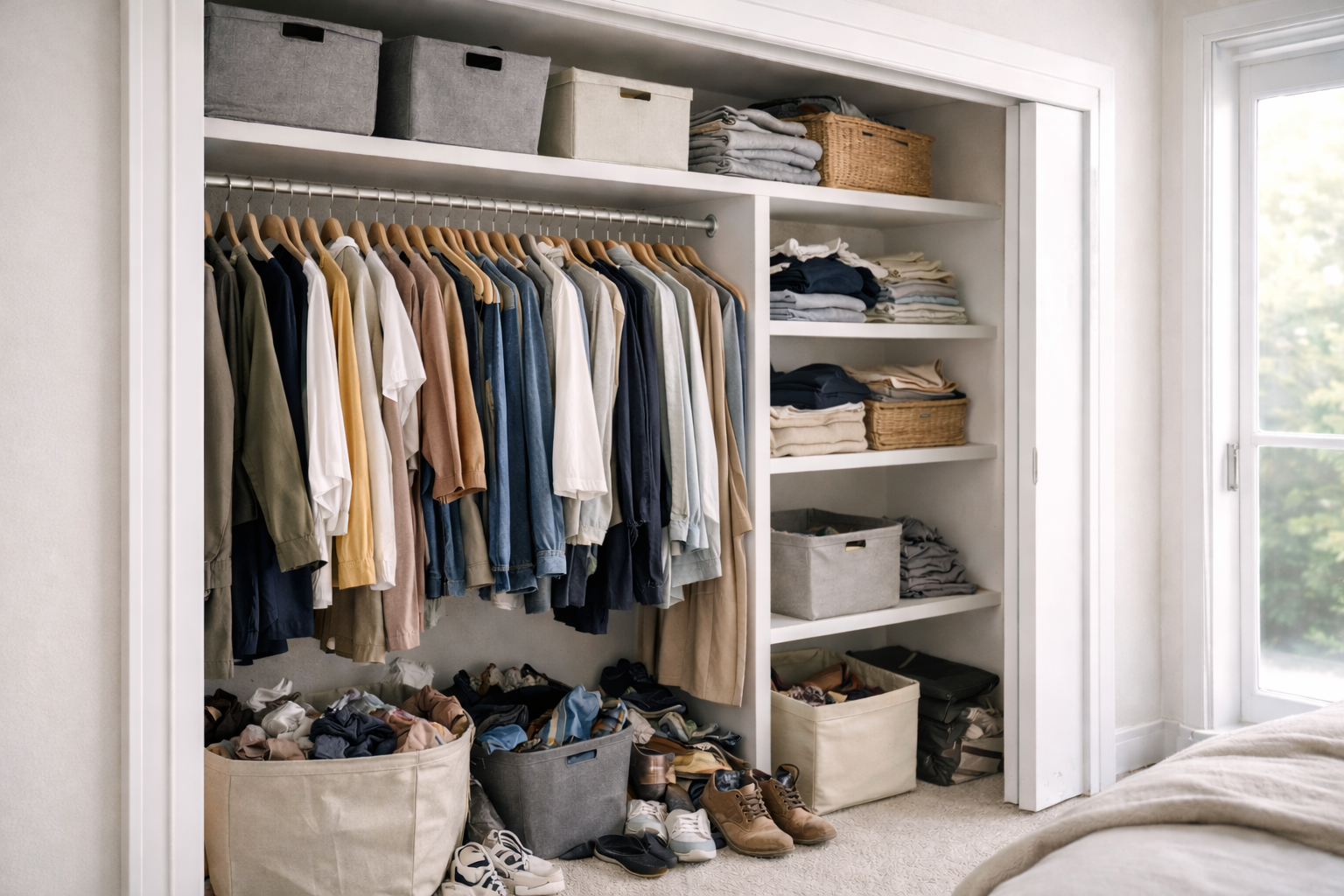
Small closets have a reputation for being impossible. No matter how much effort people put into organizing them, the space never seems to cooperate. Clothes get wrinkled, shoes pile up, and finding anything quickly becomes a challenge. Over time, frustration replaces motivation, and the closet turns into a source of daily stress.
What makes small closets feel impossible is not just their size. It is a combination of unresolved problems that compound over time. When these problems are not addressed directly, any organizing effort becomes temporary. When they are fixed, even the smallest closet can function smoothly.
This article breaks down the most common problems that make small closets feel unmanageable and explains how to fix them in a way that lasts.
Why Small Closets Fail More Quickly Than Large Ones
Large closets can absorb mistakes. Extra space hides inefficiencies, clutter, and poor layout decisions. Small closets cannot. Every mistake is immediately visible.
When space is limited, even small organizational errors create friction. One overcrowded shelf, one poorly placed bin, or one overloaded rod can disrupt the entire system.
Small closets require precision, not perfection. Fixing the right problems makes a bigger difference than adding more storage.
Problem 1: Treating a Small Closet Like a Large One
One of the most common mistakes is organizing a small closet using the same logic as a large one. Deep shelves, bulky bins, and wide drawers are often introduced without considering scale.
In a small closet, these elements consume space faster than expected. They reduce access and make the closet feel tighter.
How to Fix It
Choose storage elements designed for compact spaces. Shallow shelves, slim bins, and narrow drawers work better than large organizers.
Think in terms of scale. Every item should fit the space proportionally.
Problem 2: Overcrowding the Hanging Rod
Hanging rods often become overloaded in small closets. Clothes press together, wrinkle, and block visibility.
Overcrowding also increases friction. Removing one item disrupts several others, making daily use frustrating.
How to Fix It
Reduce hanging density. Switch to slim hangers to free up immediate space.
Separate garments by length and purpose. Fold items that do not benefit from hanging.
Less pressure on the rod improves access and appearance.
Problem 3: No Clear Priority for What Lives in the Closet
Small closets cannot hold everything. When they try to, chaos follows.
Many closets store items that are rarely used alongside daily essentials. This forces constant digging and rearranging.
How to Fix It
Define the closet’s role clearly. Decide which items deserve prime space.
Daily and weekly wear should occupy the most accessible areas. Rarely used items should move higher, deeper, or out of the closet entirely.
Prioritization creates order.
Problem 4: Floor Space Used as a Dumping Ground
In small closets, the floor often becomes the final destination for anything that does not fit elsewhere. Shoes, bags, and random items accumulate quickly.
This blocks access and creates visual clutter that spreads upward.
How to Fix It
Assign a specific function to the floor. Use slim shoe racks, low-profile drawers, or contained bins.
When the floor has structure, it stops acting as a catch-all.
Problem 5: Deep Storage That Hides More Than It Helps
Deep storage seems efficient, but in small closets it usually causes more harm than good. Items stored behind others are forgotten.
Hidden items are rarely maintained. They become clutter rather than storage.
How to Fix It
Favor shallow storage that keeps items visible. Front-facing shelves and narrow bins improve access.
Visibility prevents accumulation and duplication.
Problem 6: Mixing Too Many Categories in One Area
When categories blend, disorder spreads. Shoes mix with folded clothes, accessories migrate across shelves, and boundaries disappear.
This makes maintenance exhausting.
How to Fix It
Create clear zones with physical boundaries. Use shelves, bins, or designated areas for each category.
Zones prevent overlap and make organization intuitive.
Problem 7: Poor Lighting Makes Small Closets Worse
Lighting issues are amplified in small closets. Dark corners hide clutter and reduce motivation to maintain order.
When visibility is low, items are misplaced and forgotten.
How to Fix It
Improve lighting using portable solutions. Battery-powered or motion-activated lights increase clarity without installation.
Better lighting improves usability instantly.
Problem 8: Organizing for Storage Instead of Access
Many small closets are optimized to store as much as possible rather than to be used comfortably.
This leads to tight packing and difficult access.
How to Fix It
Shift focus to access. Items should be easy to reach and return.
Leaving small gaps between items often improves functionality more than adding storage.
Access-first layouts last longer.
Problem 9: No System for Incoming Items
Small closets collapse quickly when new items enter without a plan.
Purchases are added wherever space appears, disrupting balance.
How to Fix It
Create a rule for new items. If something new comes in, something else must move or leave.
This keeps capacity stable.
Problem 10: Trying to Fix Everything at Once
Overhauling a small closet in one session often leads to rushed decisions and unstable systems.
Fatigue sets in, and habits struggle to adapt.
How to Fix It
Fix one problem at a time. Start with the issue causing the most daily friction.
Incremental changes are easier to maintain.
How Small Closets Become Functional Again
Small closets become functional when problems are addressed at the system level. This means aligning layout with behavior, prioritizing access, and respecting capacity limits.
Function comes from clarity, not complexity.
When the system works, maintenance becomes easy.
Why Fixing Problems Beats Buying More Products
Most small closet issues are not product problems. They are system problems.
Buying more organizers without fixing the underlying issues adds layers of complexity.
Problem-based organization delivers lasting results with fewer tools.
Building Confidence in Small Space Organization
Small closets often feel discouraging. People blame the space instead of the system.
When problems are identified and fixed, confidence grows. The closet becomes manageable, predictable, and supportive.
Confidence leads to consistency.
Maintaining Order Over Time
Small closets require ongoing attention, but not constant effort.
Seasonal rotation, occasional decluttering, and small adjustments keep the system healthy.
When the layout supports habits, order lasts.
Why Small Closets Feel Impossible Until They Don’t
Small closets feel impossible because they expose every flaw. Once the main problems are fixed, the space feels surprisingly capable.
The shift is often dramatic. What once felt chaotic becomes calm.
Fixing the right problems changes everything.
Frequently Asked Questions
Why do small closets feel harder to organize?
Because limited space magnifies every inefficiency and mistake.
Do small closets require minimalist wardrobes?
Not necessarily, but they require prioritization and rotation.
Is shallow storage really better than deep storage?
Yes. Visibility and access matter more than depth.
Can lighting really improve small closets?
Absolutely. Better visibility improves maintenance and perception.
What is the best first fix for a small closet?
Reducing overcrowding and defining clear priorities.feature of a small-space closet?
Adaptability over time.

Ryan Lewis is a home organization enthusiast who specializes in smart, renter-friendly solutions for small spaces. With a passion for functional design and practical living, Alex shares tips, guides, and ideas to help readers create calm, clutter-free environments—no matter the size of their home.