
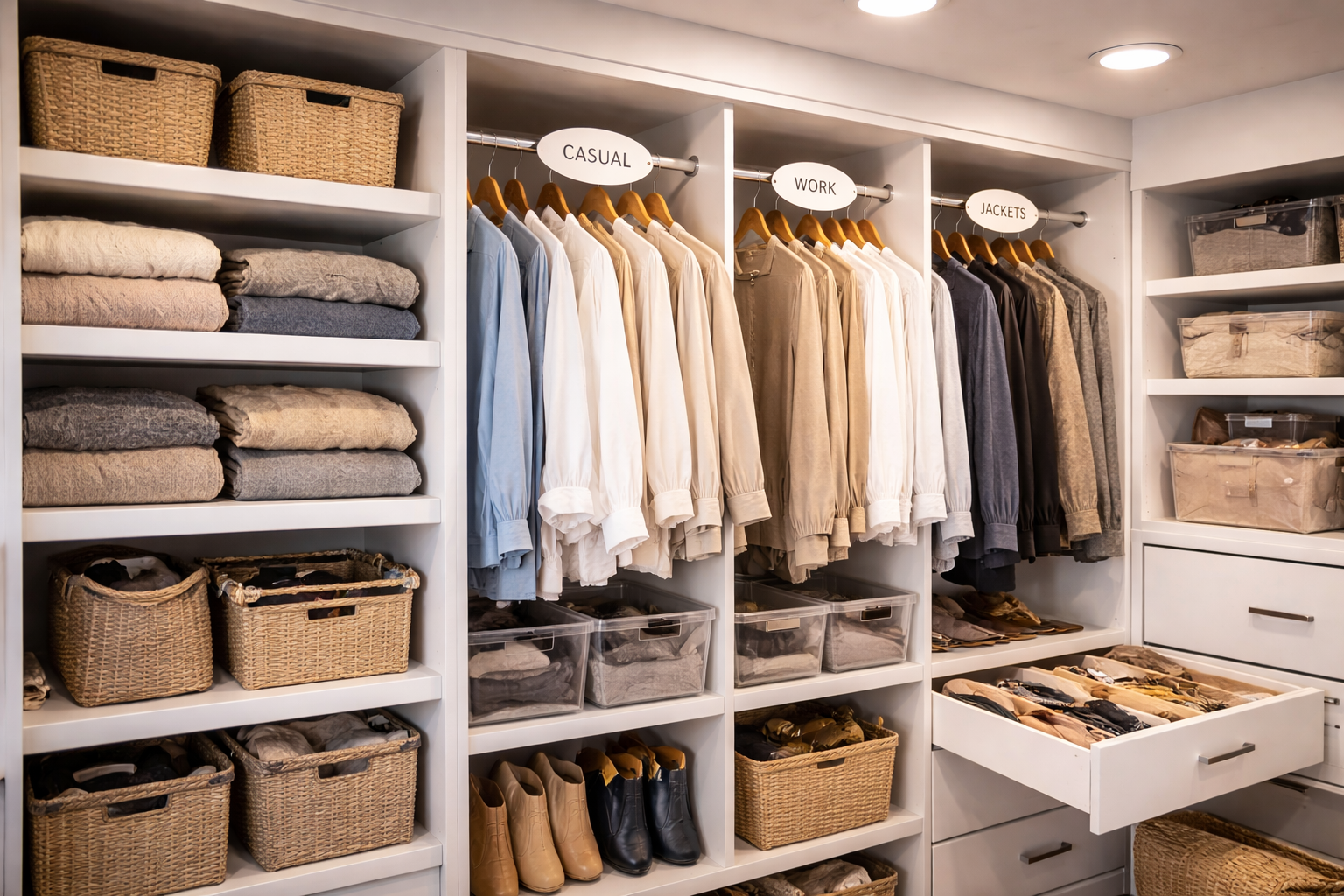
Rental closets are often designed with minimal structure. A single rod, one upper shelf, sometimes no drawers, no internal partitions, and limited flexibility.
While this basic layout may technically hold clothing, it rarely supports efficient organization.
Over time, clothing categories merge, folded stacks collapse, accessories disappear into corners, and daily routines become slower. The issue is not always lack of space. It is lack of separation.
Closet dividers are one of the most underrated renter-friendly solutions available. They create invisible architecture inside an otherwise plain closet.
Without drilling, permanent installation, or violating lease agreements, dividers introduce structure, visual clarity, and long-term control.
When used strategically, dividers transform a rental closet from reactive storage into a systemized layout.
Here is how to use renter-safe closet dividers properly, strategically, and sustainably.
Why Most Rental Closets Fail Organizationally
Rental closets fail for one main reason: they are open compartments without boundaries.
Without boundaries:
Folded stacks lean into each other
Hanging categories blend together
Shoes spread unpredictably
Accessories migrate across shelves
Open horizontal surfaces encourage expansion. Expansion invites clutter.
Built-in closets in custom homes include vertical partitions for a reason. They create stopping points. Rental closets lack those stopping points.
Dividers recreate that structure.
The Psychology Behind Physical Separation
Organization is not only physical. It is behavioral.
When a shelf has no boundary, you unconsciously expand into the entire surface. When a divider limits a section, you edit more carefully.
Dividers create:
Capacity awareness
Category control
Visual accountability
Maintenance discipline
If your sweater section is limited to one divided area, you are less likely to overcrowd it.
Physical boundaries influence decision-making.
Shelf Dividers: The Foundation of Structured Folding
One of the most common rental closet problems is collapsing folded stacks.
Sweaters lean sideways.
T-shirts spill into adjacent piles.
Jeans become unstable.
Shelf dividers slide vertically onto existing shelves and create independent compartments. They require no screws, no adhesives, and no tools.
Benefits include:
Maintained stack alignment
Cleaner visual appearance
Easier removal of single items
Prevention of leaning
When shelves are divided into controlled sections, folded clothing maintains shape longer and requires fewer resets.
This is one of the simplest upgrades with the highest visual impact.
Hanging Rod Dividers: Category Clarity Without Construction
Hanging rods in rental closets are typically uninterrupted bars. Over time, workwear, casual clothing, and outerwear blend into one long row.
Rod dividers act as visual markers between categories.
They:
Slide directly onto the rod
Require no installation
Create immediate separation
Improve daily outfit selection
You can divide by:
Work
Casual
Formal
Seasonal
Outerwear
Even simple labeled markers dramatically reduce morning friction.
When categories are clearly separated, decision fatigue decreases.
Adjustable Tension Dividers for Deep Shelves
Many rental closets have deep top shelves that become chaotic because items are stacked too far back.
Adjustable tension dividers expand horizontally between shelf walls and create vertical segmentation.
They are ideal for:
Handbags
Bulkier sweaters
Backup linens
Seasonal bins
Because they rely on pressure rather than hardware, they remain lease-safe.
Deep shelves require segmentation. Without it, back-of-shelf clutter accumulates unnoticed.
Drawer Dividers for Micro-Organization
If your rental closet includes drawers, internal dividers are essential.
Without separation:
Socks mix
Belts tangle
Jewelry overlaps
Scarves knot
Expandable drawer dividers create structured compartments inside existing drawers.
They:
Prevent shifting
Maintain folded precision
Support consistent layout
Internal organization protects external structure.
Drawers without dividers often become hidden clutter zones.
Visual Dividers Using Matching Storage Containers
Dividers do not always need to be rigid panels.
Matching bins can serve as structured separation.
For example:
One bin for gym clothing
One for winter accessories
One for travel items
When containers are uniform in color and size, they visually segment space.
Visual segmentation is often as powerful as physical separation.
Consistency amplifies control.
Using Dividers to Control Volume
One overlooked advantage of dividers is volume limitation.
When each category has a defined compartment, you immediately see when it is full.
This creates a natural editing trigger.
If the workwear section no longer fits comfortably within its divider boundaries, it signals that decluttering may be necessary.
Without boundaries, excess spreads invisibly.
Dividers create capacity awareness.
Frequency-Based Sectioning
Closet dividers can also be used to organize by frequency of use.
Create clear divisions for:
Daily rotation
Weekly rotation
Occasional wear
Seasonal storage
When frequently worn items are grouped in accessible sections, efficiency increases.
Less-used categories can occupy secondary divided areas.
Function-based separation enhances workflow.
Dividers in Small Closets vs Large Closets
In small closets, dividers prevent overcrowding.
In larger closets, dividers prevent sprawl.
Both scenarios benefit.
Small spaces require strict segmentation.
Large spaces require containment discipline.
Regardless of size, separation improves sustainability.
Preventing the “Pile Effect”
The pile effect occurs when folded clothing becomes one continuous mass.
Dividers break the pile effect by forcing segmentation.
Instead of one unstable stack of 20 sweaters, you create four controlled stacks of five.
Smaller stacks are:
Easier to maintain
Less likely to collapse
Visually cleaner
Micro-organization strengthens macro-organization.
Combining Dividers With Lighting
Lighting enhances the effectiveness of dividers.
Under-shelf LED strips highlight separated stacks and make compartments more visible.
When divisions are clearly illuminated, maintenance becomes easier.
Visibility prevents neglect.
Dark shelves encourage disorder.
Avoiding Over-Segmentation
While dividers are powerful, overuse can create rigidity.
Too many small compartments make flexibility difficult.
Start with broad category separation.
Refine only when necessary.
Balance is essential.
Maintenance Strategy for Divider Systems
Dividers create structure, but maintenance preserves it.
Implement:
Weekly five-minute resets
Monthly review of full sections
Seasonal rotation
When divider boundaries are respected consistently, long-term organization becomes sustainable.
Structure without maintenance eventually weakens.
How Dividers Create a Built-In Feel
Custom closets include vertical partitions by design.
By adding renter-safe dividers, you simulate architectural segmentation.
The closet begins to feel:
Intentional
Structured
Professional
Permanent
Even though nothing is drilled or permanently installed.
Perception changes when structure exists.
Final Thoughts: Structure Is Stronger Than Space
Most rental closet problems are not caused by lack of space. They are caused by lack of boundaries.
Renter-friendly closet dividers introduce those boundaries without altering walls or violating leases.
They:
Prevent stack collapse
Separate categories
Limit overflow
Enhance visibility
Improve daily routines
Small structural additions create major functional improvements.
When your closet has internal architecture, even a basic rental layout can feel refined and controlled.
Organization is not about adding more space.
It is about creating defined space.

Ryan Lewis is a home organization enthusiast who specializes in smart, renter-friendly solutions for small spaces. With a passion for functional design and practical living, Alex shares tips, guides, and ideas to help readers create calm, clutter-free environments—no matter the size of their home.