
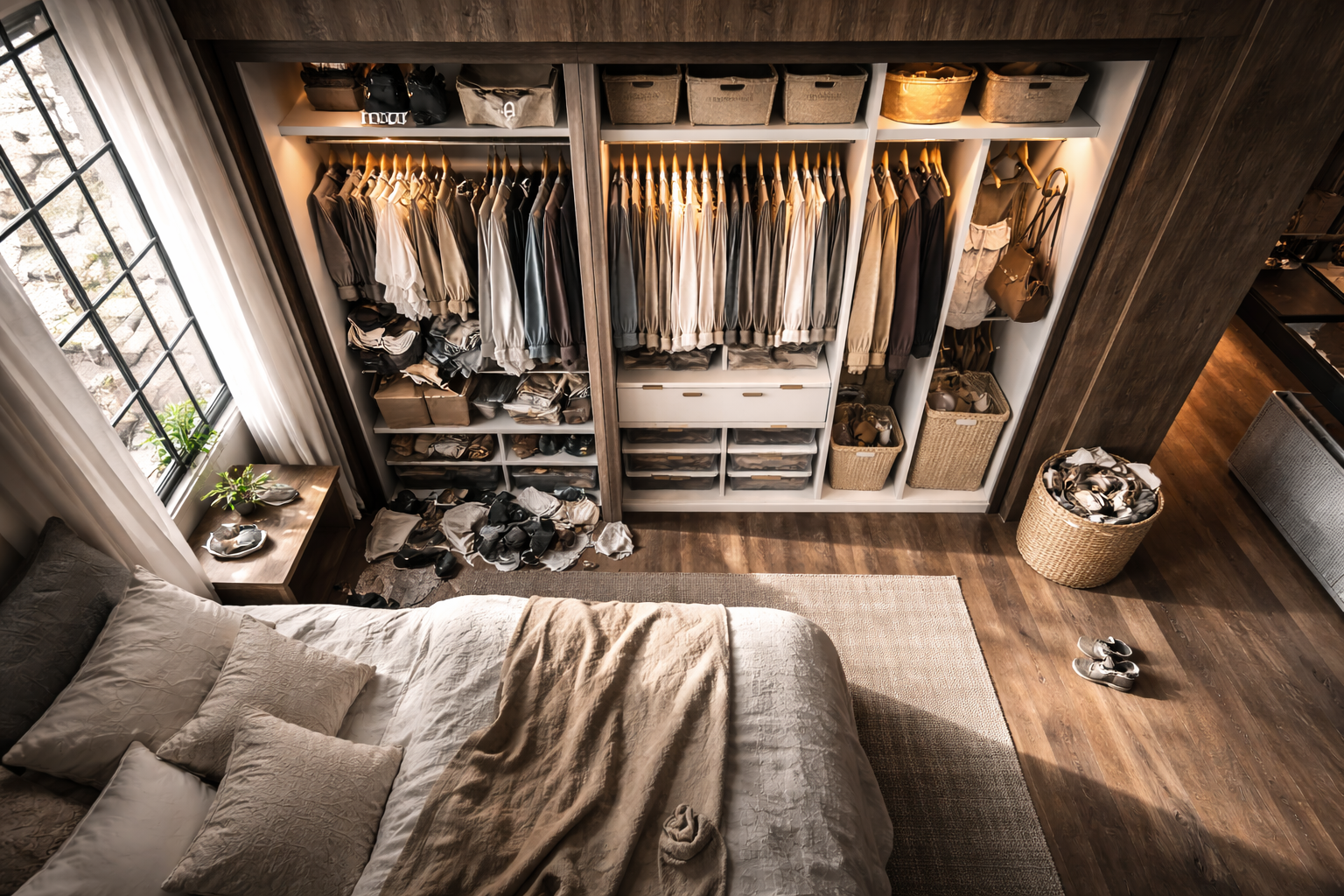
In a one-room apartment, every square foot carries multiple responsibilities. Your bedroom may also function as your office.
Your living area may double as a dining space. Storage is no longer just about placing items somewhere out of sight. It becomes a structural element that influences comfort, movement, and daily efficiency.
Closets in one-room apartments often struggle under pressure. They are expected to store clothing, accessories, shoes, seasonal items, and sometimes even non-clothing essentials.
When poorly designed, they overflow into visible areas, making the apartment feel cramped and disorganized.
The solution is not adding bulky furniture. It is designing a multi-functional closet system that maximizes vertical space, defines zones clearly, and maintains visual lightness.
Here is a complete strategic guide to designing a closet that works harder without occupying more space.
Why Multi-Functionality Matters in One-Room Living
In traditional homes, closets serve one purpose: storing clothes. In compact apartments, they must serve several.
A well-designed closet in a one-room apartment should:
Store clothing efficiently
Hide visual clutter
Support seasonal rotation
Provide quick daily access
Maintain a clean visual presence
When closets lack structure, the entire apartment absorbs the chaos.
In small spaces, storage is architecture.
Step 1: Analyze Your Real Storage Needs
Before redesigning your closet, evaluate what truly needs to live inside it.
Categorize your belongings into:
Daily essentials
Workwear
Occasional clothing
Shoes
Accessories
Non-clothing items currently stored inside
Many one-room apartments fail because closets try to hold too much.
Remove anything that can be stored elsewhere, such as:
Documents
Extra linens
Rarely used electronics
The closet should prioritize clothing and clothing-related accessories.
Step 2: Divide the Closet Into Functional Bands
Think vertically.
Divide your closet into three horizontal bands:
Upper band: long-term or seasonal storage
Middle band: daily rotation
Lower band: shoes and accessories
This layered structure prevents mixing categories.
When categories mix, maintenance collapses.
Layering creates structure without adding furniture.
Step 3: Install Double Hanging Rods
One of the most powerful upgrades in small closets is installing a second hanging rod.
If your current rod is high, you are likely wasting 40% of vertical space.
Install a tension rod beneath the primary rod for:
Shirts
Blouses
Folded pants
Light jackets
Reserve the upper rod for:
Long dresses
Coats
Formal garments
Double hanging doubles capacity without increasing footprint.
Step 4: Integrate Hidden Upper Storage
Ceiling-level shelves are valuable in one-room apartments.
Use matching labeled bins for:
Off-season clothing
Travel items
Special occasion wear
Keep upper storage lightweight and clearly marked.
High storage zones should not require daily access.
Separation by frequency preserves efficiency.
Step 5: Convert Closet Doors Into Functional Panels
Closet doors are underused surfaces.
Add:
Over-the-door hanging organizers
Slim hook systems
Accessory panels
Use them for:
Belts
Scarves
Small bags
Lightweight accessories
This converts flat surfaces into storage without adding bulk.
In compact apartments, walls must work.
Step 6: Maintain Clear Floor Space
Closet floors in one-room apartments should remain visually open.
Use:
Stackable vertical shoe boxes
Slim tiered racks
Under-shelf shoe organizers
Avoid piling shoes directly on the floor.
Visible floor depth increases perceived space.
Perception matters in compact living.
Step 7: Use Drawer Dividers for Internal Control
If your closet includes drawers, internal segmentation is critical.
Without dividers:
Socks tangle
Accessories mix
Small items disappear
Install expandable dividers to maintain micro-structure.
Internal organization prevents overflow.
Hidden chaos spreads if ignored.
Step 8: Establish a Rotational System
One-room apartments cannot support unlimited wardrobe expansion.
Adopt:
Seasonal rotation
One-in-one-out rule
Quarterly wardrobe audits
Keep only current-season clothing in the daily rotation zone.
Rotation preserves functionality.
Step 9: Use Lighting to Elevate Functionality
Dark closets feel smaller and harder to manage.
Install:
Rechargeable LED strips
Motion-sensor lights
Neutral white bulbs
Good lighting improves:
Visibility
Maintenance
Speed of outfit selection
Bright closets feel intentional.
Step 10: Avoid Over-Compartmentalization
While zoning is important, too many small compartments can restrict flexibility.
Start with broader zones.
Refine only when friction appears.
Simplicity sustains longevity.
Step 11: Maintain Visual Uniformity
Uniform hangers and bins create cohesion.
Choose:
One hanger style
Matching storage containers
Consistent label formatting
Visual harmony reduces cognitive stress.
Small apartments amplify visual noise quickly.
Consistency protects calm.
Step 12: Incorporate a Quick-Access Zone
Every one-room closet should include a quick-access section near the door.
Use it for:
Daily jacket
Current handbag
Frequently worn shoes
Quick-access zones prevent internal disruption.
Efficiency reduces disorder.
Step 13: Protect Accessibility
Do not overfill rods or shelves.
Leave small gaps between categories.
Spacing prevents compression.
Compression increases wrinkles and frustration.
Breathing room is functional, not decorative.
Step 14: Create a Backup Containment Plan
If overflow begins, have a system ready.
Use:
Under-bed containers
Slim rolling storage
Vacuum-sealed bags
Closet pressure must be managed.
Planning prevents emergency clutter.
Step 15: Think in Cubic Volume, Not Surface Area
Small closets require three-dimensional thinking.
Instead of focusing only on shelves, consider:
Height
Depth
Layering
Under-shelf baskets
Cascading hangers
Vertical shoe stacks
Cubic optimization multiplies efficiency.
Step 16: Weekly Maintenance Ritual
In one-room apartments, minor disorganization becomes visible quickly.
Schedule a weekly reset:
Realign hangers
Return displaced items
Refold stacks
Clear floor space
Five minutes weekly prevents hours monthly.
Consistency maintains balance.
Psychological Benefits of Multi-Functional Closet Design
Structured closets reduce daily friction.
When everything has a defined place:
Morning routines accelerate
Clutter anxiety decreases
Apartment flow improves
Multi-functional design supports mental clarity.
Clarity enhances productivity.
Final Thoughts: Design Smarter, Not Larger
You do not need more furniture to improve your closet.
You need:
Layered zoning
Vertical optimization
Clear frequency segmentation
Uniform visual systems
Consistent maintenance
In one-room apartments, closets are not secondary spaces.
They are structural anchors.
When designed intelligently, they absorb clutter, maintain calm, and protect the openness of your entire apartment.
Small spaces demand strategy.
Strategy creates freedom.

Ryan Lewis is a home organization enthusiast who specializes in smart, renter-friendly solutions for small spaces. With a passion for functional design and practical living, Alex shares tips, guides, and ideas to help readers create calm, clutter-free environments—no matter the size of their home.