
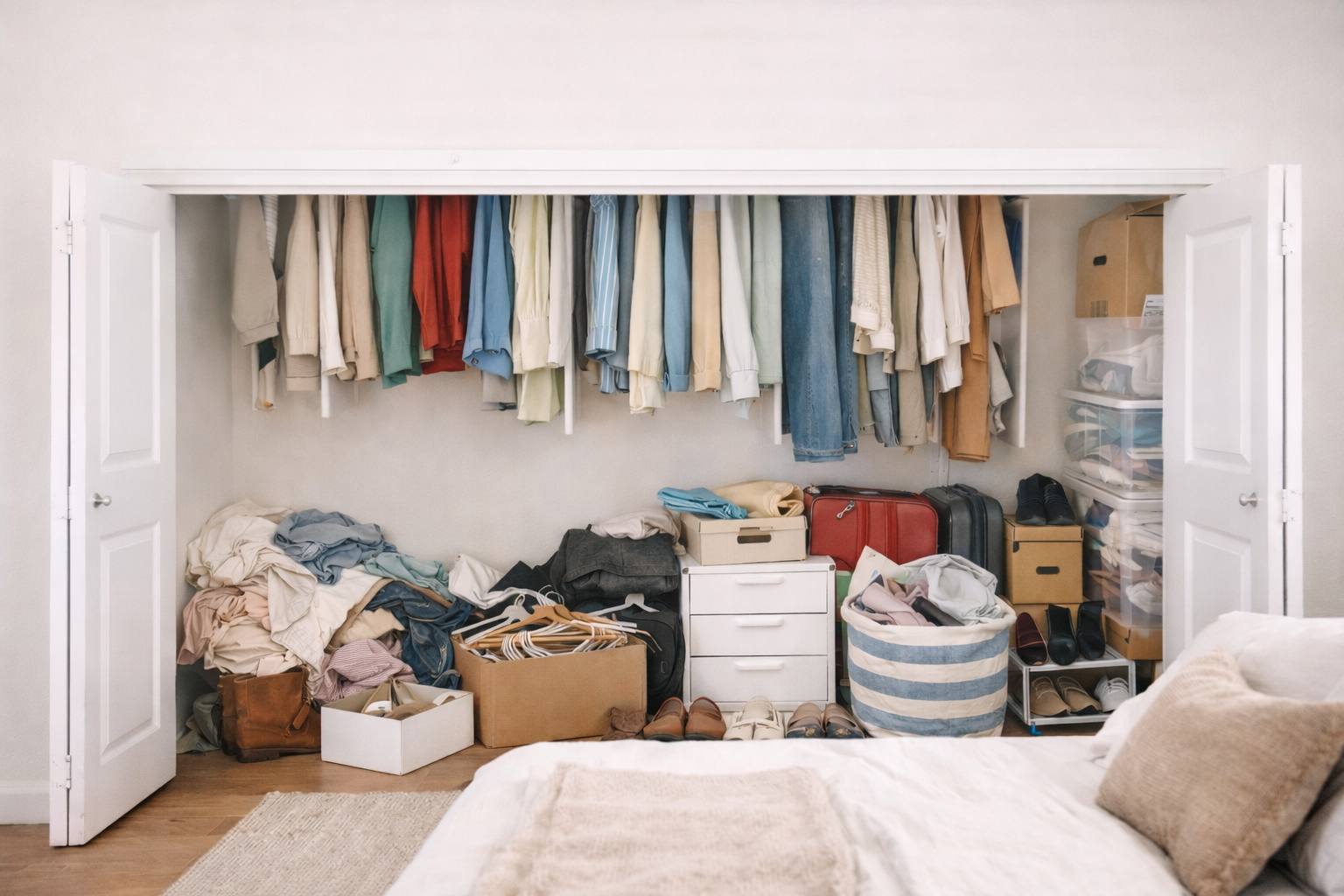
Closet floor space is often treated as leftover territory. After shelves, rods, and drawers are installed, whatever remains on the floor is expected to absorb the excess.
Shoes pile up, bags accumulate, bins slide around, and soon the lower zone becomes the most chaotic part of the closet.
This is not a personal failure. It is a structural misunderstanding.
The closet floor is not secondary space. It is a structural zone with unique constraints and behaviors.
When it is ignored, disorder spreads upward. When it is designed intentionally, it stabilizes the entire system.
This article explains why closet floor space is so frequently misused, how its structural role differs from upper zones, and how to design the floor as a functional foundation rather than a dumping ground.
The Closet Floor Is Not Neutral Space
Every structural zone has physics. The floor is governed by gravity, contact, and movement.
Items placed on the floor are more likely to be bumped, kicked, or displaced. They also carry more visual weight, because the eye naturally registers clutter near the ground as disorder.
Treating the floor as neutral ignores these forces.
Why Floor Clutter Feels Worse Than Shelf Clutter
Clutter on shelves feels contained. Clutter on the floor feels invasive.
This is because floor clutter interrupts movement. It affects how you step, turn, and reach.
Even small amounts of floor clutter can make a closet feel unusable.
The Floor as the Structural Base of the Closet
The floor supports everything above it. When the floor zone is unstable, upper systems are stressed.
Shoes blocking access make it harder to reach hanging clothes. Bags piled on the floor interfere with drawers. Overflow from shelves often lands downward.
A weak base creates cascading failure.
Why People Overload the Floor Zone
People overload the floor because it feels forgiving. There are no height limits and no fixed boundaries.
This apparent flexibility is deceptive.
Without boundaries, items spread laterally and vertically until access collapses.
The Difference Between Designed Floor Space and Residual Floor Space
Designed floor space has a role. Residual floor space is whatever is left after everything else is planned.
Most closets rely on residual floor space.
Residual space becomes clutter by default.
Floor Space Behaves Differently From Shelf Space
Shelves limit stacking height. The floor does not.
Shelves constrain width. The floor often does not.
These differences change how items behave.
On the floor, items migrate, merge, and sprawl.
Why Floor Storage Needs More Structure, Not Less
Because the floor is unconstrained, it requires more intentional structure than shelves.
Boundaries, containers, and assigned roles are essential.
Unstructured floor space will always degrade.
Common Floor Storage Mistakes
Several mistakes appear repeatedly in closets of all sizes.
Shoes scattered without limits
Bags piled on top of each other
Bins placed without alignment
Items stacked too high
These mistakes share one cause: lack of defined structure.
Floor Zones Should Be Fewer, Not More
Many closets create multiple overlapping floor functions.
Shoes here, bags there, overflow everywhere.
This fragmentation creates confusion.
Fewer, clearly defined floor zones perform better.
Assigning a Single Role to Each Floor Zone
Each floor zone should have one role only.
For example:
Shoes only
Bags only
Luggage only
Mixed roles invite chaos.
Single-role zones maintain clarity.
Why Shoes Dominate Floor Space
Shoes are heavy, rigid, and awkwardly shaped.
They naturally migrate to the floor.
Without a clear shoe strategy, shoes overwhelm the entire lower zone.
Shoe Storage and Floor Stability
Shoes stored loosely create instability.
They shift, tilt, and block access.
Structured shoe storage stabilizes the floor visually and physically.
The Vertical Impact of Poor Floor Planning
When the floor is crowded, upper zones suffer.
You hesitate to bend. You avoid accessing lower shelves. You pile items above instead.
Poor floor planning pushes clutter upward.
Why Tall Floor Storage Often Fails
Tall bins or stacked boxes on the floor block sightlines and access.
They turn the floor into a wall.
This reduces usable width and depth.
Tall floor storage should be rare and intentional.
Low-Profile Floor Storage as a Structural Advantage
Low-profile storage preserves sightlines and access.
It keeps the floor visually light.
Lower height increases stability.
Floor Storage and Access Pathways
Closets require movement paths.
Floor clutter blocks these paths, forcing awkward reaches.
Access pathways must be preserved intentionally.
Why Floor Space Should Support, Not Compete With, Upper Storage
The floor should make upper storage easier to use.
If the floor competes for space, the system is unbalanced.
Support means containment and predictability.
Floor Storage and Weight Distribution
Heavy items belong low.
This is not only practical but structural.
Weight placed high destabilizes systems and increases wear.
The floor is the correct place for heavy items.
Why Floor Zones Need Hard Boundaries
Boundaries prevent sprawl.
They define where items belong and where they do not.
Boundaries can be physical or visual.
Without them, the floor expands uncontrollably.
Containers Versus Open Floor Storage
Open storage invites accumulation.
Containers impose limits.
Limits are protective.
Containers turn the floor into defined territory.
The Problem With Using the Floor for Overflow
Overflow is a warning signal.
Using the floor as overflow hides the signal.
The problem remains unresolved.
Floor overflow should be temporary, not permanent.
Floor Storage and Cleaning Behavior
Floor clutter discourages cleaning.
Dust accumulates. Maintenance is avoided.
Clear floors support cleanliness.
Cleanability is a structural benefit.
Why Floor Design Matters More in Small Closets
Small closets magnify floor mistakes.
A single misplaced bin can block half the space.
Precision matters more when margins are small.
Using the Floor to Create Visual Calm
A clear or orderly floor anchors the entire closet visually.
Even if shelves are full, a clean floor creates calm.
The eye reads from the ground up.
Floor Storage and Visual Weight
Items on the floor feel heavier visually.
Dark or bulky items amplify this effect.
Floor zones should be visually restrained.
How Floor Planning Reduces Daily Friction
When floor zones are predictable, movement is easier.
You step, reach, and retrieve without hesitation.
Ease of movement reduces friction.
Diagnosing Floor-Related Failure
Signs of floor failure include:
Blocked access
Frequent kicking or shifting
Stacking instability
Avoidance of lower zones
These are structural signals.
Fixing Floor Problems Without Adding Storage
Most floor problems are solved by removing items or redefining roles.
Adding storage rarely helps.
Clarity beats capacity.
Why Less Floor Storage Often Works Better
Reducing floor storage increases access and visual calm.
It also forces better use of vertical zones.
Less can be more.
Designing the Floor as a Foundation
The floor should stabilize the system.
It should not absorb chaos.
Foundation design is intentional design.
When Floor Storage Is Appropriate
Floor storage works best for:
Shoes
Heavy bins
Luggage
Rarely accessed items
It fails for daily clutter.
Floor Space and Long-Term Maintenance
Good floor design reduces daily effort.
Bad floor design requires constant correction.
Maintenance is structural.
The Structural Rule of Closet Floors
If items block your feet, the system is overloaded.
Movement is a priority.
Why Floor Awareness Changes Everything
Once the floor is treated as a structural zone, decisions change.
You stop piling and start planning.
Awareness replaces reaction.
Frequently Asked Questions
Should anything be stored directly on the floor
Yes, but only items with defined roles and boundaries.
Why does floor clutter spread so fast
Because the floor has no natural constraints.
Are tall bins on the floor a good idea
Rarely. They block access and visibility.
What is the first floor fix to try
Remove items until movement paths are clear.
Can floor design improve the whole closet
Yes. A stable base improves everything above it.

Ryan Lewis is a home organization enthusiast who specializes in smart, renter-friendly solutions for small spaces. With a passion for functional design and practical living, Alex shares tips, guides, and ideas to help readers create calm, clutter-free environments—no matter the size of their home.