
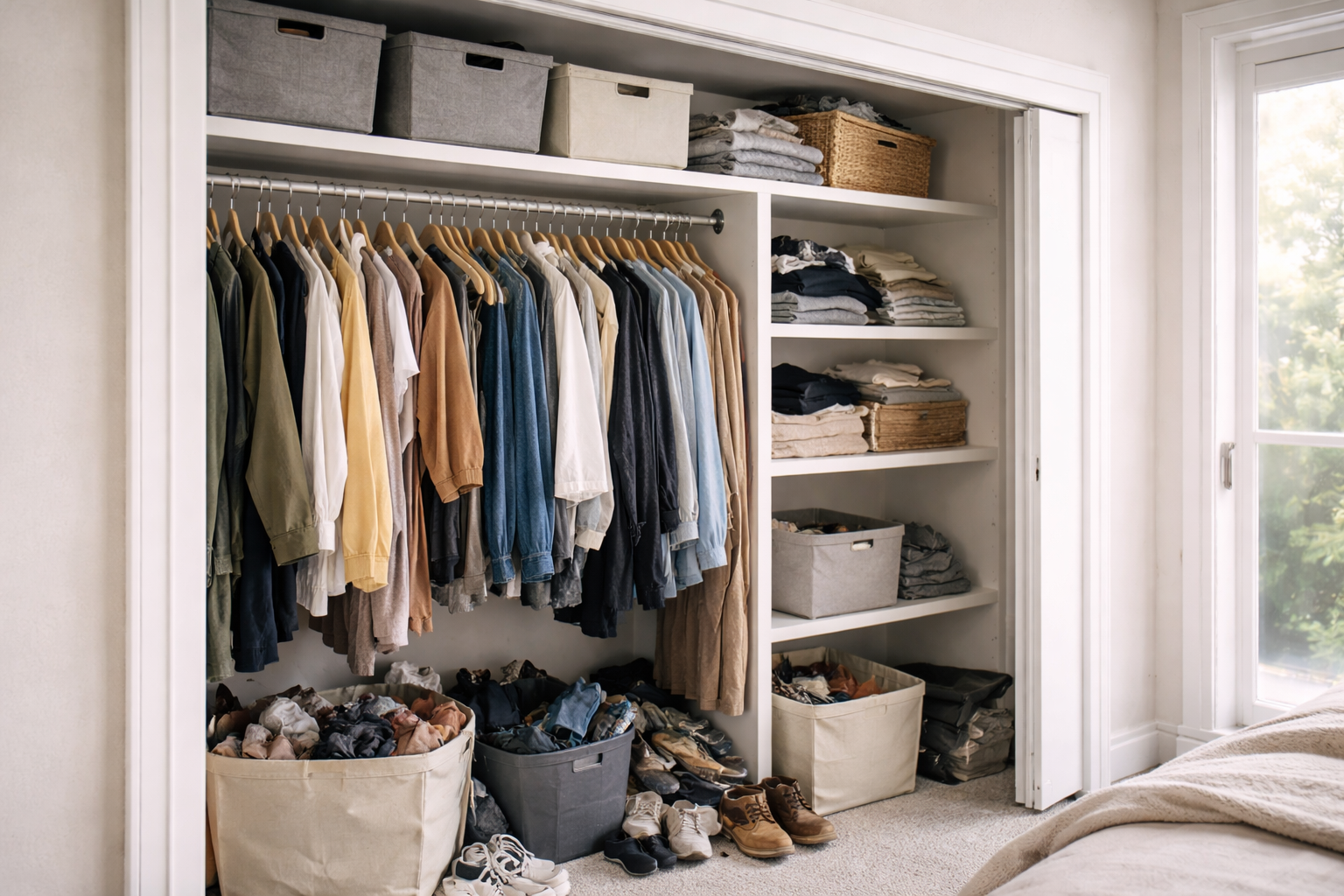
Many people blame themselves for closet clutter. They assume they are lazy, disorganized, or incapable of maintaining order.
Over time, this belief becomes internalized. The messy closet turns into proof of a personal flaw rather than a design failure.
This interpretation is both unfair and inaccurate. Closet clutter is rarely caused by laziness. In most cases, it is the predictable outcome of a system that works against human behavior instead of supporting it.
This article explains why closet clutter is not a personal failure, how most closets are unintentionally designed to fail, and what actually works when you stop blaming yourself and start fixing the system.
Why We Moralize Closet Clutter
Clutter is often framed as a character issue. Organized people are seen as disciplined. Disorganized people are seen as careless. This moral framing creates shame, which prevents clear problem-solving.
Closets become a private space where this shame plays out daily. Every time you see the mess, it feels like evidence of inadequacy.
The truth is simpler and less personal. Most closets are poorly designed environments placed under unrealistic expectations.
Human Behavior Is Predictable and Closets Ignore It
Human behavior follows patterns. We seek ease, avoid friction, and default to the path of least resistance, especially when tired or rushed.
Most closets ignore these patterns completely. They assume high energy, perfect memory, and consistent motivation. When real humans interact with these systems, clutter appears.
Clutter is not rebellion. It is adaptation.
Problem 1: Closets Require Too Much Precision
Many closets demand precision to stay organized. Clothes must be folded exactly. Items must be returned to specific locations. Categories must be respected strictly.
Precision systems fail under normal life conditions.
Why Precision Fails in Real Life
People are tired in the evening. They are rushed in the morning. Laundry piles arrive in batches. Precision requires energy that is not always available.
When precision drops, the system collapses.
Structural Fix
Design for approximation, not precision. Broad zones instead of narrow categories. Flexible storage instead of exact placement.
A system that tolerates imperfection stays functional.
Problem 2: Closets Punish Speed
Speed is essential in daily life. Many closets punish speed by making fast actions disruptive.
When putting something away quickly creates mess, people stop trying.
How This Creates Clutter
Clothes get draped over chairs. Shoes stay on the floor. Accessories collect on surfaces outside the closet.
This is not laziness. It is efficiency.
Structural Fix
Make fast actions safe. Storage should allow quick placement without damaging the system.
If speed does not break organization, clutter decreases naturally.
Problem 3: No Immediate Reward for Good Behavior
Human brains respond to feedback. Many closets provide negative feedback for effort and no reward for consistency.
You organize the closet, and within days it looks messy again. The effort feels wasted.
Why This Breaks Motivation
When effort does not produce visible or lasting results, the brain disengages.
Structural Fix
Create visible stability. Systems should hold their shape longer so effort feels rewarded.
Resilient layouts reinforce positive behavior.
Problem 4: The Closet Competes With Attention
Modern life is cognitively demanding. Closets that require attention compete with already limited mental resources.
When a system asks you to remember rules, locations, and sequences, it loses.
Structural Fix
Reduce cognitive demand. Storage should be intuitive. Locations should feel obvious.
A closet should not need instructions.
Problem 5: Clutter Is a Signal of Mismatched Capacity
When a closet constantly overflows, it is signaling that capacity and demand are misaligned.
This is not a willpower issue. It is a volume issue.
Why This Happens
Closets often hold more than they can comfortably manage. Items fight for space. Boundaries blur.
Structural Fix
Reduce visible density. Rotate items. Create margins.
Capacity limits must be respected for order to exist.
Problem 6: Closets Ignore Transition Moments
Life is full of transitions. Work to home. Clean to dirty. Worn to unworn.
Many closets do not provide transitional spaces, forcing items into inappropriate zones.
Resulting Behavior
Clothes pile up in limbo. Not clean enough to store, not dirty enough to wash.
Structural Fix
Design transition zones. A place for “worn but not dirty.” A space for incoming laundry.
When transitions are supported, clutter decreases.
Problem 7: Emotional Weight of Clothing Is Ignored
Clothes are not neutral objects. They carry identity, memory, and expectation.
Closets that mix emotional items with functional ones create internal conflict.
How This Creates Clutter
People avoid dealing with emotionally charged items. They get pushed aside rather than processed.
Structural Fix
Separate emotional storage from functional storage. Archive items away from daily-use zones.
This reduces emotional friction.
Problem 8: The Closet Does Not Adapt to Change
Bodies change. Jobs change. Lifestyles change.
Closets often remain frozen in a previous version of life.
Why This Leads to Clutter
Outdated items block relevant ones. The system no longer reflects reality.
Structural Fix
Build adaptability. Use modular storage. Review layout periodically.
Living systems outperform fixed ones.
Problem 9: The Closet Assumes Equal Value for All Items
Most closets treat all items as equal. In reality, some items are used constantly and others rarely.
Equal treatment creates inefficiency.
Structural Fix
Prioritize by frequency. High-use items deserve prime space.
This reduces friction and clutter.
Problem 10: Shame Prevents Problem Solving
When clutter is framed as laziness, people stop experimenting. They blame themselves instead of the system.
Shame freezes improvement.
Structural Fix
Remove moral judgment. Treat clutter as data.
What you see is information about what is not working.
Reframing Closet Clutter as Feedback
Clutter is not failure. It is feedback.
It tells you where friction exists, where capacity is exceeded, and where behavior is unsupported.
When you listen to clutter instead of fighting it, solutions emerge.
Designing Closets That Work With Humans
Human-centered closets share common traits.
They are forgiving.
They are flexible.
They reduce decisions.
They absorb disruption.
These traits matter more than aesthetics.
Why Blame-Free Organization Works Better
When blame is removed, experimentation begins.
You test layouts. You adjust zones. You learn what works.
Progress replaces guilt.
How Letting Go of Laziness Narratives Improves Life
When you stop seeing clutter as a personal flaw, stress decreases.
You regain agency. You focus on design instead of self-criticism.
Organization becomes constructive, not punitive.
Building Systems That Respect Energy Levels
Good systems work on low-energy days.
They do not require perfection. They recover easily.
Energy-aware design is the foundation of lasting order.
What a Supportive Closet Feels Like
A supportive closet feels quiet.
It does not demand attention. It does not judge. It does not overwhelm.
It simply works.
Frequently Asked Questions
Is clutter really not about laziness?
In most cases, no. It is about friction, capacity, and poor system design.
Why do some people seem naturally organized?
Their systems align better with their behavior, often unconsciously.
Can changing the system really change habits?
Yes. Behavior follows environment more than intention.
Do I need to buy new organizers?
Not necessarily. Reorganizing zones and priorities often helps more.
What is the first step to fixing chronic clutter?
Stop blaming yourself and observe where the system fails.

Ryan Lewis is a home organization enthusiast who specializes in smart, renter-friendly solutions for small spaces. With a passion for functional design and practical living, Alex shares tips, guides, and ideas to help readers create calm, clutter-free environments—no matter the size of their home.