
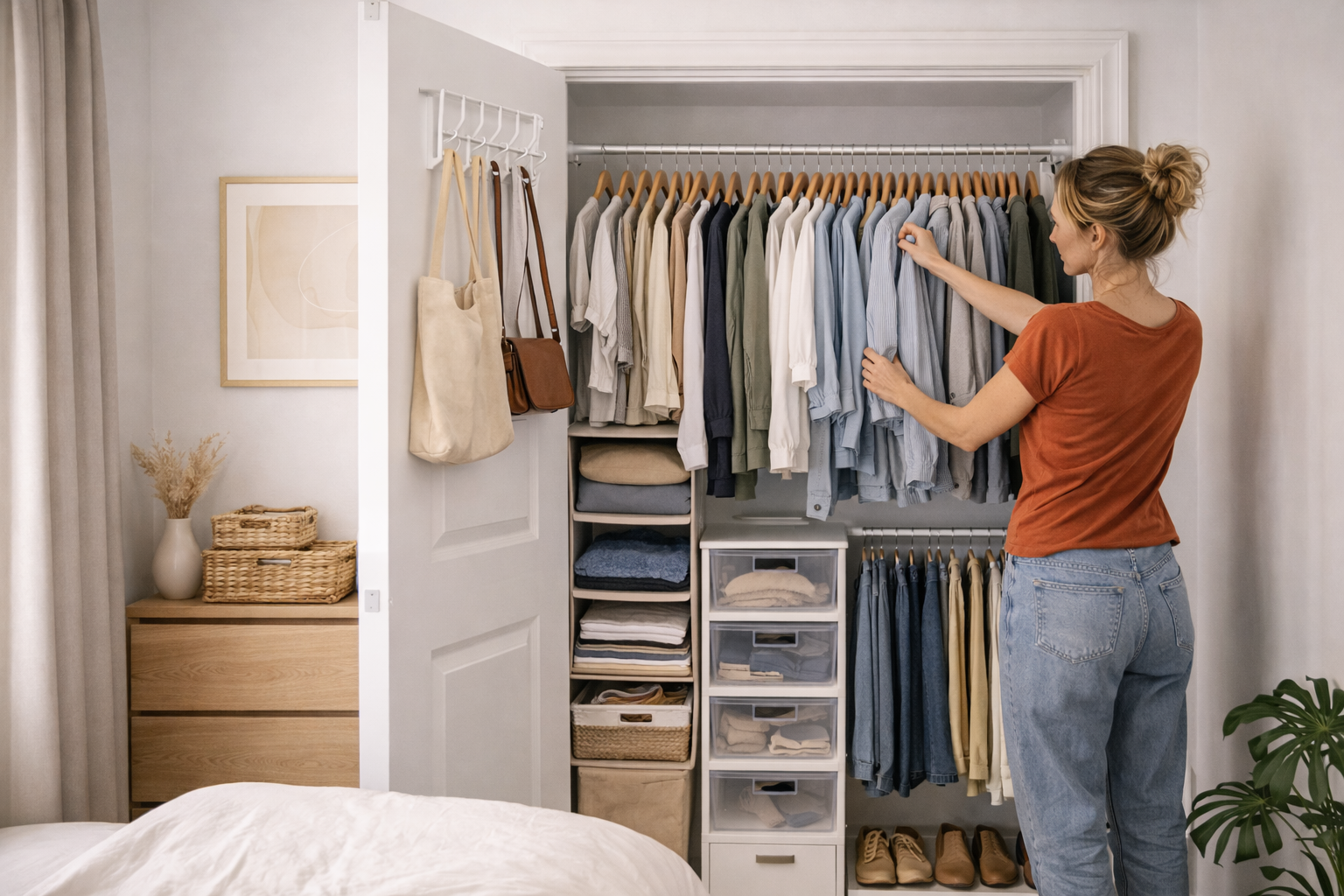
Living in an apartment with a tiny closet forces you to make smarter decisions about clothing storage. When the closet is small, every mistake is amplified.
Clothes become wrinkled, piles form quickly, and items disappear behind others. Over time, frustration builds, not because there is no space at all, but because the space that exists is poorly structured.
Organizing clothes in apartments with tiny closets is less about buying more organizers and more about designing a layout that respects limits.
Tiny closets cannot behave like standard closets. They require a different logic, one that prioritizes access, balance, and restraint.
This article explains how to organize clothes effectively in apartments with tiny closets by focusing on layout strategies that make limited space workable and sustainable.
Why Tiny Closets Feel Harder to Manage
Tiny closets fail quickly when treated like larger ones. Standard layouts assume room for depth, multiple shelves, and generous hanging space. Tiny closets rarely offer these luxuries.
The main challenge is congestion. When clothes are packed too tightly, visibility drops and maintenance becomes exhausting. Items get pushed to the back, forgotten, and replaced by new purchases, creating a cycle of clutter.
Understanding that tiny closets require lighter, more intentional layouts is the first step toward lasting organization.
Rethinking How Much Clothing Belongs in the Closet
One of the most important decisions in a tiny closet is determining how much clothing should actually live there. Trying to store everything in a single small space almost always fails.
Tiny closets work best when they hold daily and weekly wear. Seasonal or rarely used items should be rotated out. This does not mean owning less necessarily, but it does mean storing strategically.
A realistic clothing volume allows the layout to function properly.
Designing Hanging Space for Tiny Closets
Hanging space is usually the backbone of clothing storage, but in tiny closets it must be handled carefully. Overcrowded rods cause clothes to overlap, wrinkle, and push forward.
Using slim, non-slip hangers reduces bulk immediately. Separating garments by length also helps. Short items such as shirts and skirts can hang together, while long garments are grouped separately.
This separation improves visibility and reduces congestion, even when space is limited.
When to Use Hanging Storage and When Not To
Not all clothing benefits from hanging in a tiny closet. Bulky knits, casual items, and clothing worn less frequently often perform better folded.
Designing the layout so that hanging space is reserved for items that truly need it improves efficiency. This prevents rods from becoming overloaded and makes daily access easier.
Tiny closets perform best when hanging is selective rather than automatic.
Creating a Compact Folded Clothing Layout
Folded clothing must be contained carefully in tiny closets. Loose stacks collapse quickly and create clutter.
Slim drawers, narrow shelves, or hanging organizers work well for folded items. These elements provide boundaries that prevent shifting and make maintenance easier.
Keeping folded clothing grouped by type improves access and reduces visual noise.
Managing Overflow Without Expanding the Closet
Overflow is inevitable if the layout does not account for change. Tiny closets need built-in flexibility.
Seasonal rotation is essential. Clothing that is out of season should move to higher shelves, bins, or separate storage locations. Daily-use items stay accessible.
This approach keeps the closet functional year-round without expanding its footprint.
Using Vertical Space Without Creating Visual Clutter
Vertical space is valuable in tiny closets, but it must be used with restraint. Overstacking creates visual heaviness and makes access difficult.
Using vertical storage in clean, aligned sections works best. Hanging shelves or stacked bins should be limited to what can be maintained comfortably.
When vertical storage is controlled, tiny closets feel taller rather than more crowded.
Organizing Clothing by Frequency of Use
Frequency-based organization is especially important in tiny closets. Items used daily should be easiest to reach. Less-used items should move higher or farther back.
This layout reduces friction and prevents daily disruption. When clothing aligns with routines, maintenance becomes simpler.
Tiny closets punish inefficiency, so frequency matters.
Using Closet Doors to Support Clothing Storage
Closet doors offer valuable support space that does not compete with clothing depth. Interior door organizers can hold accessories, scarves, belts, or even lightweight folded items.
Using doors for non-bulky clothing-related storage frees up interior space for garments that require more room.
Door-based storage keeps the layout balanced and accessible.
Creating Clear Clothing Zones
Tiny closets cannot afford overlap. When clothing types mix without boundaries, clutter spreads quickly.
Clear zones help prevent this. A hanging zone, a folded clothing zone, and an accessories zone give structure to the layout.
Zones reduce decision fatigue and make daily use smoother.
Avoiding Deep Storage That Hides Clothes
Deep storage is one of the biggest enemies of tiny closets. Items stored behind others are rarely used and often forgotten.
Shallow shelves, narrow bins, and front-facing layouts improve visibility. When clothes are easy to see, they are easier to manage.
Visibility is a core principle of tiny closet organization.
Choosing Containers That Support Clothing Care
Containers should protect clothing, not compress it excessively. Overstuffed bins cause wrinkles and make retrieval difficult.
Choosing appropriately sized containers allows clothes to breathe and maintain shape. This also reduces the need for constant refolding.
Containers should support care as well as organization.
Using Lighting to Improve Clothing Visibility
Poor lighting makes tiny closets feel smaller and more chaotic. Even a good layout suffers without adequate visibility.
Portable lighting improves perception and access. Battery-powered or motion-activated lights illuminate clothing without installation.
Better lighting supports organization habits and reduces frustration.
Adapting Layouts as Wardrobes Change
Wardrobes evolve over time. Tiny closets must adapt accordingly.
A layout that worked last year may struggle this year. Modular and adjustable storage allows small changes without a full redesign.
Adaptability is essential for long-term success.
Common Clothing Organization Mistakes in Tiny Closets
One common mistake is storing too much in one place. Another is using organizers designed for larger spaces.
Ignoring frequency of use is also a frequent issue. When rarely worn items block daily wear, clutter returns quickly.
Avoiding these mistakes preserves balance.
Maintaining Clothing Organization Long Term
Tiny closets demand consistency. Small lapses are immediately visible.
Regular check-ins, seasonal rotation, and quick resets keep the layout functional. Because the system is simple, maintenance requires less effort.
Consistency protects the investment of time and energy.
Why Thoughtful Layout Beats More Storage in Tiny Closets
Tiny closets cannot be fixed by adding volume alone. More storage often worsens the problem.
Thoughtful layout improves access, visibility, and flow. It allows clothing to be used rather than hidden.
Layout, not storage, is the key to success.
Frequently Asked Questions
How do renters manage clothes in extremely tiny closets?
By limiting daily storage to essentials and rotating seasonal items.
Should everything be hung in a tiny closet?
No. Hanging should be reserved for items that benefit from it.
How can tiny closets stay organized long term?
By organizing based on frequency, using clear zones, and maintaining restraint.
Do containers help or hurt tiny closets?
They help when sized correctly and used to control, not compress, clothing.
Is lighting really necessary in tiny closets?
Yes. Lighting dramatically improves visibility and usability.

Ryan Lewis is a home organization enthusiast who specializes in smart, renter-friendly solutions for small spaces. With a passion for functional design and practical living, Alex shares tips, guides, and ideas to help readers create calm, clutter-free environments—no matter the size of their home.