
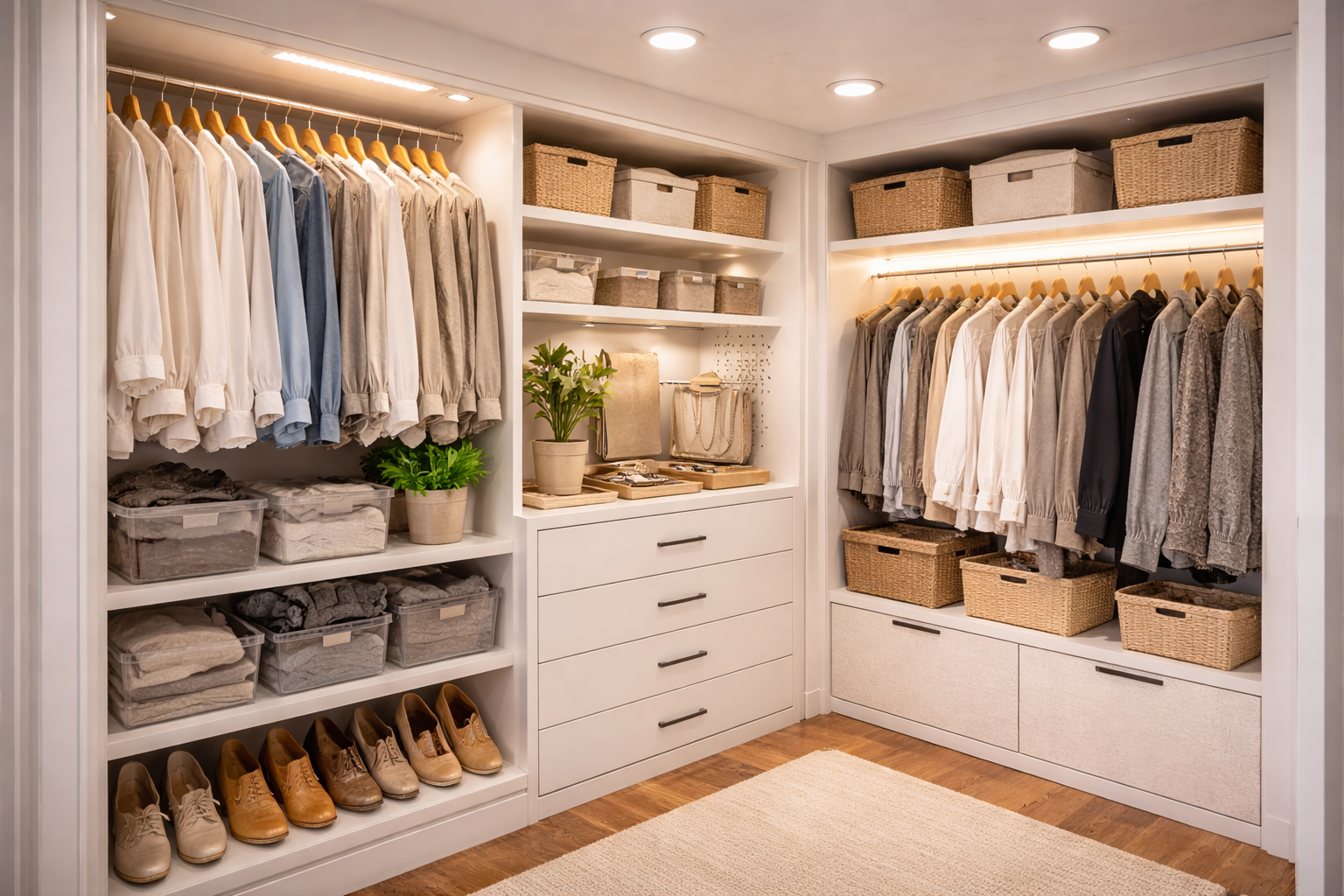
Renters often assume that a truly custom closet is something reserved for homeowners.
Built-in cabinetry, integrated lighting, perfectly spaced shelving, aligned hanging rods, and seamless drawer systems seem like luxuries that require construction and permanent installation.
When you move into a rental apartment and see a basic white shelf with a single rod, it is easy to feel limited.
But a custom closet is not defined by walls or carpentry. It is defined by structure, cohesion, visual discipline, balance, lighting, and intentional organization.
The difference between a temporary-looking rental closet and a refined, custom-feeling one is strategy.
You do not need to drill holes, install permanent fixtures, or violate your lease to create a space that feels elevated and thoughtfully designed.
You need to layer modular systems intelligently, maintain visual consistency, and eliminate chaos.
Here is exactly how to do that.
Start With a Full Structural Reset
Before upgrading anything, remove everything.
Take every item out of your closet and look at the space empty. Most rental closets look worse when full because clutter hides the structure.
Clean thoroughly:
Wipe down shelves
Dust the rod
Vacuum corners
Clean baseboards
Remove adhesive residue
A clean foundation immediately changes how the space feels. Custom closets always look polished because nothing looks neglected.
Then declutter aggressively. Custom closets are curated, not overcrowded.
Ask:
Does this reflect my current lifestyle?
Is this item adding value or visual noise?
Would I replace this if it disappeared tomorrow?
Reducing excess volume creates room for design.
Define a Visual Direction Before Adding Anything
Custom spaces feel intentional because they follow a visual theme.
Choose a direction:
Light and minimal
Warm and natural
Modern and monochrome
Soft neutral palette
Once you choose your direction, commit to it.
If you mix random plastic bins, colorful hangers, mismatched baskets, and unrelated storage boxes, the closet will always feel improvised.
Consistency is the foundation of customization.
Standardize Your Hangers Immediately
Nothing destroys a custom feel faster than mismatched hangers.
Wire hangers, bulky plastic ones, wooden ones in different finishes — they visually compete with each other.
Replace all hangers with one consistent style. Options include:
Slim velvet hangers for a clean modern look
Uniform wooden hangers for warmth
Matte black or white hangers for minimalist appeal
Uniform hangers instantly align clothing at the same height and spacing.
That alignment mimics professional closet design.
Build Clear Functional Zones
A custom closet is never random. It is zoned with intention.
Create distinct areas for:
Daily essentials
Work or formal wear
Outerwear
Shoes
Accessories
Seasonal storage
Keep each zone physically separate.
If your closet is small, separation can be visual rather than spatial. Use labeled bins or slight spacing gaps to signal transitions.
Zoning creates mental clarity.
Clarity creates calm.
Use Matching Storage Containers Only
Replace inconsistent boxes with coordinated storage.
Choose bins in matching materials such as:
Canvas
Woven texture
Matte plastic
Neutral fabric
Avoid mixing patterns and colors.
If possible, choose one neutral tone and repeat it throughout the closet.
Repetition creates harmony. Harmony creates a custom feel.
Introduce Modular Drawer Towers
If your rental closet lacks drawers, simulate built-in cabinetry using freestanding drawer units.
Choose narrow, vertical towers that fit inside the closet footprint without touching walls.
Align them flush with shelves to create a seamless look.
When modular units are symmetrical and color-coordinated, they appear integrated rather than temporary.
Placement precision makes all the difference.
Add Vertical Layering With Tension Rods
Most rental closets waste vertical space.
Install tension rods to:
Create double hanging sections
Separate categories
Add lower hanging for shorter garments
Layered rods mimic custom closet architecture without drilling.
Vertical division increases capacity and design complexity simultaneously.
Create Visual Symmetry
Symmetry is one of the most powerful tools in high-end design.
Balance left and right sides when possible:
Evenly distribute bins
Align shoes in straight rows
Maintain equal spacing
The human brain interprets symmetry as order and sophistication.
Even small closets can benefit from balanced alignment.
Upgrade Lighting Strategically
Lighting dramatically impacts perception.
Use:
Rechargeable LED light bars under shelves
Motion-sensor strip lights
Neutral white bulbs (4000K–5000K)
Layer lighting vertically to eliminate shadows.
Good lighting enhances clothing texture and color visibility.
A bright, evenly lit closet always feels more premium.
Keep the Floor Completely Clear
Cluttered floors signal disorder.
Install a slim shoe rack or stackable shoe boxes to elevate footwear off the ground.
Keep bags stored upright in designated bins.
Empty floor space increases perceived square footage.
Space equals luxury.
Incorporate One Refined Styling Element
Custom closets feel curated, not sterile.
Add one subtle styling element:
A narrow mirror
A small neutral bench (for walk-ins)
A structured basket
A minimalist plant
Keep it restrained. One focal point is enough.
Too many decorative elements create clutter.
Conceal What Does Not Need Displaying
Not everything belongs in open view.
Use closed containers for:
Backup items
Rarely worn clothing
Sentimental pieces
Custom closets feel edited.
Selective visibility enhances sophistication.
Maintain Consistent Spacing
Spacing matters more than most people realize.
Leave small gaps between garment categories.
Avoid overcrowding rods.
Maintain breathing room on shelves.
Closets that are packed tightly look temporary.
Closets with spacing look intentional.
Develop a Maintenance Discipline
No closet remains custom-looking without maintenance.
Adopt:
Weekly quick resets
Monthly edits
Seasonal rotation
One-in-one-out purchase rule
Design is preserved through consistency.
Think Like a Designer Working With Constraints
Professional designers often work within limitations.
They do not rely solely on construction. They rely on alignment, repetition, balance, proportion, and restraint.
Approach your rental closet the same way.
Ask:
Is this aligned?
Is this symmetrical?
Is this cohesive?
Is this overcrowded?
The mindset shift is powerful.
Avoid Permanent Modifications
Never use:
Screws
Wall anchors
Industrial adhesives
Structural alterations
Everything you add should be removable.
True renter-friendly customization respects lease boundaries.
Psychological Impact of a Custom Closet
A well-designed closet affects daily confidence.
You:
Get dressed faster
See your options clearly
Feel less overwhelmed
Maintain organization longer
A closet that feels intentional improves daily routine quality.
Function and psychology are connected.
Final Perspective: Custom Is a System, Not a Renovation
You do not need built-in carpentry to create a built-in feel.
Through:
Decluttering
Uniform hangers
Matching storage
Layered lighting
Symmetry
Spacing discipline
Modular shelving
Consistent maintenance
You can transform a basic rental closet into a structured, refined, visually cohesive space.
Customization is achieved through discipline, not demolition.
When everything has purpose and alignment, even a rental closet can feel permanent.

Ryan Lewis is a home organization enthusiast who specializes in smart, renter-friendly solutions for small spaces. With a passion for functional design and practical living, Alex shares tips, guides, and ideas to help readers create calm, clutter-free environments—no matter the size of their home.