
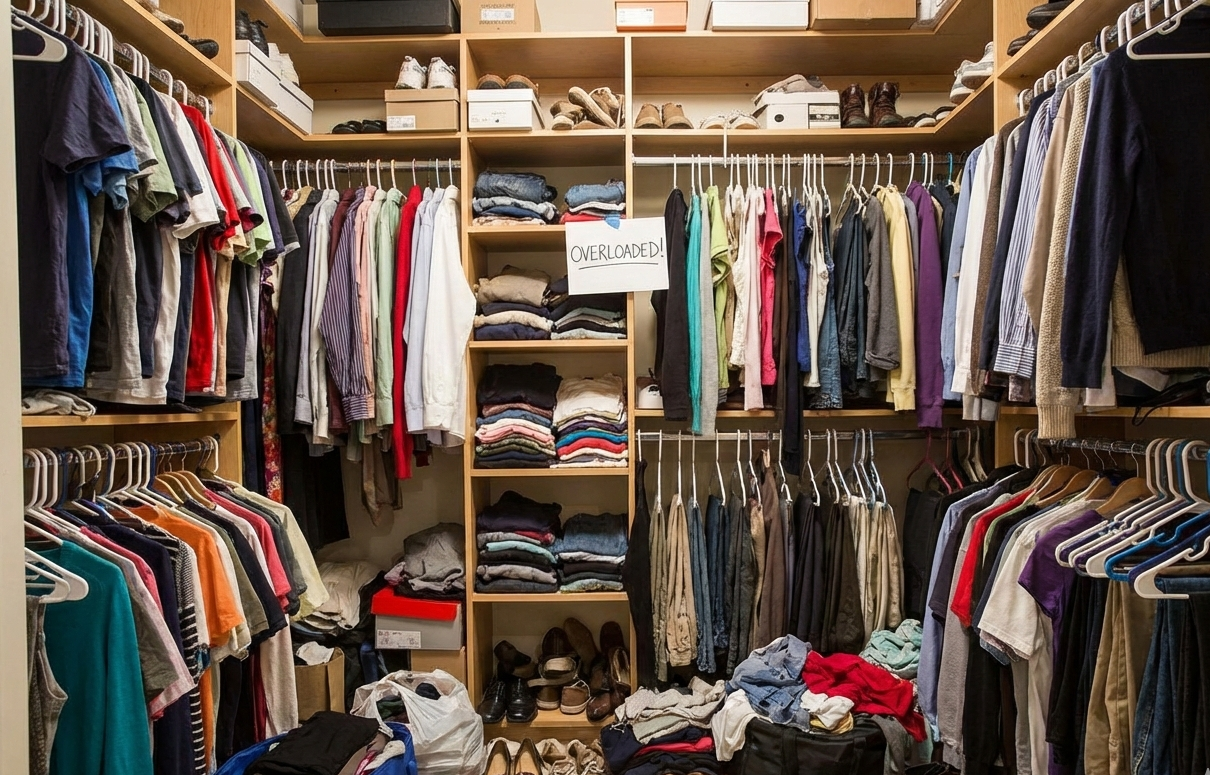
Many people describe their closet as small. Too small. Impossibly small. They assume that the lack of space is the main reason for clutter, stress, and frustration. This belief feels logical, but in most cases it is incomplete.
The real problem is not size. It is overload. Closets rarely fail because they are physically small. They fail because they are overloaded in the wrong ways, with the wrong items, in the wrong places, and at the wrong priorities.
This article explains why most closets feel smaller than they actually are, how overload quietly destroys usability, and how to fix the problem without changing the size of the space.
Why “Small” Is Usually a Misdiagnosis
When people say a closet is small, what they usually mean is that it does not work. They struggle to find items, clothes wrinkle easily, and storage feels chaotic.
A truly small but well-designed closet can feel calm and sufficient. A larger but overloaded closet can feel impossible.
The sensation of smallness often comes from friction, not dimensions.
Overload Is About Density, Not Quantity
Overload does not mean owning too many items in absolute terms. It means having too many items competing for the same functional zones.
When hanging rods are packed tightly, when shelves are filled edge to edge, and when the floor is crowded, density increases. High density reduces access, visibility, and ease of use.
Closets fail when density crosses a threshold the system cannot handle.
Problem 1: Too Many Items in Prime Space
Prime space is the easiest-to-reach area of the closet. It should be reserved for the most frequently used items.
Many closets misuse prime space by filling it with rarely worn clothes, sentimental items, or “just in case” pieces.
Impact on Daily Life
Daily items get pushed aside. Getting dressed requires digging. Frustration becomes routine.
Structural Fix
Audit prime space. Identify what is used weekly and move everything else out of that zone.
Prime space should serve daily life, not storage guilt.
Problem 2: No Separation Between Functional and Archival Items
Closets often mix functional clothing with archival clothing. Past jobs, old sizes, special events, and future aspirations all share the same space as everyday wear.
This creates both physical and emotional overload.
Why This Matters
Archival items demand attention without providing utility. They crowd out relevant options and increase decision fatigue.
Structural Fix
Create a clear boundary. Functional items live in the closet. Archival items live elsewhere or in secondary zones.
The closet becomes a tool again, not a museum.
Problem 3: Overloaded Hanging Space
Hanging rods are often the most overloaded part of the closet. Clothes press together, wrinkle, and block airflow.
This reduces both capacity and usability.
Why This Happens
Hanging is treated as default storage, even for items that do not need it.
Structural Fix
Reserve hanging for items that benefit from it. Fold bulky knits, casual items, and rarely worn clothing.
Reducing hanging density often creates immediate relief.
Problem 4: Vertical Space Used Without Strategy
Vertical space is powerful but dangerous. Many closets stack upward aggressively without considering access.
Upper zones become cluttered and unstable.
Impact on Usability
Items stored too high are avoided. They become dead storage.
Structural Fix
Use vertical space selectively. Upper zones should hold low-frequency items in contained, labeled storage.
Vertical space should support rotation, not chaos.
Problem 5: Floor Space Carrying Too Many Roles
The closet floor often holds shoes, bags, bins, and overflow items simultaneously.
This creates congestion at the base of the system.
Why This Is a Problem
When the floor is overloaded, access to everything above it becomes harder.
Structural Fix
Assign the floor one or two clear roles only. For example, daily shoes and one buffer bin.
Limiting roles increases clarity.
Problem 6: Containers That Compress Instead of Clarify
Containers are often used to force items into tight spaces. This increases density and reduces visibility.
Compressed storage looks efficient but fails in daily use.
Structural Fix
Use containers to group, not compress. Choose sizes that allow items to sit comfortably.
Containers should reduce friction, not increase it.
Problem 7: Visual Overload Makes Space Feel Smaller
Even when physical space exists, visual overload makes closets feel cramped.
Mixed colors, textures, and storage styles fragment attention.
Psychological Impact
The brain interprets visual noise as complexity and unfinished work.
Structural Fix
Simplify visually. Align hangers. Reduce container variety. Group similar colors.
Visual calm expands perceived space.
Problem 8: No Space for Temporary Disorder
Life produces temporary disorder. Laundry cycles, travel, and busy weeks create overflow.
Closets without buffer space collapse under these normal events.
Structural Fix
Designate buffer zones. A small flexible area absorbs temporary mess without breaking the system.
Buffer space is essential for resilience.
Problem 9: Treating All Items as Equal
Not all items deserve equal space or access. Treating them equally creates inefficiency.
Structural Fix
Rank items by frequency and importance. Allocate space accordingly.
High-value items deserve priority placement.
Problem 10: Expecting the Closet to Solve Everything
Closets are often asked to solve all storage problems in small homes.
This expectation leads to overload.
Structural Fix
Define the closet’s role clearly. It should serve specific needs, not absorb everything.
Boundaries protect functionality.
How to Tell If Your Closet Is Overloaded
Signs of overload include difficulty finding items, frequent rearranging, wrinkled clothes, and avoidance.
If you feel relief when items are removed, overload is present.
Reducing Overload Without Reducing Belongings
Overload can often be reduced without discarding items.
Rotation, reallocation, and priority-based storage free space without loss.
The key is separating access from ownership.
Why Overload Feels Like a Space Problem
When systems fail, we blame space. Space feels objective and unchangeable.
But systems are flexible. Fixing overload changes how space behaves.
Turning the Closet Back Into a Tool
A functional closet supports daily life quietly.
When overload is reduced, clarity returns. Decisions become easier. Stress decreases.
The closet becomes invisible again.
How Overload Reduction Improves Daily Energy
Small daily frustrations drain energy.
Reducing overload removes these drains, freeing mental space for more important things.
The impact is subtle but powerful.
Frequently Asked Questions
How do I know if my closet is overloaded?
If items compete for space, access is difficult, and clutter returns quickly, overload is likely.
Do I need to get rid of clothes to fix overload?
Not always. Rotation and reallocation often solve the problem.
Why does my closet feel small even after organizing?
Because density and visual noise still exist.
Is buffer space really necessary?
Yes. Without it, systems break under normal life conditions.
What is the fastest way to reduce overload?
Remove rarely used items from prime space.

Ryan Lewis is a home organization enthusiast who specializes in smart, renter-friendly solutions for small spaces. With a passion for functional design and practical living, Alex shares tips, guides, and ideas to help readers create calm, clutter-free environments—no matter the size of their home.