
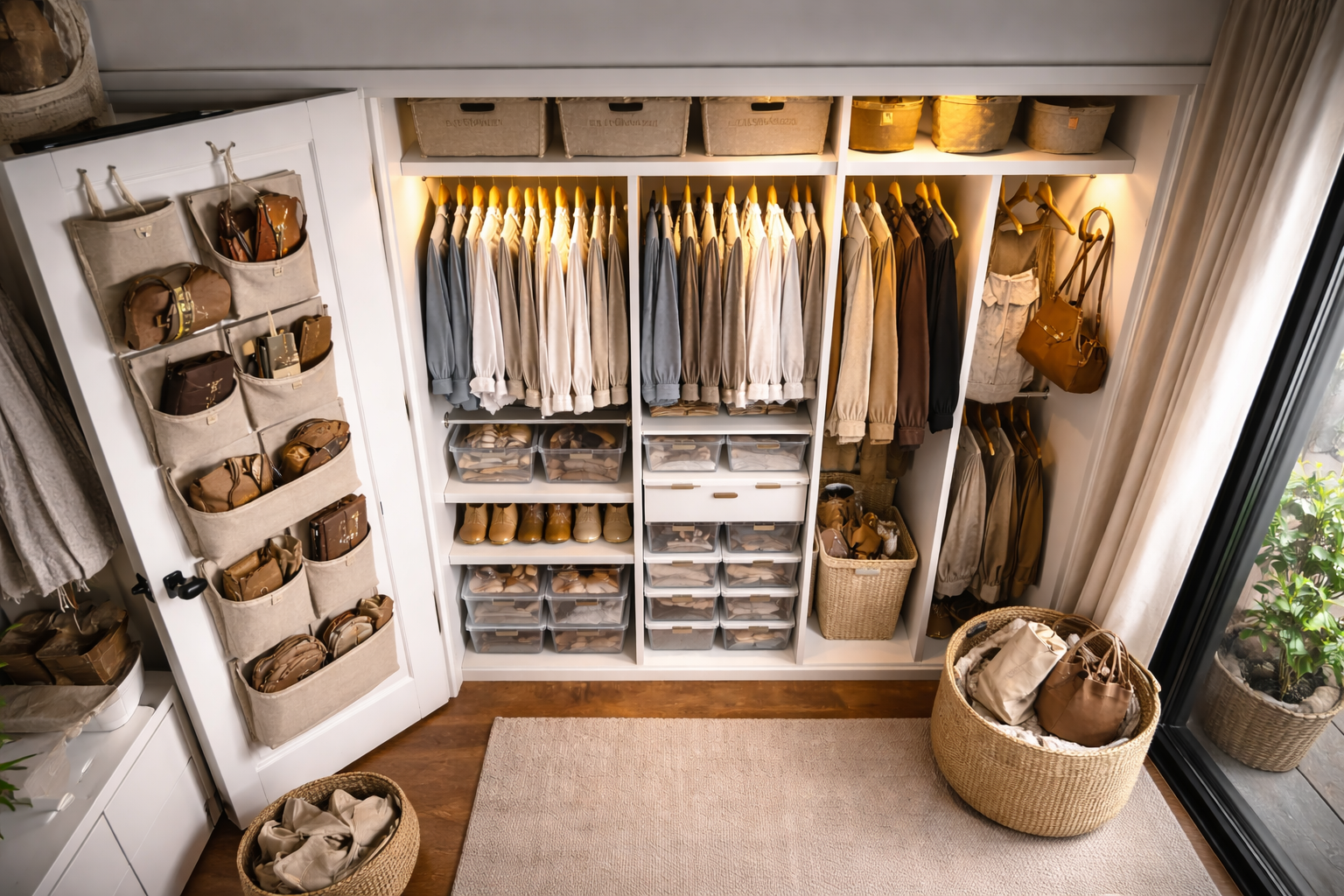
Studio apartments under 550 square feet demand intentional design decisions at every level.
In this type of layout, there are no traditional boundaries separating bedroom, living room, and workspace.
Everything coexists in one continuous visual field. Because of this, closet organization carries far more weight than in larger homes.
When closet zoning is poorly executed in a studio apartment, the consequences extend beyond the closet itself.
Clothing spills into visible areas, overflow reaches chairs and corners, and the entire apartment feels smaller and more chaotic.
In contrast, when closet zoning is structured and strategic, the apartment gains clarity, visual breathing room, and functional efficiency.
Zoning is not about adding random organizers. It is about defining invisible architectural boundaries within limited square footage.
Here is a comprehensive system for implementing intelligent closet zoning in studio apartments under 550 square feet.
Why Closet Zoning Is Critical in Studio Layouts
In a one-bedroom apartment, clutter can be hidden behind doors. In a studio, visual overflow impacts the entire environment.
Without zoning:
Clothing categories merge
Daily routines become inefficient
Visual density increases
Maintenance becomes reactive rather than proactive
With zoning:
Each category has a defined home
Expansion is limited
Access improves
Clutter stays contained
In studios, the closet functions as both storage and structural stabilizer. Its internal order influences the perceived order of the entire apartment.
Begin With a Functional Audit
Before creating zones, assess how you actually use your wardrobe.
Ask:
What do I wear 70% of the time?
What items are rarely used?
How many shoes are in active rotation?
Which pieces are seasonal?
In studio living, you cannot afford theoretical organization. Your layout must reflect real behavior.
A zoning system based on unrealistic ideals will collapse quickly.
Primary Zoning Principle: Frequency First
The most effective zoning strategy begins with frequency of use.
Divide your closet vertically into three primary functional bands:
Upper zone: seasonal or rare-use items
Middle zone: daily rotation
Lower zone: secondary items or accessories
The middle zone should sit at eye level and contain what you use most.
When frequently worn clothing is immediately accessible, daily friction decreases.
Ease of access encourages maintenance.
Secondary Zoning: Category Clustering
Within each frequency band, cluster by clothing category.
For example, in the daily rotation zone:
Workwear together
Casual wear together
Activewear together
Avoid blending categories along one long rod.
Micro-boundaries prevent blending and improve clarity.
In small spaces, clarity is non-negotiable.
Use Vertical Stacking Instead of Horizontal Spreading
Horizontal spreading consumes valuable width and increases visual clutter.
Instead, stack zones vertically:
Double hanging rods for shirts and folded pants
Upper shelves for seasonal bins
Lower compartments for shoes
Vertical zoning multiplies usable capacity without expanding footprint.
Studios demand three-dimensional thinking.
Create a Defined Entry-Point Zone
Every studio closet benefits from a “front-facing” zone nearest the door.
This zone should hold:
Current-season jackets
Daily shoes
Frequently worn bags
Positioning high-use items near the opening reduces internal disruption.
You access what you need without disturbing deeper sections.
Efficiency preserves structure.
Implement Visual Density Balancing
Visual density refers to how heavy or compact a section appears.
Avoid placing bulky coats next to delicate blouses without separation.
Group heavier garments together.
Group lighter fabrics together.
Balanced density creates visual harmony and prevents the closet from feeling compressed.
In studios, perception directly affects comfort.
Use Lighting to Reinforce Zoning
Lighting is not decorative in small closets. It is functional architecture.
Install:
Rechargeable LED strips under shelves
Motion-sensor lighting inside compartments
When each vertical level is illuminated, boundaries become clearer.
Shadows hide clutter. Light exposes it.
Exposed clutter is easier to control.
Establish Strict Seasonal Rotation
Studio apartments cannot accommodate full-year wardrobes in active zones.
Adopt disciplined seasonal rotation:
Store off-season clothing in vacuum bags
Use under-bed storage
Place labeled bins in upper closet zones
When seasons change, rotate decisively.
Rotation prevents slow overcrowding.
Discipline preserves space.
Accessory Zoning: Containment Is Essential
Accessories often cause disproportionate clutter.
Dedicate one vertical strip or door panel to:
Belts
Scarves
Small bags
Jewelry
Use over-the-door organizers or slim wall hooks (renter-safe).
Separating accessories prevents them from invading primary clothing zones.
Containment maintains order.
Shoe Zoning in Studios
Shoes consume floor area quickly.
In a studio under 550 square feet, closet floor visibility must remain clear.
Use:
Vertical stackable shoe boxes
Slim multi-tier racks
Under-shelf shoe organizers
Keep only current-season pairs accessible.
Store occasional shoes in upper labeled bins.
Floor visibility increases perceived depth.
Depth enhances openness.
Micro-Zones Within Drawers
If your closet includes drawers, internal segmentation is critical.
Divide drawers into compartments for:
Socks
Undergarments
Belts
Small accessories
Without internal zoning, drawers become hidden chaos.
Hidden chaos eventually spreads.
Micro-structure sustains macro-structure.
Limit Each Zone’s Capacity
One of the most powerful zoning tools is artificial limitation.
Assign maximum capacity to each category:
No more than 12 shirts in daily rotation
No more than 3 jackets
No more than 8 accessible shoes
When zones are capped, you are forced to edit.
Editing prevents accumulation.
Accumulation destroys small-space efficiency.
Maintain Consistent Visual Palette
In studio apartments, visual noise expands spatial stress.
Choose:
Matching hangers
Uniform storage bins
Consistent labeling style
Neutral palettes reduce cognitive overload.
When the closet looks cohesive, the entire apartment feels calmer.
Visual calm equals psychological calm.
Weekly Zoning Reset Ritual
Small spaces require small, consistent interventions.
Implement a weekly five-minute reset:
Return displaced items
Realign hangers
Refold stacks
Reposition shoes
Frequent micro-maintenance prevents large reorganization sessions.
Consistency builds resilience.
Avoid Over-Segmentation
While zoning is powerful, too many compartments create rigidity.
Start with broad categories.
Refine only when friction appears.
Over-segmentation reduces flexibility.
Flexibility matters in evolving studio living.
Adaptability for Future Moves
Studio renters often relocate.
Choose modular systems that adapt to:
Different rod heights
Different closet depths
Different door styles
Portable zoning protects your investment.
Build systems that travel.
Psychological Benefits of Clear Zoning
Structured closets reduce decision fatigue.
When categories are separated clearly:
Outfits are selected faster
Stress decreases
Maintenance feels manageable
In small apartments, mental clarity is as important as physical space.
Well-zoned closets support emotional stability.
Final Perspective: Zoning Creates Breathing Room
Studio apartments under 550 square feet require intentional internal architecture.
Smart closet zoning:
Defines boundaries
Controls expansion
Improves access
Reduces visual noise
Enhances perceived space
The difference between cramped and controlled often lies behind the closet doors.
When internal structure exists, the external environment stabilizes.
In compact living, zoning is not optional.
It is foundational.

Ryan Lewis is a home organization enthusiast who specializes in smart, renter-friendly solutions for small spaces. With a passion for functional design and practical living, Alex shares tips, guides, and ideas to help readers create calm, clutter-free environments—no matter the size of their home.